

Marine fuel buyers entered 2026 facing a perfect storm, suffering some of the highest bunker prices ever experienced, paired with a sharp and concerning decline in fuel quality. Across the traditional marine fossil fuel supply chain, VPS has seen a marked rise in fuel quality issues, with the Middle East conflict playing a major role in driving both price volatility and quality deterioration. For ship owners/operators, the message is clear, today’s fuel market is not only more expensive, it is also becoming more complex and unpredictable, with a higher degree of operational risk.
This deterioration is already showing itself in the test data VPS have produced. Between January and July 2026, VPS issued 29 Bunker Alerts, more than the total issued across the whole of 2024 and already closing in on the 37 alerts recorded throughout all of 2025. In just seven months of 2026, the scale and frequency of these alerts underline a clear, accelerating rise in fuel quality problems across the industry.
Of the current 29 Bunker Alerts issued so far, Jan-Jul 2026, the combination of abrasive issues due to elevated cat-fines, plus fuel stability issues, account for 72% of these alerts. The ports requiring cat-fines and/or stability-related bunker alerts were, ARA, Balboa, Busan, Callao, Hamburg, Houston, Las Palmas, Philadelphia, Piraeus, Rotterdam, San Roque, Singapore and Valencia.
What is of additional interest is that marine gas oil does not account for a single Bunker Alert so far in 2026. It is HSFO and VLSFO dominating the fuels requiring such warnings.
Looking at the rate of off-specifications across each of the main marine fossil fuel types, HSFO is currently running at 8.87% of samples tested, being off-specification for at least one ISO8217 test parameter, whilst VLSFO has 9.88% off-specification level, MGO has 9.03% and ULSFOs is at 19.58%.
ISO 8217 provides specification requirements for marine fuel as delivered to the ship. From a commercial perspective the fuel is only required to meet the specification at the point of custody transfer, ie at the ship’s manifold. However, compliance at this point, is not a guarantee of assurance that the fuel can be used without operational difficulties throughout its onboard lifecycle. This includes, how the fuel is stored, treat and consumed in main engines, generator engines, boilers, or other machinery. The condition of the fuel which ultimately reaches the machinery, is also strongly influenced by onboard fuel management, including storage and settling temperatures, settling time, purification temperature and throughput, purifier configuration and desludging arrangements, filtration, maintenance of the correct injection viscosity and other operational factors.
This is why knowing the characteristics of the bunkered fuel is critical to managing it correctly onboard.
Appropriate testing can identify characteristics which, although not necessarily resulting in an ISO 8217 specification failure, may warrant additional operational attention. VPS therefore evaluates bunker fuels not only against the applicable specification requirements, but also provides operational advice where analytical findings indicate that additional precautions may be appropriate during storage, treatment or consumption.
VPS testing and observations, based on over 45 years of marine fuel testing experience and expertise, strongly align with a recent Linkedin post by marine and energy consultants, Brookes Bell. Their post highlighted a growing concern within the industry, stating a P&I Club had reported that bunker-related claims are up 50% this year, with many of the fuels involved having technically passed ISO8217 standard specification testing.
The same post noted that some ISO8217-compliant fuels have still caused operational damage. This has left shipowners to manage complex evidentiary disputes after problems arose. Its key warning was clear: Standard compliance testing alone isn’t catching the problem. If “passing spec” is not necessarily the same as being “safe-to-burn”, then the critical question becomes, “What additional testing is needed to identify the real operational risks?”
VPS have recognised that for some time, the ISO8217 standard is not an all-encompassing set of tests providing the highest level of asset, crew and environmental protection. For this reason, VPS offer a range of additional tests, as well as our Additional Protection Service (APS) test bundles. For example, in the case of avoiding damages from cat-fines, the Fuel System Check (FSC) service, can provide valuable information in regard to monitoring purifier efficiency and the removal of cat-fines, protecting the engine to a higher degree. Whereas, Separability Number testing, is a key compliment to the hot filtration stability tests of TSP, TSA and TSE in mitigating stability risks. Should additional cold-flow information be required, the VPS proprietary Wax Appearance Temperature (WAT) testing provides key storage and fuel transfer temperature information. Whilst the VPS chemical screening services can identify potentially harmful chemicals within a fuel before the fuel is burnt. Then more detailed Gas Chromatography Mass Spectrometry (GCMS) forensic analysis provides key information to potentially support the fuel claims process.
VPS account managers and technical specialists can help shipowners and operators determine which laboratory tests are most appropriate for their fleet, based on the fuel characteristics, vessel operations and potential risk exposure. This guidance can support the mitigation of risks linked to engine damage, SOLAS compliance, legislative requirements and wider operational reliability.
The VPS Technical Advisory Team reviews bunker analysis results together with the vessel operational observations to provide practical advice on fuel storage, handling, purification and overall fuel management. Where appropriate, additional laboratory tests, or test bundles, may be recommended to further evaluate the fuel and assist in identifying the cause of an operational issue, supporting more informed decision-making.
VPS continues to monitor regional and global fuel quality trends through its laboratory network and customer feedback. Information received from vessels experiencing similar operational issues is valuable in helping VPS identify emerging trends and provide timely technical guidance to the wider shipping industry.
Source: VPS



Related News.
Intelligent Skies, Secure Seas: Navigating Connectivity, Cyber Resilience, and AI Liability at the 5th CSN Greece ICT Conference
The 5th CSN Greece ICT Conference, held on 19th November 2026 at the Ploes Floating Venue in Paleo Faliro, Athens, successfully convened maritime…

EU moves to ban tankers insured in Russia, repair services at Russian refineries
EU targets Russian-insured tankers, refineries Von der Leyen announces 22nd sanctions package All 27 member states must approve new…
IMO tackling fraudulent registries together
Strong national systems and international information sharing are crucial to tackling fraudulent registries and fraudulent ship registration…
Open letter on freedom of navigation and the protection of seafarers
Dear High Representative Kallas, Dear Foreign Affairs Ministers, European Shipowners | ECSA, BIMCO, the Cruise Lines International Association…

Davies Turner warns of Rising Asia-UK Container Disruption and European Port Congestion
Davies Turner, one of the UK’s largest independent freight forwarding and logistics companies, says that disruption to container shipments from Asia…

Disruptions still dominate tanker market outlook
"This year, tanker markets have been affected by disruption to transits through the Strait of Hormuz, the Houthi blockade of Saudi Arabian Red Sea…

Panama’s President called on to match COP31 Heroism with action at shipping climate talks
As a series of crucial meetings tasked with cutting greenhouse gas emissions from global shipping takes place this week and next, environmental NGOs…

Trafigura appoints Helio Cumbi as Executive Director, Mozambique
Trafigura has appointed Helio Cumbi as Executive Director, Mozambique, and Business Development Lead for East and Southern Africa Oil. Helio is a…

“K” LINE holds FY2026 Global Dry Bulk Meeting
Kawasaki Kisen Kaisha, announces that it held a global meeting for its dry bulk business at the company’s head office on November 9 and 10. The…
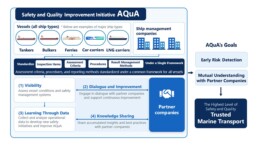
MOL launches ‘AQuA’ safety and quality improvement initiative
Standardizing Group-wide Safety and Quality Assessment Criteria to Enhance Vessel Safety and Quality Mitsui O.S.K. Lines, announced the launch of…
Subscribe to our newsletter!
if you dont want to swim alone in the ocean of news, sign up for the newsletter, and you will receive daily all the important news of world shipping!
