Korea partners with US to train shipbuilding workforce amid shortage
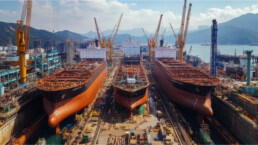

With the opening of the Korea-U.S. Shipbuilding Partnership Center (KUSPC) to back the Korea-U.S. shipbuilding cooperation project MASGA, Korean shipbuilders and universities have moved in earnest to train shipbuilding workers in the United States. The U.S. lacks both production workers for shipyards and research and development (R&D) personnel.
According to the shipbuilding industry on the 4th, Korean shipbuilders rolled out a series of plans to train U.S. shipbuilding workers on Mar. 23, when the Korea-U.S. Shipbuilding Partnership Center opened. When the U.S. government released the Maritime Administration’s comprehensive strategy Maritime Action Plan (MAP) in February defining shipbuilding as a core national security industry, it named workforce development as one of its four pillars.
Hanwha Ocean will train instructors who will directly teach trainees going forward. Hanwha Ocean signed a memorandum of understanding (MOU) with Delaware County Community College (DCCC), near Hanwha Philly Shipyard Inc. in Pennsylvania, to develop an instructor training program in shipbuilding.
A Hanwha Ocean official said, “We proceeded to develop an instructor training program based on the judgment that instructors must first be trained for the Korean shipbuilding technologies to be introduced going forward.”
Hanwha Philly Shipyard Inc. and DCCC have been building a shipbuilding workforce training model since January this year with subsidies from the U.S. federal government. The subsidies total $8 million over four years. The goal is to train up to 500 apprentices by next year. A system linking trainees’ on-site practicums with hiring is also being built.
Samsung Heavy Industries will jointly establish a workforce development center with advanced infrastructure with U.S. MRO (maintenance, repair and overhaul) specialist shipbuilder Vigor Marine Group. Samsung Heavy Industries will build a training center near Vigor Marine Group’s shipyard and support VR/AR (virtual/augmented reality) welding and painting training programs.
The Korea-U.S. Shipbuilding Partnership Center also plans to operate and identify U.S. shipbuilding workforce education programs through 2028 and dispatch about 30 professional instructors from Korea.
The U.S. shipbuilding industry faces a severe labor shortage. According to consulting firm McKinsey & Company, major U.S. shipyards are struggling to secure enough skilled workers such as welders and electricians.
There is also a shortage of majors in related fields who can conduct design research or build automation systems. According to the National Center for Education Statistics (NCES) under the Department of Education, only four 2-year and 4-year institutions in the United States have naval architecture and ocean engineering departments: the University of New Orleans, the University of Michigan, the Naval Academy, and Webb Institute, a specialized college of naval architecture and ocean engineering.
Korean universities will also take part in cultivating future talent in naval architecture and ocean engineering in the United States. The Seoul National University Department of Naval Architecture and Ocean Engineering is discussing an agreement to run a credit recognition exchange program with San Diego State University (SDSU) next year.
As early as the fall semester next year, SDSU mechanical engineering students will enroll at Seoul National University as exchange students. Seoul National University plans to teach core courses in naval architecture and ocean engineering, including fluid mechanics, structural mechanics, and production mechanics.
At SDSU, Professor Patrick Kwon, who became chair of the mechanical engineering department in 2024, is pursuing the establishment of a new naval architecture and ocean engineering program and cooperation with Korean corporations. Since March, SDSU has been operating a joint research center with Samsung Heavy Industries (SHI-SDSU Advanced Maritime Center).
Woo Jong-hun, a professor in the Seoul National University Department of Naval Architecture and Ocean Engineering, said, “Actually designing ships and building them is most important, but the United States has virtually no workforce, universities, or research institutions in this field.”
Woo said, “For an industry to develop, undergraduate output and various research and development systems must be maintained,” adding, “In Korea, diverse research is conducted up to shipbuilding production and design, and professional workers are produced, sustaining the industry, but in the United States, as universities declined, undergraduate output did not occur properly for a long period, and this has reduced the U.S. shipbuilding workforce.”
Source: ChosunBiz



Related News.

Poland’s additional national requirements distort competition says Danish Shipping
Poland has introduced a national survey requirement for smaller foreign-flagged vessels operating in Polish waters. This creates significant…

Battery Vessels could help electrify most of Global Shipping Emissions
Battery-electric ships are economical only if the pack is cycled frequently, so they have been confined to short-sea, ferry and harbour vessels…

Mintra and Ledgid explore collaboration to connect Maritime digital identity, learning and workforce development
Mintra® and LEDGID are exploring opportunities to bring together complementary capabilities in digital learning, maritime training, professional…

World Shipping Council calls for global agreement on shipping emissions as industry investment surpasses $200 billion USD
The World Shipping Council (WSC) is calling on governments to agree on binding global greenhouse gas regulations for international shipping without…

What happened to the ITF whistleblower’s complaint?
In January 2026, a whistleblower complained that International Transport Workers’ Federation (ITF) General Secretary Stephen Cotton had manipulated…

Growing regulatory scrutiny puts seafarer wellbeing firmly on maritime safety agenda, VIKAND warns
Seafarer wellbeing is coming under greater regulatory scrutiny as international rules and guidance increasingly recognise crew health and welfare as…

Good Times Bad Times the Premium Stays with the Strait
In October, we wrote that if the transfer network off Oman kept pace, Gulf crude would carry China's refill and keep drawing tonnage east,…

Allied Weekly Market Review Week 47
Pls find below the Allied - Weekly Market Review - Week 47 ALLIED - Weekly Market Report- Week 47


Climate TRACE releases September 2026 Emissions Data
Climate TRACE reported that global greenhouse gas (GHG) emissions for the month of September 2026 totaled 4.7 billion tonnes CO₂e. This remains…
Subscribe to our newsletter!
if you dont want to swim alone in the ocean of news, sign up for the newsletter, and you will receive daily all the important news of world shipping!
