Ageing bulker fleet drives growing demand for tank top protection
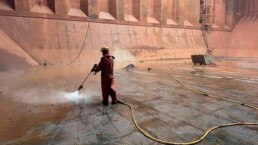

Bulk carrier owners are investing in corrosion protection for cargo hold tank tops as a cost-effective way of avoiding steel replacement work during drydocking and reducing long-term maintenance costs.
German corrosion protection specialist Steelpaint says it is seeing a marked increase in the number of owners trialling its heavy-duty Stelpant system on cargo hold tank tops and other high-wear areas, with a significant proportion of those trials progressing on to larger applications and fleet orders.
For decades, tank tops have remained one of the few areas inside bulk carrier cargo holds that many operators have chosen not to protect. The argument being that the constant impact damage during the loading/unloading of iron ore, coal, combined with mechanical impact from bulldozers/grabs, aggregates and other abrasive cargoes made the regular repeat coating work nothing more than a costly exercise.
What’s more, once damaged, many owners feared coatings could contaminate some cargoes while offering little long-term protection.
“We’ve reached a point where owners are starting to question assumptions that have existed for years,” said Frank Müller, Director of Steelpaint. “Shipowners are naturally cautious. They don’t want to be the first to try something new, but they certainly don’t want to be the last. Once operators see comparable vessels successfully using the system, confidence grows remarkably quickly.”
The company’s zinc-rich Stelpant PU-Zinc system can be applied under normal commercial operating conditions, allowing owners to evaluate performance through repeated loading, unloading and cargo hold washing cycles. Minimal standard steel preparation is required, such as dry blasting or the more environmentally friendly wet blasting.
The company says this practical approach has proven critical in convincing owners that coating tank tops can deliver long-term results.
Steelpaint is now undertaking around ten trial applications each year, representing a noticeable increase over previous years.
“In many cases an owner starts with a small test patch before progressing to a complete tank top, then perhaps a full cargo hold or several holds, before eventually introducing the system across multiple vessels,” Müller said. “We see a very clear progression from an initial trial to larger applications and then repeat orders.”
The company estimates that heavy-duty cargo hold applications are contributing to sustained annual growth of around 10-15%, reflecting what it sees as a gradual but significant shift towards proactive corrosion management within the dry bulk sector.
One of the principal drivers behind this change is the age profile of today’s global bulk carrier fleet.
“The last major newbuilding peak for bulk carriers was around 2010,” said Li Yinlong, General Manager of Steelpaint China. “That means the average bulk carrier is now around 15 or 16 years old and cargo hold steel condition continues to deteriorate year by year.”
He said owners are increasingly reassessing maintenance strategies as newbuilding deliveries remain comparatively slow and many operators look to retain vessels in service for longer.
“Because of the current balance between supply and demand, together with the slower pace of fleet renewal, shipowners are willing to keep ageing vessels operating for longer,” Li said.
“That makes corrosion prevention much more important. Owners are looking at ways to extend vessel life, reduce future docking costs and minimise the risk of replacing steel on tank tops and lower hopper areas.”
Based on experience gained to date, Li believes demand for corrosion protection systems will continue to grow over the next five years.
As of June 2026, Steelpaint had completed work on 11 Berge Bulk vessels, together with projects for Anglo-Eastern, MUR Shipping, Maran Dry Management, Xiamen Minhua Shipping, and Lomar Shipping. A further full tank top application for Load Line Group is scheduled to begin shortly.
The company is also seeing increasing interest from multi-purpose vessel operators, reflecting a broader recognition that protecting heavily loaded cargo hold areas can reduce lifecycle maintenance requirements.
Recent projects have been completed at several leading Chinese repair yards, including Youlian Shipyard, Xinya Dockyard, Qingdao Beihai Shipyard and Shanghai Yuan Shipyard, where applications have focused on tank tops, lower hopper and stool sections, bulkheads and hatch coamings.
According to Steelpaint, the commercial case extends well beyond the cost of applying a coating. “Classification societies regularly monitor cargo hold steel thickness throughout a vessel’s life. As corrosion reduces plate thickness, owners can eventually be required to replace sections of steel during drydockings,” said Müller.
While the steel itself represents part of the cost, Steelpaint says the much larger financial impact often comes from the extended off-hire period required to complete steel renewal.
Based on its analysis, Steelpaint estimates that maintaining cargo hold steel through planned coating maintenance and periodic touch-up repairs could reduce lifecycle costs by up to US$4.5M per large bulk carrier through avoided steel renewal and reduced downtime.
“As fleets continue to age, we believe more operators will view tank top protection not simply as another coating, but as part of a long-term asset management strategy,” said Müller



Related News.

Poland’s additional national requirements distort competition says Danish Shipping
Poland has introduced a national survey requirement for smaller foreign-flagged vessels operating in Polish waters. This creates significant…

Battery Vessels could help electrify most of Global Shipping Emissions
Battery-electric ships are economical only if the pack is cycled frequently, so they have been confined to short-sea, ferry and harbour vessels…

Mintra and Ledgid explore collaboration to connect Maritime digital identity, learning and workforce development
Mintra® and LEDGID are exploring opportunities to bring together complementary capabilities in digital learning, maritime training, professional…

World Shipping Council calls for global agreement on shipping emissions as industry investment surpasses $200 billion USD
The World Shipping Council (WSC) is calling on governments to agree on binding global greenhouse gas regulations for international shipping without…

What happened to the ITF whistleblower’s complaint?
In January 2026, a whistleblower complained that International Transport Workers’ Federation (ITF) General Secretary Stephen Cotton had manipulated…

Growing regulatory scrutiny puts seafarer wellbeing firmly on maritime safety agenda, VIKAND warns
Seafarer wellbeing is coming under greater regulatory scrutiny as international rules and guidance increasingly recognise crew health and welfare as…

Good Times Bad Times the Premium Stays with the Strait
In October, we wrote that if the transfer network off Oman kept pace, Gulf crude would carry China's refill and keep drawing tonnage east,…

Allied Weekly Market Review Week 47
Pls find below the Allied - Weekly Market Review - Week 47 ALLIED - Weekly Market Report- Week 47


Climate TRACE releases September 2026 Emissions Data
Climate TRACE reported that global greenhouse gas (GHG) emissions for the month of September 2026 totaled 4.7 billion tonnes CO₂e. This remains…
Subscribe to our newsletter!
if you dont want to swim alone in the ocean of news, sign up for the newsletter, and you will receive daily all the important news of world shipping!
