Norsepower Rotor SailTM force measurement validated by RISE
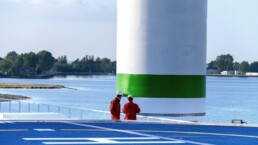

Norsepower, the global leader in wind-assisted propulsion for commercial shipping, today announced that its proprietary force measurement technology for wind-assisted ship propulsion (WASP) has been independently validated by RISE technology infrastructure SSPA Maritime Centre. The evaluation was carried out onboard MV Chinook Oldendorff ,equipped with three Norsepower Rotor SailsÔ, and it is among the first third-party validations of a continuous performance monitoring system for wind propulsion.
July 22, 2026, Helsinki, Finland– Measuring the thrust generated by a WASP device is the most direct way to quantify its performance — but doing so reliably, over long periods of operation, and translating the result into real vessel power savings, has remained a persistent challenge for the industry.
Norsepower addressed this with a proprietary measurement technique based on pressure sensors integrated directly into the rotor system. To verify its accuracy, Norsepower worked with RISE, which applied its own performance assessment methodology to convert the measured thrust forces into estimated power savings. RISE then compared these estimates against a large number of on/off tests carried out over six months of normal vessel operation.
The results showed that the force measurements remained stable over time and correlated well with the savings identified through the operational on/off testing — a joint effort building on Norsepower’s core measurement technology together with RISE’s independent conversion and assessment methodology.
“The measurements demonstrated good stability throughout the test period. Combined with initial calibration using on/off testing, this provides a promising solution for quantifying WASP energy savings over time,” said Sofia Werner, Head of Strategic Development at RISE SSPA Maritime Centre.
This validation marks a meaningful step toward continuous, transparent monitoring of wind propulsion performance in commercial shipping — and it points directly to where international discussions are heading. As the IMO advances its GHG Fuel Intensity (GFI) framework, the maritime industry needs a credible way to measure and verify the real-world contribution of wind-assisted propulsion. This work shows that continuous, direct thrust measurement — the top tier (Tier IV) of the methodology proposed to the IMO for assessing wind propulsion under GFI — is not just theoretically sound, but a proven, operational solution. It gives the industry a viable path to the kind of rigorous, auditable performance data that GFI compliance will demand.
By enabling reliable, real-time visibility into actual fuel and emissions savings, the technology also opens the door to new commercial models: shipowners and charterers can share transparent, verified performance data as a basis for splitting the costs and benefits of wind propulsion — supporting wider adoption across the industry.
“Our force measurement third-party validation demonstrates how the whole industry benefits when we can independently prove that wind propulsion performance can be measured accurately and consistently. That’s what will build the trust needed for wind propulsion to scale,” said Heikki Pöntynen, CEO of Norsepower.



Related News.

Poland’s additional national requirements distort competition says Danish Shipping
Poland has introduced a national survey requirement for smaller foreign-flagged vessels operating in Polish waters. This creates significant…

Battery Vessels could help electrify most of Global Shipping Emissions
Battery-electric ships are economical only if the pack is cycled frequently, so they have been confined to short-sea, ferry and harbour vessels…

Mintra and Ledgid explore collaboration to connect Maritime digital identity, learning and workforce development
Mintra® and LEDGID are exploring opportunities to bring together complementary capabilities in digital learning, maritime training, professional…

World Shipping Council calls for global agreement on shipping emissions as industry investment surpasses $200 billion USD
The World Shipping Council (WSC) is calling on governments to agree on binding global greenhouse gas regulations for international shipping without…

What happened to the ITF whistleblower’s complaint?
In January 2026, a whistleblower complained that International Transport Workers’ Federation (ITF) General Secretary Stephen Cotton had manipulated…

Growing regulatory scrutiny puts seafarer wellbeing firmly on maritime safety agenda, VIKAND warns
Seafarer wellbeing is coming under greater regulatory scrutiny as international rules and guidance increasingly recognise crew health and welfare as…

Good Times Bad Times the Premium Stays with the Strait
In October, we wrote that if the transfer network off Oman kept pace, Gulf crude would carry China's refill and keep drawing tonnage east,…

Allied Weekly Market Review Week 47
Pls find below the Allied - Weekly Market Review - Week 47 ALLIED - Weekly Market Report- Week 47


Climate TRACE releases September 2026 Emissions Data
Climate TRACE reported that global greenhouse gas (GHG) emissions for the month of September 2026 totaled 4.7 billion tonnes CO₂e. This remains…
Subscribe to our newsletter!
if you dont want to swim alone in the ocean of news, sign up for the newsletter, and you will receive daily all the important news of world shipping!
