Cruise Ships exposing Iceland’s residents to dangerous levels of Air Pollution
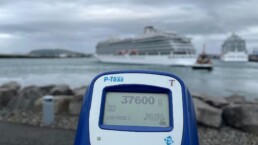

Air quality measurements recorded during visits of cruise ships – such as the Viking Mars and Sky Princess – to the port of Sundahöfn, in Reykjavík, Iceland, show high air pollution levels with an average of 35-40 times higher than safe low particle levels recommended by the World Health Organization (WHO) – 1,000 particles/cm3.
The measurements, made on July 7th, contained a high content of soot (black carbon) which is toxic to human health and a strong climate pollutant that drives warming of the Arctic. Similarly high pollution levels were measured on July 11th in Reykjavík harbour – close to populated city areas, where smaller cruise ships and boats are not always able to connect to onshore electrical power.

Sky Princess – Princess Cruises cruise ship leaving Sundahöfn, Iceland
Smaller cruise ships and boats can use a shore-based electrical connection (onshore power) rather than running their engines in Reykjavík’s harbour. However, at the much larger Sundahöfn Port nearby, ships cannot yet use shore power, pending a power plant coming on stream in 2028.
The measurements, taken by Dr Kåre Press-Kristensen, senior advisor on air quality & climate at Green Global Future, found average concentrations measured while the cruise ships were in port were around 35-40,000 particles/cm3, peaks in the ships’ main smoke plume were above 100,000, falling to around 1000/cm3 when the cruise ships departed the port, suggesting that residents in Reykjavik are regularly exposed to high levels of air pollution when wind is towards the city from the cruise port.

Air pollution measurements taken near cruise ships in the city port Reykjavík, Iceland
Such pollution increases the risk of strokes, cardiovascular diseases, lung diseases, cancer, and as a result, the risk of premature mortality among residents. In addition, soot particles are a key driver for global warming. See WHO information regarding health risks.
“It’s certainly welcome that Iceland has decided to install onshore power for cruise ships allowing cruise ships to use clean Icelandic electricity when the plant is ready in 2028, instead of idle running all day in the port”, says Dr Kåre Press-Kristensen. “However, to rapidly reduce emissions at sea, shipping around the Arctic, including in Iceland’s waters, ships must switch to distillate fuels – increasingly identified as polar fuels – like marine gas oil.
“Iceland can promote this by supporting a proposal on polar fuels at the International Maritime Organization; banning scrubber water discharges in territorial seas as recommended by OSPAR, and as other Nordic nations have done; as well as by establishing a green corridor between Reykjavik and Nuuk thereby protecting the very fragile Arctic ecosystems”, added Press-Kristensen. “The expense of installing shore power facilities will be recouped through connection fees and electricity sales much faster than for traditional infrastructure projects. This will eliminate local pollution from ships at berths, improve public health in the wider vicinity and reduce global warming.”
“Iceland should start monitoring air pollution at all ports in Iceland and support the Nordic Council recommendation for action at the International Maritime Organization (IMO) by joining the Danish-led proposal on polar fuels currently on the table for consideration at the IMO, thus mandating the need for cleaner fuels in Icelandic waters”, said Arni Finnsson, Board Chair at the Iceland Nature Conservation Association. “Iceland should also move towards implementing a scrubber water discharge ban, adoption of green corridors, provision of onshore power for fishing vessels, and construction of electric fishing vessels. These are all low hanging fruits which will contribute to reducing air pollution and global warming caused by shipping, as well as creating energy supply safety for Iceland.”
Iceland and Emission Control Areas
“The Northeast Atlantic Emission Control Area (ECA) adopted by the IMO on May 1st this year is a very welcome step towards reducing emissions of air pollutants SOx and NOx, but it will not adequately address black carbon emissions which lead to climate heating in the Arctic, because ships can still use traditional heavy fuel oils in combination with scrubbers or ultra low sulphur fuel oils to comply with the sulphur requirements in the ECA”, said Dr Sian Prior, Lead Advisor to the Clean Arctic Alliance. “Both these compliance methods will not reduce black carbon emissions to the same low levels that using polar fuels can do.”
A proposal on polar fuels, co-sponsored by Denmark, Germany, France and the Solomon Islands is currently on the table at the International Maritime Organization.
“The Clean Arctic Alliance is calling on other progressive countries – like Iceland – to support the creation of this new regulation requiring the use of cleaner maritime fuels in order to protect the Arctic”, added Prior. “It is important that the regulation is applied across the whole Arctic above 60oN latitude in the Atlantic – below the Arctic Circle and including all Iceland’s waters – as black carbon emissions are transported hundreds to thousands of kilometers in the atmosphere when released further south and fall on to Arctic snow and ice”.
Background: Heavy Fuel Oil Ban
July 1, 2026, marked two years since an IMO ban on the use and carriage for use of heavy fuel oil came into force in the Arctic to address the risk of HFO spills, but it won’t be fully in place until July 2029 and even then will only apply to waters where sea ice can be encountered. This year, the North-East Atlantic Emission Control Areas (ECA) was adopted by the International Maritime Organization (IMO) on May 1st, 2026 to address SOx and NOx emissions, and will take effect until March 2027. Iceland, as an IMO member in this part of the Atlantic, will be obliged to enforce this law when it comes into force. Although crucially important, neither of these regulations will specifically address the Arctic’s black carbon problem. Switching to clean fuels – marine gas oils or new low carbon fuels coming onto the market – will further reduce emissions of black carbon, which is why Iceland’s backing of the polar fuel proposal led by Denmark is very important.
Black Carbon Emissions from Ships in the Arctic 2019 – 2024: Iceland

This slide deck contains a selection of data contextual to Iceland and black carbon emissions in the Arctic, extracted from Black Carbon Emissions from Ships in the Arctic 2019 – 2024
Black Carbon Emissions from Ships in the Arctic 2019 – 2024, provides a comprehensive analysis of tank-to-wake black carbon emissions from Arctic shipping using three geographic definitions: a latitudinal band north of 60oN (excluding the Baltic Sea and Gulf of Alaska), the Polar Code Arctic waters, as well as a broader ecological boundary defined by the Arctic Monitoring and Assessment Programme (AMAP). It estimates black carbon emissions for the years 2019, 2022 and 2024. The report examines the seasonal patterns of Arctic shipping routes, profiling vessel characteristics, fuel consumption by EEZ and vessel type as well as energy use. Historical estimates show how Arctic shipping activity and associated emissions have changed over time, while forecasts reveal how growth in emissions could affect the Arctic, and inform decisions on fuel choices, such as that proposed by PPR 13/6, operational practices and regulatory strategies.
Download: Black Carbon Emissions from Ships in the Arctic 2019 – 2024 – Iceland



Related News.

Highly successful conclusion of the 2nd CSN Northern European Crewing Conference in Hamburg: Crewing 5.0 in Focus
We are delighted to report the highly successful conclusion of the 2nd CSN Northern European Crewing Conference, which took place on the 22nd of…

Dualog launches secure messaging for ship and shore
Dualog has launched Dualog Chat, a secure messaging service built for shipping. The first service in Workspace by Dualog, Chat gives crews and shore…
India and the Widening Tanker Freight Squeeze
This week’s Tanker Market Monitor tracks India’s return to Iraqi supply as Gulf oil movements recover amid persistent shipping risk. Yanbu is…
Star Bulk announces strategic partnership with Hermes World Maritime
Star Bulk Carriers Corp. (the "Company" or "Star Bulk") (Nasdaq & Euronext Athens: SBLK), today announced that it has entered into a strategic…

Thai Cave Rescue Diver Chris Jewell to Bring Lessons in Risk and Safety to IMCA Global Summit
The International Marine Contractors Association (IMCA) will launch its new strategy to 2030 as hundreds of offshore leaders and technical…

Port call optimisation pilot projects reveal significant emissions savings potential
Commercial ships spend between 4% and 6% of their operating year waiting outside ports. That idle time is one of the clearest inefficiencies in…
Port Houston celebrates Historic Project 11 Milestone
Houston Ship Channel expansion strengthens safety, efficiency, and regional prosperity Port Houston joined federal, state, and local elected…

Global VLCC Spot Earnings rise to $805,000/Day
Clarksons Research, the data and analytics arm of the Clarksons Group, continue to track and monitor shipping activity and markets impacted by the…
IMO adopts frameworks to assess marine geoengineering research activities
New guidance will help governments evaluate marine geoengineering research proposals to ensure they are safe for the environment. The…

BIMCO adopts addendum to support investments in retrofit projects
The shipping industry is working to improve fuel efficiency and ship performance to address decarbonisation requirements, new regulations and rising…
Subscribe to our newsletter!
if you dont want to swim alone in the ocean of news, sign up for the newsletter, and you will receive daily all the important news of world shipping!
