

Buying cargo insurance directly from your shipper, per-shipment, especially when that shipper operates on a global scale, is not about dismissing brokers or traditional cargo insurers. These have an important place, particularly for complex or high-value trades that need specialist underwriting. But for most standard containerized shipments on regular trade lanes, the shipper-integrated model has five distinct advantages worth understanding.
- Thanks to unique data your shipper knows the real risks: when you buy insurance through your shipper, the underwriting is informed by something no external party can fully replicate, which is direct operational knowledge of your shipment. Your shipper knows the exact route your cargo will travel, the carriers, ports, and transshipment points involved. They have historical loss data on every lane they operate. They understand how your specific commodity behaves in transit whether for instance it’s temperature-sensitive electronics or bulk agricultural goods. They have a depth of route-specific, commodity-specific intelligence based on your data. This knowledge doesn’t just make for better risk assessment but also for better coverage terms, accurate pricing, and fewer disputes when something goes wrong.
- Per-shipment coverage: pay for what you ship. Annual open-cover policies are the industry default, but they come with a built-in inefficiency. Premiums are averaged across an entire cargo profile. Low-risk shipments subsidize high-risk ones. If cargo mix shifts mid-year, coverage may not keep up. And at claims time, under-declaration disputes are more common than anyone in the industry likes to admit. Per-shipment insurance, by contrast, is precise as its premium reflects the actual value, route, and commodity of that specific shipment. There are no coverage gaps when trade patterns shift. There is no under-declaration risk as the shipment value is declared at booking. A company only pays for the coverage they need when they need it. Per-shipment coverage is built for this reality.
- Large shippers unlock the right pricing: when shippers are large, you benefit from their scale in ways that go beyond freight rates. A logistics provider moving tens of thousands of containers a year negotiates insurance terms at a level no individual importer or mid-sized exporter could replicate. They pool risk across an enormous cargo base, which gives them access to institutional-grade pricing and coverage terms from leading underwriters. This typically means all-risk coverage is present under Institute Cargo Clauses (A) which is the broadest available. War and strikes coverage are often included as a standard. Competitive per-shipment premiums are included (that would be difficult to match independently) and strong insurer relationships are present. For a company shipping 30–100 containers a year, this difference in both price and coverage quality versus a standalone policy can be significant.
- Claims are faster when the insurer and shipper are aligned
This is where shipper-integrated insurance shows its clearest advantage and where the difference is felt most acutely. When a loss occurs and your insurance is through your shipper, the insurer and the party with operational knowledge of your shipment are either the same entity or closely aligned. Documentation flows internally. Surveyors are engaged faster. There’s no incentive for parties to deflect responsibility, because the same relationship covers both the freight and the claim. The alternative — which many importers and exporters know from experience — can look like filing a claim with a standalone insurer, insurer requests documentation are held by the carrier, carrier disputes when and where the damage occurred, the insurer suggests it may be a carrier liability issue, not an insurance issue and some much time can pass by with little to no result. The question worth asking is: how much operational bandwidth does your team have for a claims dispute that drags on for months? Shipper-integrated insurance doesn’t eliminate all claims complexity — but it significantly reduces the coordination friction that turns straightforward losses into protracted disputes. - Operational simplicity that compounds over time: there’s a quieter advantage that supply chain managers and CFOs tend to appreciate once they’ve experienced it: the elimination of insurance administration as a separate workstream. When coverage is embedded in your freight invoice on a per-shipment basis:
o No separate premium payments to track and reconcile.
o No annual renewal to manage or miss.
o No risk of coverage lapses between policy periods.
o Evidence of coverage is tied directly to each Bill of Lading — clean and audit-friendly.
For companies managing significant shipment volumes, coverage gaps happen less because of bad policies and more because of administrative errors — forgetting to declare, under-declaring, or simply not realising a renewal lapsed. Per-shipment insurance from your shipper removes those failure points entirely.
The questions worth asking your logistics partner
If you’ve never explored this with your current shipper, these five questions are a good place to start:
1. Do you offer per-shipment cargo insurance, and on what terms?
2. Is coverage under ICC (A) all-risk, or named perils only?
3. Are war and strikes risks included, or additional?
4. What is your average claims settlement timeline?
5. Can you share an example of how a recent claim was handled?
The answers will tell you a great deal — not just about the insurance product, but about the quality and transparency of your logistics partner overall.
A Final Thought
Cargo insurance is one of those areas where the default choice — an annual open cover through a broker or forwarder — feels safe because it’s familiar. And for some shipments, some cargo types, and some trade relationships, it genuinely is the right choice. But for standard containerized cargo on regular lanes, there’s a strong case that buying per-shipment coverage from a large, established shipper gives you better pricing, better claims alignment, and less administrative complexity than the traditional route. Not because brokers don’t add value — but because for this use case, proximity and scale matter. And your shipper has both.
Source: Maersk



Related News.

Navigating the Multi-Orbit Era: In Conversation with Intellian’s Jon Harrison at SMM 2026
At SMM 2026 in Hamburg, the rapid evolution of maritime satellite communications took centre stage. Across the exhibition halls, discussions among…

Cyprus ports need joint energy and investment strategy, shipping agents chief says
Cyprus needs a coordinated strategy for shipping, energy and environmental protection to support port investment and modernisation, Cyprus shipping…

MASO Public Affairs introduces MASO Regulatory Intelligence
A new subscription service helping businesses understand what is changing and what it means for them MASO Public Affairs introduces MASO Regulatory…
Anglo-Eastern helps turn CMBTECH’s ammonia ambition into an operational reality
From early feasibility study and risk-based design to newbuilding supervision, crew readiness and technical management, Anglo-Eastern drew on its…

Escalation of attacks threatens to derail recovery in Middle East oil exports
World oil demand is forecast to fall by 2.5 mb/d y-o-y in 4Q26 and 2.6 mb/d on average in 2026. As the Iran war manifests itself through restricted…

New study finds shipping pays twice its share to EU ETS earmarked revenues should triple to help build market for sustainable fuels and technologies
Shipping is responsible for around 10% of EU ETS emissions but pays almost 20% of the ETS bill. Unlike other sectors, it has never received free…

MSARC strengthens maritime mass rescue readiness through training and national live exercise off Dakar, Senegal
Joint MSARC–FHAS programme combines three days of SAR training with a national multi-agency live exercise The Maritime Search and Rescue Council ,…
Sogese report deliveries are still being delayed as container freight rates fluctuate
FOR IMPORTERS Spot rates into the Mediterranean are back at January levels, Far East to Europe reliability sits at pandemic lows, and nearly…

Glencore begins trading on Australian Securities Exchange
Glencore has begun trading on the Australian Securities Exchange under the ASX code GLC. Gary Nagle, Glencore’s CEO, said it was an exciting day for…
BIMCO Shipping Number of the Week
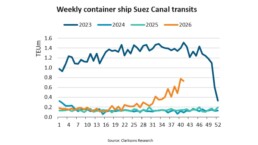
Suez Canal container ship transits exceed 50% of pre-disruption levels "During the first two weeks of October, weekly container ship capacity…
Subscribe to our newsletter!
if you dont want to swim alone in the ocean of news, sign up for the newsletter, and you will receive daily all the important news of world shipping!
