bound4blue eases eSAIL® adoption with ABS review of Pwind calculation methodology
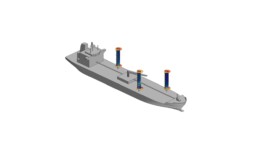

- ABS reviewed bound4blue’s methodology for producing the aerodynamic polars used to build the wind propulsion system force matrix for Pwind calculation
- Third party review provides shipowners with a credible, regulation-ready pathway to quantify the contribution of eSAIL® installations for EEDI/EEXI and FuelEU Maritime compliance
- Independent review reinforces confidence in bound4blue’s CFD-based approach and supports faster, more efficient deployment of future wind propulsion projects
Wind propulsion pioneer bound4blue has achieved another milestone, with ABS review of its proprietary force matrix methodology for calculating Pwind values. The independent review adds to the growing number of classification society assessments of bound4blue’s methodology, giving shipowners added confidence when quantifying regulatory and financial benefits of eSAIL® suction sails, helping accelerate adoption and streamline compliance.
Boosting the business case
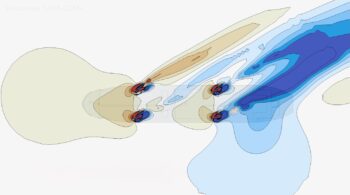
bound4blue’s approach aims to deliver both confidence and speed. The innovative methodology combines advanced Computational Fluid Dynamics (CFD) modelling with wind tunnel validated tools to generate vessel-specific aerodynamic force matrices. As such it avoids the need for expensive and time-consuming full-scale testing, while still accounting for both sail-to-sail and ship-to-sail aerodynamic interactions. This ensures each installation is assessed according to its unique configuration and operating characteristics.
Achieving such reliable calculations is an increasingly important regulatory step for shipowners looking to embrace clean, readily available and proven wind power. Verified Pwind values can be used within EEDI and EEXI calculations, while also helping to determine FuelEU Maritime’s Wind Reward Factor. While such methodologies do not indicate factors such as fuel savings or hydrodynamic performance, they do shed light on reduced compliance costs, strengthening the overall business case for wind propulsion.
Robust, credible, transparent
José Miguel Bermúdez, CEO and co-founder of bound4blue, comments: “In a transitioning, and increasingly complex, industry, third party reviews deliver both certainty and transparency for shipowners considering suction sail installations. That is a vital factor in accelerating the adoption curve for advanced wind propulsion technology.”
Bermúdez continues: “Independent review from leading Class Societies such as ABS gives stakeholders confidence that the aerodynamic methodology behind our Pwind calculations is robust, credible, and suitable for regulatory use. This creates a clear pathway to compliance, making it easier for shipowners to capture not only the environmental benefits of wind propulsion, but also the significant financial advantages available through today’s regulatory frameworks.”
The review also supports that bound4blue’s methodology can be applied with confidence across future projects. While each wind propulsion system force matrix remains specific to an individual vessel and installation, the underlying process has undergone expert third-party assessment, unlocking reduced project development and approval timelines for future eSAIL® installations.
Building industry confidence
According to Alberto Llopis, Head of Aerodynamics at bound4blue, the achievement reflects years of investment in aerodynamic research and validation:
“The focus of this review is the generation of accurate aerodynamic polars and force matrices that represent how eSAIL® systems perform under different wind conditions. Our methodology combines sophisticated CFD calculations and in-house tool development with extensive wind tunnel validation to provide insights into complex aerodynamic interactions. We’re delighted to have worked with ABS, as we continue in our quest to build confidence and credibility for wind power amongst shipowners, financiers, charterers and other key stakeholders.”
Michael Kei, ABS Vice President of Technology, said: “ABS is committed to supporting the safe adoption of innovative technologies that help the industry comply with evolving regulations. We are pleased to work with bound4blue on their technology, helping provide a clear and consistent framework for evaluation of wind-assisted propulsion systems and supporting informed decision-making across the industry.”
The methodology used by bound4blue to determine force matrix from the combination of RANS-based CFD simulations, wind tunnel model tests, and potential-based interference analysis for multiple installation of eSAIL® was reviewed in accordance with applicable IMO Regulations and ITTC Guidelines.
Powerful benefits
bound4blue has cemented its position at the forefront of the wind propulsion segment with a stream of high-profile contracts and installations for its autonomous, suction sail technology.
eSAILs® generate forward thrust up to seven times greater than conventional rigid sails of the same size. By harnessing wind as a clean energy source, they ease engine loads, reduce fuel consumption and decrease greenhouse gas emissions, supporting both regulatory compliance and financial performance.
The mechanically simple, non-ATEX units are suitable for a broad range of vessel types, including tankers, bulkers, ro-ros, cruise vessels, ferries, gas carriers, and general cargo vessels. The company has deployed eSAIL® systems on eleven ships, with seven more in its order book, representing more than 50 eSAILs®.



Related News.

Poland’s additional national requirements distort competition says Danish Shipping
Poland has introduced a national survey requirement for smaller foreign-flagged vessels operating in Polish waters. This creates significant…

Battery Vessels could help electrify most of Global Shipping Emissions
Battery-electric ships are economical only if the pack is cycled frequently, so they have been confined to short-sea, ferry and harbour vessels…

Mintra and Ledgid explore collaboration to connect Maritime digital identity, learning and workforce development
Mintra® and LEDGID are exploring opportunities to bring together complementary capabilities in digital learning, maritime training, professional…

World Shipping Council calls for global agreement on shipping emissions as industry investment surpasses $200 billion USD
The World Shipping Council (WSC) is calling on governments to agree on binding global greenhouse gas regulations for international shipping without…

What happened to the ITF whistleblower’s complaint?
In January 2026, a whistleblower complained that International Transport Workers’ Federation (ITF) General Secretary Stephen Cotton had manipulated…

Growing regulatory scrutiny puts seafarer wellbeing firmly on maritime safety agenda, VIKAND warns
Seafarer wellbeing is coming under greater regulatory scrutiny as international rules and guidance increasingly recognise crew health and welfare as…

Good Times Bad Times the Premium Stays with the Strait
In October, we wrote that if the transfer network off Oman kept pace, Gulf crude would carry China's refill and keep drawing tonnage east,…

Allied Weekly Market Review Week 47
Pls find below the Allied - Weekly Market Review - Week 47 ALLIED - Weekly Market Report- Week 47


Climate TRACE releases September 2026 Emissions Data
Climate TRACE reported that global greenhouse gas (GHG) emissions for the month of September 2026 totaled 4.7 billion tonnes CO₂e. This remains…
Subscribe to our newsletter!
if you dont want to swim alone in the ocean of news, sign up for the newsletter, and you will receive daily all the important news of world shipping!
