Airbus awarded Aeolus-2 wind sensing satellite contract
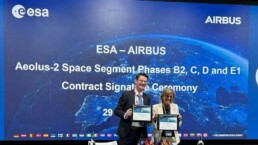

Airbus Defence and Space has signed the initial contract for the design and build of the Aeolus-2 wind sensing satellite from the European Space Agency (ESA) at a ceremony at ESA’s UK headquarters ECSAT at Harwell.
Aeolus-2 will follow the first Aeolus wind sensing satellite built by Airbus and launched in 2018. The satellite provided the first-ever high-resolution vertical wind profiles from space, enabling a 4% improvement of numerical weather forecasting, and significantly enhanced the accuracy of global weather prediction models benefiting European stakeholders and society – link to report.
“Aeolus exceeded expectations and demonstrated the transformative impact that space-based wind observations can have on weather forecasting. Aeolus-2 represents the natural evolution of that achievement – from pioneering research to an operational service that will benefit citizens and businesses worldwide. We are happy to provide the authorisation to proceed, which marks an important milestone in ensuring Europe remains at the forefront of atmospheric observation and meteorological innovation,” said Simonetta Cheli, ESA’s Director of Earth Observation Programmes.
“The UK has been at the forefront of satellite weather forecasting since the original Aeolus mission, and I’m delighted that Airbus Defence and Space in the UK will once again play a leading role in this next chapter. Aeolus-2 will deliver real benefits for people across the UK, from more accurate weather forecasts that protect lives and communities, to the highly skilled jobs that come from being a key partner in Europe’s most ambitious space science programmes,” said Liz Lloyd, UK Space Minister.
“Our involvement in Aeolus-2 is made possible by the UK’s continued investment in the European Space Agency and EUMETSAT, ensuring British expertise and industry remain central to cutting-edge space science. This is exactly the kind of high-skilled, high-impact work that demonstrates the UK’s world-leading position in the global space sector,” she continued.
“Aeolus-2 is more than a scientific mission; it is a major investment in British talent,” said Kata Escott, Managing Director of Airbus Defence and Space in the UK. “This project allows our highly skilled UK teams to apply their unique expertise to enhance weather monitoring and lead the way globally in Earth observation and science.”
Data from Aeolus, which flew in orbit until 2023, significantly enhanced the accuracy of global weather prediction models and provided critical data for understanding atmospheric circulation and long-term climate change. Aeolus-2 will also be equipped with another pioneering Doppler wind lidar with ultraviolet lasers which will scan from the ground up to 30km taking measurements every 0.01 seconds, covering all of the globe every seven days. Aeolus-2 will have an additional detector to measure aerosols in the atmosphere.
The first Aeolus satellite helped improve knowledge of hurricanes, and of how volcanic ash travels in the high atmosphere. It also improved data availability at the poles and the equator, reducing the mean error between predictions and observations by more than 4%.
Light from the lasers on Aeolus bounce off small particles such as dust, ice and water droplets, and the light scattered back collected by the telescope shows the speed and wind direction based on the Doppler shift of the particles.
Aeolus-2 is being developed by the European Space Agency (ESA) in partnership with EUMETSAT (European Organisation for the Exploitation of Meteorological Satellites) and will benefit major weather centres, including the UK’s Met Office and European Centre for Medium-Range Weather Forecasts (ECMWF).
Aeolus-2 will orbit the Earth 15 times a day and deliver data to users within 120 minutes of the oldest measurement in each orbit. The satellite will be in a 450 km orbit and a lifetime of 5.5 years.



Related News.

Poland’s additional national requirements distort competition says Danish Shipping
Poland has introduced a national survey requirement for smaller foreign-flagged vessels operating in Polish waters. This creates significant…

Battery Vessels could help electrify most of Global Shipping Emissions
Battery-electric ships are economical only if the pack is cycled frequently, so they have been confined to short-sea, ferry and harbour vessels…

Mintra and Ledgid explore collaboration to connect Maritime digital identity, learning and workforce development
Mintra® and LEDGID are exploring opportunities to bring together complementary capabilities in digital learning, maritime training, professional…

World Shipping Council calls for global agreement on shipping emissions as industry investment surpasses $200 billion USD
The World Shipping Council (WSC) is calling on governments to agree on binding global greenhouse gas regulations for international shipping without…

What happened to the ITF whistleblower’s complaint?
In January 2026, a whistleblower complained that International Transport Workers’ Federation (ITF) General Secretary Stephen Cotton had manipulated…

Growing regulatory scrutiny puts seafarer wellbeing firmly on maritime safety agenda, VIKAND warns
Seafarer wellbeing is coming under greater regulatory scrutiny as international rules and guidance increasingly recognise crew health and welfare as…

Good Times Bad Times the Premium Stays with the Strait
In October, we wrote that if the transfer network off Oman kept pace, Gulf crude would carry China's refill and keep drawing tonnage east,…

Allied Weekly Market Review Week 47
Pls find below the Allied - Weekly Market Review - Week 47 ALLIED - Weekly Market Report- Week 47


Climate TRACE releases September 2026 Emissions Data
Climate TRACE reported that global greenhouse gas (GHG) emissions for the month of September 2026 totaled 4.7 billion tonnes CO₂e. This remains…
Subscribe to our newsletter!
if you dont want to swim alone in the ocean of news, sign up for the newsletter, and you will receive daily all the important news of world shipping!
