HD Hyundai expands SMR-powerd ships to car carriers
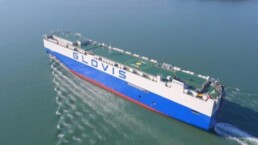

HD Hyundai has set out to secure a lead in next-generation eco-friendly vessel technology by expanding the application of small modular reactor propulsion technology from container ships to car carriers.
HD Hyundai’s shipbuilding affiliates, HD Hyundai Heavy Industries and HD Korea Shipbuilding & Offshore Engineering, announced on June 5 that they received approval in principle for the conceptual design of a large pure car and truck carrier applying a molten salt reactor from Lloyd’s Register at Posidonia 2026, a major global shipbuilding and shipping exhibition held in Athens, Greece.
This project was jointly promoted by HD Hyundai Heavy Industries, HD Korea Shipbuilding & Offshore Engineering, Hyundai Glovis, G-Marine Service, and the Korea Atomic Energy Research Institute. HD Hyundai handled the vessel conceptual design and technical review, while Hyundai Glovis proposed operational plans based on its experience in operating car carriers. G-Marine Service conducted reviews from a ship management perspective, and the Korea Atomic Energy Research Institute was in charge of reviewing the MSR technology.
An MSR is a type of SMR that uses molten salt, a mixture of nuclear fuel and coolant, as fuel. It is evaluated as a suitable technology for offshore nuclear power generation due to its high safety and efficiency. An SMR-propelled vessel is a concept that mounts a small reactor on a ship and utilizes the energy produced there as propulsion power, and unlike existing fossil fuel-propelled vessels, it is considered advantageous in that it does not emit carbon dioxide during operation and enables long-term, high-output operation. HD Hyundai had previously been promoting the development of container ships applying an MSR-based propulsion system, and with this certification as an opportunity, it has expanded the application target of the technology to car carriers.
According to market research firm Research and Markets, the global maritime car carrier market is expected to grow at an annual average of 3.8% from 2024 to 2030, reaching approximately $4.5 billion in 2030, driven by the expansion of finished vehicle exports, the increase in electric vehicle cargo volume, and the demand for transition to eco-friendly vessels. As mid- to long-term growth in the car carrier market is anticipated, this development by HD Hyundai is interpreted as a strategy to preemptively respond to future demand for eco-friendly and high-efficiency PCTCs.
However, before nuclear-propelled merchant ships can actually begin operations, complex challenges such as regulations, insurance, port acceptability, and crew training must be overcome even after this conceptual design review. The European Maritime Safety Agency (EMSA) pointed out that while nuclear power can be a pathway contributing to the decarbonization of shipping, challenges related to production, safety, security, education, liability, and insurance systems must first be resolved.
During this exhibition, HD Hyundai also received global classification certifications for various eco-friendly vessel technologies, including a liquefied petroleum gas (LPG) dual-fuel propelled container ship and an LPG carrier applying a Type-B tank with enhanced safety. HD Hyundai Heavy Industries signed a comprehensive memorandum of understanding (MOU) with Skaramangas Shipyard, the largest shipyard in Greece, to jointly participate in projects for Greek Navy and Coast Guard vessels, as well as manned and unmanned complex systems including unmanned surface vehicles (USV). Additionally, Avikus, HD Hyundai’s subsidiary specializing in autonomous ship navigation, signed an MOU with HJ Shipbuilding & Construction for the adoption of the autonomous navigation solution ‘HiNAS Control’ as a standard specification.
HD Hyundai stated, “We are showcasing leading eco-friendly vessel technology in cooperation with major shipping companies and classification societies,” adding, “We will continue to lead the era of carbon-neutral vessels through technology development and investment.”
Source:Business Korea



Related News.

Poland’s additional national requirements distort competition says Danish Shipping
Poland has introduced a national survey requirement for smaller foreign-flagged vessels operating in Polish waters. This creates significant…

Battery Vessels could help electrify most of Global Shipping Emissions
Battery-electric ships are economical only if the pack is cycled frequently, so they have been confined to short-sea, ferry and harbour vessels…

Mintra and Ledgid explore collaboration to connect Maritime digital identity, learning and workforce development
Mintra® and LEDGID are exploring opportunities to bring together complementary capabilities in digital learning, maritime training, professional…

World Shipping Council calls for global agreement on shipping emissions as industry investment surpasses $200 billion USD
The World Shipping Council (WSC) is calling on governments to agree on binding global greenhouse gas regulations for international shipping without…

What happened to the ITF whistleblower’s complaint?
In January 2026, a whistleblower complained that International Transport Workers’ Federation (ITF) General Secretary Stephen Cotton had manipulated…

Growing regulatory scrutiny puts seafarer wellbeing firmly on maritime safety agenda, VIKAND warns
Seafarer wellbeing is coming under greater regulatory scrutiny as international rules and guidance increasingly recognise crew health and welfare as…

Good Times Bad Times the Premium Stays with the Strait
In October, we wrote that if the transfer network off Oman kept pace, Gulf crude would carry China's refill and keep drawing tonnage east,…

Allied Weekly Market Review Week 47
Pls find below the Allied - Weekly Market Review - Week 47 ALLIED - Weekly Market Report- Week 47


Climate TRACE releases September 2026 Emissions Data
Climate TRACE reported that global greenhouse gas (GHG) emissions for the month of September 2026 totaled 4.7 billion tonnes CO₂e. This remains…
Subscribe to our newsletter!
if you dont want to swim alone in the ocean of news, sign up for the newsletter, and you will receive daily all the important news of world shipping!
