ESA leads high-level reflection on future skills and talents for the European space ecosystem
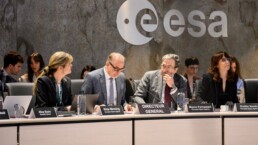

ESA unveils the ESA Skills Digital Twin Initiative to map current skills needed in the European space sector and identify emerging and critical gaps. An executive roundtable with industry, academia and international organisations was held in Paris on Wednesday 8 April 2026 to discuss the initiative’s findings, a first stepping stone towards wider reflections.
The European space human capital ecosystem is undergoing significant changes due to a variety of factors, from demographic trends to the rise of new technologies. In this context, understanding the most critical skills of today, anticipating those of the future, and gaining a clear view of the supply and demand of talent have become essential for ESA to sustain Europe’s position in space. Building upon several reflections performed both inside and outside of the Agency, ESA is proud to present to the public for the first time the ESA Skills Digital Twin Initiative.
This project has been developed by ESA in partnership with the European House Ambrosetti (TEHA) Group. It combines analytical research, stakeholder engagement and AI and web scraping across the European space ecosystem to develop a Digital Twin of the European Space ecosystem.
The Skill Digital Twin is a structured mapping of skills and talent demand distribution across the sector and the current and emerging gaps. By scanning and interpreting data from job postings and aerospace talent profiles, and combining it with direct inputs from relevant actors in the ecosystem, the project was able to deliver a comprehensive analysis of the current and future trends in skills demand and evolution (including both technical and transversal skills) and in workforce composition and trajectories. The research highlighted three possible lines for future actions, under the headings of analysis, skills initiatives, and stimulus of innovation, to support the development of a competitive, future-ready talent pool for the European space sector and beyond.
The results of the study are compiled in a dedicated White Paper, which is available at this link.
The White Paper was presented for the first time during the ESA Future Skills Executive Roundtable: Preparing the Human Capital of Tomorrow. This event took place at the ESA Headquarters in Paris on 8 April 2026, bringing together 25 experts from space agencies, industry, academia and international organisations to discuss and enrich the findings of the initiative. The roundtable was a great success, as it provided a dedicated space for informed exchange on the structural skills challenges faced by the European space ecosystem, including the impact of technological change, increasing competition for talent, and the need for stronger alignment between education, workforce development, and sectoral demand. It explored how the sector can collectively address rapidly evolving skills needs through aligned and joint actions.
The findings of the White Paper and the insights coming from the Executive Round table are feeding into a continuous dialogue and a wider reflection about the future of human capital in the European space sector. The next objective will be to foster sustained dialogue and collaboration across the European space ecosystem on future skills, also involving new stakeholders.



Related News.

Poland’s additional national requirements distort competition says Danish Shipping
Poland has introduced a national survey requirement for smaller foreign-flagged vessels operating in Polish waters. This creates significant…

Battery Vessels could help electrify most of Global Shipping Emissions
Battery-electric ships are economical only if the pack is cycled frequently, so they have been confined to short-sea, ferry and harbour vessels…

Mintra and Ledgid explore collaboration to connect Maritime digital identity, learning and workforce development
Mintra® and LEDGID are exploring opportunities to bring together complementary capabilities in digital learning, maritime training, professional…

World Shipping Council calls for global agreement on shipping emissions as industry investment surpasses $200 billion USD
The World Shipping Council (WSC) is calling on governments to agree on binding global greenhouse gas regulations for international shipping without…

What happened to the ITF whistleblower’s complaint?
In January 2026, a whistleblower complained that International Transport Workers’ Federation (ITF) General Secretary Stephen Cotton had manipulated…

Growing regulatory scrutiny puts seafarer wellbeing firmly on maritime safety agenda, VIKAND warns
Seafarer wellbeing is coming under greater regulatory scrutiny as international rules and guidance increasingly recognise crew health and welfare as…

Good Times Bad Times the Premium Stays with the Strait
In October, we wrote that if the transfer network off Oman kept pace, Gulf crude would carry China's refill and keep drawing tonnage east,…

Allied Weekly Market Review Week 47
Pls find below the Allied - Weekly Market Review - Week 47 ALLIED - Weekly Market Report- Week 47


Climate TRACE releases September 2026 Emissions Data
Climate TRACE reported that global greenhouse gas (GHG) emissions for the month of September 2026 totaled 4.7 billion tonnes CO₂e. This remains…
Subscribe to our newsletter!
if you dont want to swim alone in the ocean of news, sign up for the newsletter, and you will receive daily all the important news of world shipping!
