Kongsberg Maritime study highlights strong potential for fully electric RoPax vessels across key European routes
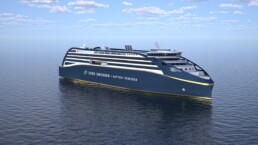

A new study from Kongsberg Maritime has identified a range of European passenger and freight routes with strong potential for the introduction of fully electric RoPax vessels, particularly across busy short‑sea corridors in Northern Europe.
Highlighting the decarbonisation opportunity in short‑sea shipping, the analysis assessed ferry routes across the continent, identifying several promising candidates, including Dover–Calais, Tallinn–Helsinki, and key services linking Scandinavia, Germany and other Baltic destinations.
The study was driven by rapidly advancing battery capabilities, falling energy‑storage costs, and the accelerating impact of EU ETS and FuelEU Maritime regulations. Taken together, these factors are now shifting the economics in favour of zero‑emission vessels on high‑frequency, short‑distance routes.
According to the study, fully electric RoPax vessels operating between 2030 and 2040 could deliver 8 to 15% lower lifetime costs compared to diesel‑powered alternatives, despite higher upfront investment. Operational cost reductions of 20 to 27% are achievable through lower energy costs and the removal of emissions‑related expenses.
Oskar Levander, Vice President Business Development – Emerging Solutions at Kongsberg Maritime, says the industry has reached a critical turning point: “Just a few years ago, diesel RoPax vessels held a clear economic advantage. That is no longer the case. Battery‑electric ships are now not only feasible but commercially compelling on a growing number of high‑frequency routes.”
Among the European services examined, several routes stand out due to a combination of short sailing distances, high utilisation and favourable port conditions. Corridors such as Dover–Calais, Tallinn–Helsinki, and a number of Scandinavian and Baltic connections offer particularly strong foundations for electrification, with infrastructure readiness and traffic density playing a key role.
To support operators making long‑term investment decisions, Kongsberg Maritime has developed two fully electric RoPax concept designs: a cargo‑focused vessel optimised for efficient operations at lower speeds, and a higher‑speed passenger‑oriented design suitable for routes with strong public‑transport and tourism demand.
Both RoPax designs are more than 200 metres in length and include modular battery rooms, intelligent energy‑management systems, and auto docking and auto crossing capabilities. They feature advanced propulsion set‑ups with electric podded propulsors, aiming to reduce system complexity and improve overall energy efficiency.
Levander added: “Building on a strong delivery track record in full-electric vessels for special applications, Kongsberg Maritime’s Power Systems is well positioned to support the continued transition towards larger-scale full-electric vessel operations”.
While the study acknowledges that port‑side charging infrastructure remains a challenge, it also highlights growing momentum across the maritime value chain. Progress will require close collaboration between shipowners, ports, grid operators and cargo stakeholders.
“For many operators, the question has shifted from whether electrification will happen to when,” Levander adds. “A number of major European routes are now approaching the point where full electrification is both technically and commercially viable.



Related News.

Poland’s additional national requirements distort competition says Danish Shipping
Poland has introduced a national survey requirement for smaller foreign-flagged vessels operating in Polish waters. This creates significant…

Battery Vessels could help electrify most of Global Shipping Emissions
Battery-electric ships are economical only if the pack is cycled frequently, so they have been confined to short-sea, ferry and harbour vessels…

Mintra and Ledgid explore collaboration to connect Maritime digital identity, learning and workforce development
Mintra® and LEDGID are exploring opportunities to bring together complementary capabilities in digital learning, maritime training, professional…

World Shipping Council calls for global agreement on shipping emissions as industry investment surpasses $200 billion USD
The World Shipping Council (WSC) is calling on governments to agree on binding global greenhouse gas regulations for international shipping without…

What happened to the ITF whistleblower’s complaint?
In January 2026, a whistleblower complained that International Transport Workers’ Federation (ITF) General Secretary Stephen Cotton had manipulated…

Growing regulatory scrutiny puts seafarer wellbeing firmly on maritime safety agenda, VIKAND warns
Seafarer wellbeing is coming under greater regulatory scrutiny as international rules and guidance increasingly recognise crew health and welfare as…

Good Times Bad Times the Premium Stays with the Strait
In October, we wrote that if the transfer network off Oman kept pace, Gulf crude would carry China's refill and keep drawing tonnage east,…

Allied Weekly Market Review Week 47
Pls find below the Allied - Weekly Market Review - Week 47 ALLIED - Weekly Market Report- Week 47


Climate TRACE releases September 2026 Emissions Data
Climate TRACE reported that global greenhouse gas (GHG) emissions for the month of September 2026 totaled 4.7 billion tonnes CO₂e. This remains…
Subscribe to our newsletter!
if you dont want to swim alone in the ocean of news, sign up for the newsletter, and you will receive daily all the important news of world shipping!
