Ohio’s MarineLINE completes first application on ATB barge conversion
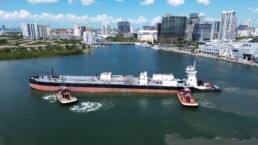

Ohio headquartered manufacturer Advanced Polymer Coatings (APC) has completed the first ever application of its MarineLINE coating system on a Jones Act vessel in a US yard.
The project was further the first conversion of an ATB petroleum barge to a chemical barge in the United States including a fully redesigned stainless steel cargo system.
The conversion of the MAM 141 ATB barge took place over 19 months at Gulf Marine Repair shipyard in Tampa in Florida and saw more than 5,000 gallons of MarineLINE applied. Gulf Marine confirmed it is the biggest conversion job the yard has ever undertaken involving more than 200 workers. In total 320 tonnes of steel was installed before the blasting and coating could begin.
The project was managed by Bob Kunkel, President of the vessel construction manager Amtech, who represented the ship owner the New York based investment firm Marathon Asset Management who purchased the vessel from Vane Brothers. Kunkel confirmed the conversion cost was a third of the $150 million cost of building a new ATB.
Mr Kunkel said changing market conditions drove the decision to invest in the vessel conversion along with the cooperation of both Gulf Marine and Anchor Sandblasting & Coating to take on the project with Amtech.
“This was a cargo driven decision,” he said. “There is an increasing volume of chemical cargoes coming into the US and a shortage of tonnage. And those chemicals are difficult to move — like methanol, caustic products and biofuels. The market is changing from traditional fuels. MarineLINE is used in Korean shipyards where I’ve worked for the last 30 years and it was enabling tankers to carry the most highly corrosive cargoes. I just thought, let’s bring that to the U.S.”
Mr Kunkel said MarineLINE has risen above the capabilities of the other coatings.
“MarineLINE brings you as close to stainless steel tanks as possible,” he said. “If I’m carrying methanol tomorrow, I can carry ethanol on Friday without considering coating recovery. That ease of cleaning and turnaround with MarineLINE is paramount — it doesn’t have to recover like a phenolic. An epoxy can take days by comparison or may not even be able to carry the more corrosive chemicals. MarineLINE gives you the ability to take the most aggressive cargoes.”
Advanced Polymer Coatings Global Marine Manager Captain Onur Yildirim, said there is great pride in working on a project which is a first.
“We’d like to thank Marathon, Amtech, Gulf Marine Repair and Anchor Sandblasting & Coating for investing in MarineLINE,” he said. “There is a crunch looming with demand for chemicals rising and a shortage of specialist vessels. As a result we are excited to grow more in the domestic US market. This conversion shows MarineLINE can be applied to coastal and inland marine chemical barges and ATBs here in the US making them more flexible. The key is to help operators improve cargo readiness and compete in more specialized trades.”
Gulf Marine Repair CEO Richard McCreary said the scale of the job saw each piece of machinery on the vessel dismantled, inspected and rebuilt or upgraded.
“I’m proud of the whole team in the yard, our workforce and contractors,” he said. “It was a very complex job with the vast amount of steel installed, while the vessel was afloat, before the application of MarineLINE itself. Gulf Marine is now the only yard in America with expertise in how to apply MarineLINE. As a result, we think Gulf Marine is in pole position to convert more ATBs to chemical carriers, as many of them discharge at the Port of Tampa — the biggest refined product import port in Florida. We also think Gulf Marine could serve the market for applying MarineLINE to the MR tankers the US wants to build.”
Tony Stokes, President of Anchor Sandblasting and Coating, which applied MarineLINE said the job was a first for his team having not used the coating before.
“We received a lot of help from the MarineLINE and Amtech teams,” he said. “They took us out to shipyards in Turkey to see how the coating is applied, then had engineers and inspectors on site to help with the application.”
Captain Yildirim said MarineLINE’s technical differentiation lies in the density of its cured polymer surface. Heat curing creates a tightly knitted molecular structure comprising up to 784 cross-links, forming a chemically inert barrier. In APC studies, MarineLINE has demonstrated resistance to more than 5,000 chemical products. According to APC’s operational modelling, a 25,000 dwt tanker fitted with MarineLINE can earn a considerable premium due to increased availability and cargo flexibility.
MarineLINE to date has predominantly been installed on tankers operating internationally being applied on approximately 700 vessels worldwide. In terms of lifetime performance, for high-specification chemicals, MarineLINE typically achieves a service life of seven to ten years, while in clean petroleum product trades some installations have exceeded 20 years.



Related News.

Poland’s additional national requirements distort competition says Danish Shipping
Poland has introduced a national survey requirement for smaller foreign-flagged vessels operating in Polish waters. This creates significant…

Battery Vessels could help electrify most of Global Shipping Emissions
Battery-electric ships are economical only if the pack is cycled frequently, so they have been confined to short-sea, ferry and harbour vessels…

Mintra and Ledgid explore collaboration to connect Maritime digital identity, learning and workforce development
Mintra® and LEDGID are exploring opportunities to bring together complementary capabilities in digital learning, maritime training, professional…

World Shipping Council calls for global agreement on shipping emissions as industry investment surpasses $200 billion USD
The World Shipping Council (WSC) is calling on governments to agree on binding global greenhouse gas regulations for international shipping without…

What happened to the ITF whistleblower’s complaint?
In January 2026, a whistleblower complained that International Transport Workers’ Federation (ITF) General Secretary Stephen Cotton had manipulated…

Growing regulatory scrutiny puts seafarer wellbeing firmly on maritime safety agenda, VIKAND warns
Seafarer wellbeing is coming under greater regulatory scrutiny as international rules and guidance increasingly recognise crew health and welfare as…

Good Times Bad Times the Premium Stays with the Strait
In October, we wrote that if the transfer network off Oman kept pace, Gulf crude would carry China's refill and keep drawing tonnage east,…

Allied Weekly Market Review Week 47
Pls find below the Allied - Weekly Market Review - Week 47 ALLIED - Weekly Market Report- Week 47


Climate TRACE releases September 2026 Emissions Data
Climate TRACE reported that global greenhouse gas (GHG) emissions for the month of September 2026 totaled 4.7 billion tonnes CO₂e. This remains…
Subscribe to our newsletter!
if you dont want to swim alone in the ocean of news, sign up for the newsletter, and you will receive daily all the important news of world shipping!
