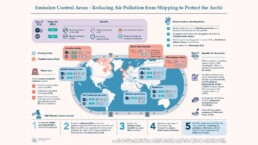

The UN International Maritime Organisation’s (IMO) Marine Environment Protection Committee (MEPC) today proceeded with the adoption of an Emission Control Area (ECA) in the Northeast Atlantic, which will now enter into force in September 2027.
After falling short of adoption during a turbulent IMO meeting last October, coastal states have now moved to drastically reduce air pollution from ships in a sea area stretching from Portugal to Greenland, via Britain and Ireland.
The Atlantic ECA will significantly expand the socio-economic, environmental, and health benefits for a large number of coastal communities as well as marine, coastal, and terrestrial habitats and wildlife along the North-East Atlantic region. “Today marks a historic day in air pollution reduction from ships, but it’s also a win for the climate”, says Sönke Diesener, shipping expert at NABU. “Besides cleaning up the air, ECAs also have a remarkable benefit for the climate: high quality fuels reduce ground level ozone formation and drive energy efficiency, causing a reduction in fuel consumption and thereby CO2 emissions. Raising the costs for dirtiest fossil operations also helps to foster the uptake of decarbonization technologies”.
“This ECA will have the co-benefit of reducing black carbon (soot) emissions for ships switching to cleaner distillate fuels”, says Dr. Kåre Press-Kristensen, senior advisor in Green Global Future, a key driver in getting Greenland involved in the ECA process at the IMO. “On top of being very damaging to public health, soot is the key reason that the Arctic is warming four times faster than the rest of the world: Soot deposits on and darkens ice and thereby increases absorption of sunlight, leading to warming and melting of the ice. The ECA is extremely important to protect the fragile environment and societies in Greenland.”
“This is indeed a massive win for coastal and Indigenous communities and for the marine environment from Portugal to Greenland, but also an opportunity to look ahead and fill in the gaps”, says Carolina Silva, shipping policy officer at ZERO. “The Atlantic ECA will connect existing ECAs in the North and the Baltic Seas, and the recently adopted Canadian Arctic waters and Norwegian EEZ, to the Mediterranean SECA in the south. It’s very clear that moving forward, the Portuguese islands of Madeira and the Azores, as well as the Spanish Canary Islands, should be included both to guarantee an economic level playing field, but most importantly to protect the coastal communities from the harmful effects of air pollution from ships.”
“ECAs can be one of the most efficient tools at IMO Member States’ disposal to tackle air pollution from ships, but it is important they remain as effective and as environmentally sound as possible”, said Dr. Liudmila Osipova, Technical Lead of the impact assessment report submitted to the IMO. “Even though this new ECA covers a large area with highly diverse ecosystems, it has met all the MARPOL Annex 6 criteria for designation and the impact assessment study took into account all ecosystems in the areas. However, additional measures are still needed to realise their full potential, particularly a ban on scrubbers, which remain allowed despite serious concerns about air and water pollution. Our research shows that banning scrubbers could reduce black carbon emissions by over 30% in the Atlantic ECA and prevent at least 300 premature deaths by 2050. Such bans have already been introduced in countries including Denmark, Finland, and Sweden.”
“The adoption of this new Emission Control Area in the Northeast Atlantic is a welcome and significant milestone for reducing the impact of shipping’s sulfur oxide (SOx) and nitrogen oxide (NOx) emissions on the Arctic. It is frustrating that despite the efforts of a large number of IMO Member States to reduce shipping air pollution, one country, Russia, whose waters are not even included within the boundaries of the ECA have indicated that they will not follow the requirements. It is now imperative that this new ECA must be complemented by an IMO regulation aimed at directly limiting emissions of black carbon, which have a disproportionate impact on the Arctic”, said Dr Sian Prior, Lead Advisor to the Clean Arctic Alliance. “Since black carbon (or soot) particles are transported in the atmosphere, a polar fuel regulation is needed that must apply throughout the whole wider Arctic and not just those areas where sea or glacier ice can be expected.”



Related News.

Intelligent Skies, Secure Seas: Navigating Connectivity, Cyber Resilience, and AI Liability at the 5th CSN Greece ICT Conference
The 5th CSN Greece ICT Conference, held on 19th November 2026 at the Ploes Floating Venue in Paleo Faliro, Athens, successfully convened maritime…

EU moves to ban tankers insured in Russia, repair services at Russian refineries
EU targets Russian-insured tankers, refineries Von der Leyen announces 22nd sanctions package All 27 member states must approve new…
IMO tackling fraudulent registries together
Strong national systems and international information sharing are crucial to tackling fraudulent registries and fraudulent ship registration…
Open letter on freedom of navigation and the protection of seafarers
Dear High Representative Kallas, Dear Foreign Affairs Ministers, European Shipowners | ECSA, BIMCO, the Cruise Lines International Association…

Davies Turner warns of Rising Asia-UK Container Disruption and European Port Congestion
Davies Turner, one of the UK’s largest independent freight forwarding and logistics companies, says that disruption to container shipments from Asia…
Disruptions still dominate tanker market outlook
"This year, tanker markets have been affected by disruption to transits through the Strait of Hormuz, the Houthi blockade of Saudi Arabian Red Sea…
Panama’s President called on to match COP31 Heroism with action at shipping climate talks
As a series of crucial meetings tasked with cutting greenhouse gas emissions from global shipping takes place this week and next, environmental NGOs…

Trafigura appoints Helio Cumbi as Executive Director, Mozambique
Trafigura has appointed Helio Cumbi as Executive Director, Mozambique, and Business Development Lead for East and Southern Africa Oil. Helio is a…

“K” LINE holds FY2026 Global Dry Bulk Meeting
Kawasaki Kisen Kaisha, announces that it held a global meeting for its dry bulk business at the company’s head office on November 9 and 10. The…
MOL launches ‘AQuA’ safety and quality improvement initiative
Standardizing Group-wide Safety and Quality Assessment Criteria to Enhance Vessel Safety and Quality Mitsui O.S.K. Lines, announced the launch of…
Subscribe to our newsletter!
if you dont want to swim alone in the ocean of news, sign up for the newsletter, and you will receive daily all the important news of world shipping!
