Vessev unlocks Waterways as the next layer of urban transit
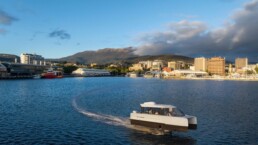

Vessev, the technology company designing and building leading-edge electric passenger vessels, announced the launch of a new hydrofoiling network in Hobart, Australia, marking a major step in using waterways as an efficient, scalable, zero-emissions layer of urban transport.
Fly Derwent, a new clean energy transport venture, will launch the network on the Derwent River, reconnecting Hobart’s thriving waterfront using Vessev’s VS–9, with expansion to a fleet of VS–12 vessels. Together, the system will create a high-frequency water transit network, without requiring major new infrastructure. Powered by Tasmania’s world-leading renewable grid, which runs on approximately 100% renewable electricity including hydrogeneration, wind and solar, the service is designed to deliver one of the lowest-emissions commuter transport models globally.
Vessev’s VS–9 and VS–12 are premium electric hydrofoiling vessels built to commercial standards for public transportation. The 29-foot VS–9 carries 10 passengers with a range of up to 50 nautical miles at a cruising speed of 25 knots, while the 37-foot VS–12 can carry up to 30 passengers.
The vessels are powered by a fully integrated foil system inspired by America’s Cup designs that automatically adjust to conditions up to 100 times per second, delivering a smooth, stable ride with virtually no wake. This opens new waterways for transport around the world, minimizing environmental impact in sensitive environments, like those found along the Derwent River.
Fly Derwent Principal Cameron McCulloch, an engineer with nearly 20 years of executive experience in the clean energy sector, said the network will be more like a metro system than a traditional ferry service.
“From the very beginning this project has been about demonstrating how Tasmania’s renewable energy focus can translate into sustainable transport leadership. This technology unlocks affordable, river-based commuter and tourism transport in Hobart without the need for large-scale infrastructure changes. That’s what excites me most – not just the boats themselves, but everything they make possible in Hobart and beyond,” McCulloch said.
“Our work with Cameron and Fly Derwent not only brings efficient and reliable transportation to Hobart, it also represents the beginning of a much larger shift in how cities think about on-the-water mobility,” said Eric Laakmann, co-founder and CEO of Vessev. “Electric hydrofoiling enables an entirely new category of water transport. Tasmania is a standout environment to demonstrate this at scale, where abundant renewable energy and strong local ambition come together to show what zero-emissions marine transport can look like.”
The VS–9 is expected to arrive in Hobart in early 2027, with the VS–12 fleet to follow.
With vessels already operating in New Zealand and additional orders underway from around the world, Vessev is working with cities and operators globally to explore how electric-powered, hydrofoiling passenger operations can reduce traffic and environmental impact by turning underutilized waterways into transit networks.



Related News.

Poland’s additional national requirements distort competition says Danish Shipping
Poland has introduced a national survey requirement for smaller foreign-flagged vessels operating in Polish waters. This creates significant…

Battery Vessels could help electrify most of Global Shipping Emissions
Battery-electric ships are economical only if the pack is cycled frequently, so they have been confined to short-sea, ferry and harbour vessels…

Mintra and Ledgid explore collaboration to connect Maritime digital identity, learning and workforce development
Mintra® and LEDGID are exploring opportunities to bring together complementary capabilities in digital learning, maritime training, professional…

World Shipping Council calls for global agreement on shipping emissions as industry investment surpasses $200 billion USD
The World Shipping Council (WSC) is calling on governments to agree on binding global greenhouse gas regulations for international shipping without…

What happened to the ITF whistleblower’s complaint?
In January 2026, a whistleblower complained that International Transport Workers’ Federation (ITF) General Secretary Stephen Cotton had manipulated…

Growing regulatory scrutiny puts seafarer wellbeing firmly on maritime safety agenda, VIKAND warns
Seafarer wellbeing is coming under greater regulatory scrutiny as international rules and guidance increasingly recognise crew health and welfare as…

Good Times Bad Times the Premium Stays with the Strait
In October, we wrote that if the transfer network off Oman kept pace, Gulf crude would carry China's refill and keep drawing tonnage east,…

Allied Weekly Market Review Week 47
Pls find below the Allied - Weekly Market Review - Week 47 ALLIED - Weekly Market Report- Week 47


Climate TRACE releases September 2026 Emissions Data
Climate TRACE reported that global greenhouse gas (GHG) emissions for the month of September 2026 totaled 4.7 billion tonnes CO₂e. This remains…
Subscribe to our newsletter!
if you dont want to swim alone in the ocean of news, sign up for the newsletter, and you will receive daily all the important news of world shipping!
