Selkie USV validated in the West Philippine sea during Tropical winter 100
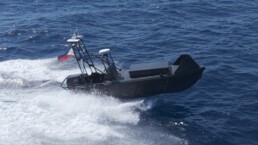

Earlier this year, Sea Machines conducted Tropical Winter 100, an autonomy sea trial involving the SELKIE unmanned surface vessel (USV) operating off Subic Bay in the West Philippine Sea.
The mission evaluated autonomous vessel / unmanned vessel operations in the same Indo-Pacific coastal environment where distributed maritime systems could be deployed. The operating area was later used in the distributed maritime autonomy vignette presented during Creative Disruptors in the Desert 2026, where U.S. Congressional and DOW stakeholders observed a mission scenario involving a forward-deployed unmanned surface vessel operating off the Philippine coast.
STRATEGIC CONTEXT IN THE WEST PHILIPPINE SEA
The West Philippine Sea forms part of the South China Sea, one of the most contested maritime regions in the Indo-Pacific. Coast guard patrols, maritime militia activity, and territorial disputes have increased demand for persistent maritime domain awareness across large coastal areas. For the United States and the Philippines, monitoring activity across these waters requires scalable systems capable of maintaining presence without expanding resources for crewed patrol fleets. Autonomous vesselsprovide a method for increasing range and extending persistent maritime coverage.
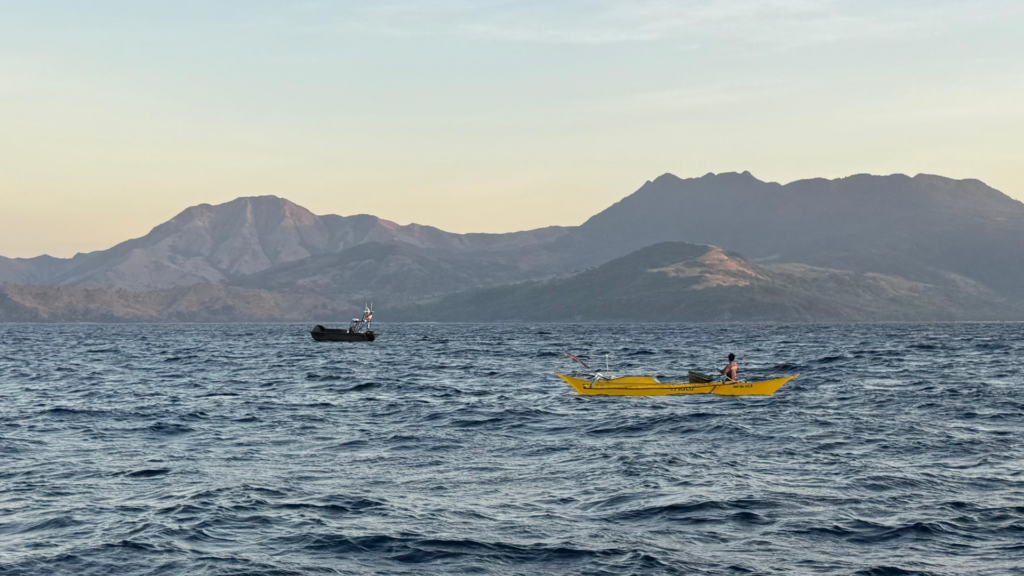
Unmanned Surface Vessel SELKIE operating in real-world maritime traffic off Botolan, Philippines.
TROPICAL WINTER 100 USV MISSION
Tropical Winter 100 evaluated SELKIE’s endurance, navigation performance, and autonomous vessel system operation during unmanned operations in Philippine coastal waters.
The mission followed a 100-nautical-mile unmanned route between Subic Bay and the west coast of Botolan. SELKIE departed Subic Bay as an unmanned surface vessel while operators monitored the vessel remotely through the autonomy interface located miles away in Olongapo.
Operating in Sea State 4, the autonomous vessel maintained a cruising speed of approximately 11 knots with sprint speeds of up to 30 knots, and completed the mission over roughly 13 hours. During the voyage the USV executed long range autonomous route following while autonomously tracking and trailing potential vessels of interest, in addition to obstacle detection, and collision avoidance while navigating through typical coastal vessel traffic near the approach to Subic Bay.
USV OPERATIONS IN THE INDO-PACIFIC
Tropical Winter 100 demonstrated how unmanned surface vessels can operate in real maritime traffic and environmental conditions in the Indo-Pacific. Conducted in the same waters later used during the Creative Disruptors in the Desert vignette, the mission showed how USVs can support persistent maritime domain awareness and distributed maritime operations in regions such as the West Philippine Sea.
WHAT’S NEXT
SELKIE will continue field demonstrations over the coming months, including integration of mission payloads, effectors, and command-and-control (C2) interfaces across customer use cases. These efforts are focused on expanding operational capability and validating system performance across a broader set of mission profiles.
For organizations evaluating unmanned surface vessel (USV) capability for maritime operations, Sea Machines is engaging with partners to demonstrate how autonomous vessel systems can be applied in operational contexts.



Related News.

Poland’s additional national requirements distort competition says Danish Shipping
Poland has introduced a national survey requirement for smaller foreign-flagged vessels operating in Polish waters. This creates significant…

Battery Vessels could help electrify most of Global Shipping Emissions
Battery-electric ships are economical only if the pack is cycled frequently, so they have been confined to short-sea, ferry and harbour vessels…

Mintra and Ledgid explore collaboration to connect Maritime digital identity, learning and workforce development
Mintra® and LEDGID are exploring opportunities to bring together complementary capabilities in digital learning, maritime training, professional…

World Shipping Council calls for global agreement on shipping emissions as industry investment surpasses $200 billion USD
The World Shipping Council (WSC) is calling on governments to agree on binding global greenhouse gas regulations for international shipping without…

What happened to the ITF whistleblower’s complaint?
In January 2026, a whistleblower complained that International Transport Workers’ Federation (ITF) General Secretary Stephen Cotton had manipulated…

Growing regulatory scrutiny puts seafarer wellbeing firmly on maritime safety agenda, VIKAND warns
Seafarer wellbeing is coming under greater regulatory scrutiny as international rules and guidance increasingly recognise crew health and welfare as…

Good Times Bad Times the Premium Stays with the Strait
In October, we wrote that if the transfer network off Oman kept pace, Gulf crude would carry China's refill and keep drawing tonnage east,…

Allied Weekly Market Review Week 47
Pls find below the Allied - Weekly Market Review - Week 47 ALLIED - Weekly Market Report- Week 47


Climate TRACE releases September 2026 Emissions Data
Climate TRACE reported that global greenhouse gas (GHG) emissions for the month of September 2026 totaled 4.7 billion tonnes CO₂e. This remains…
Subscribe to our newsletter!
if you dont want to swim alone in the ocean of news, sign up for the newsletter, and you will receive daily all the important news of world shipping!
