University College London and RAD publish definitive study on quiet electric marine technology
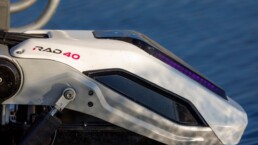

University College London has published a landmark peer-reviewed study confirming that RAD’s electric propulsion system dramatically reduces underwater noise compared to equivalent internal combustion engines, with reductions of up to 43 decibels . The research provides clear, scientific evidence that well engineered electric drives can significantly lower acoustic impact on marine life across a wide range of operating speeds.
The UK based electric marine propulsion company was proud to collaborate with the Department of Mechanical Engineering at UCL on the research paper to analyse underwater noise output. The paper, titled “A comparative study of underwater radiated noise from electric and conventional boats,” has been published in the Journal of the Acoustical Society of America (JASA) and represents one of the most comprehensive studies of its kind to date.
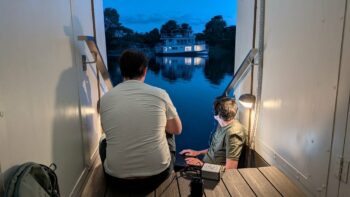
The collaboration began when UCL’s acoustic research team, led by Dr Tom Smith, approached the RAD team to conduct an underwater radiated noise (URN) trial comparing an equivalent powered conventional internal combustion engine (ICE) outboard with the RAD 40 electric outboard system. RAD supplied a pair of similar vessels for the initial trial, which took place on the River Hamble, in Hampshire, UK.
UCL observed that the RAD drive produced significantly lower underwater noise levels than anticipated, even noticeably quieter than any previously tested electric propulsion system, particularly across frequency ranges known to be most harmful to marine mammals. These initial findings prompted the commissioning of a second, more controlled trial.
To ensure maximum accuracy and reliability, a lake near Shrewsbury (UK) was selected to provide highly controlled testing conditions. Two identical boats, one fitted with a RAD 40 and one with an ICE outboard of the same power, were each tested over several days. UCL’s team, supported by RAD engineers, collected an extensive dataset including acoustic measurements from two hydrophones, high-speed underwater video footage, and airborne noise measurements across a range of speeds from four to 20 knots.
The controlled environment and extended testing period significantly improved the reliability of the results, ultimately providing conclusive evidence in support of the initial River Hamble findings.
“Small vessels are often overlooked when it comes to underwater noise, but they can be really loud. They also operate in many sensitive environments and so reducing this noise is critical. The results we obtained from the RAD drive were remarkable, particularly at low speed. It was also good to see that the high frequency electrical noise was much smaller than for some other systems, showing that this is a problem that can be fixed. Overall it’s a really positive result that will hopefully encourage greater uptake of this technology, particularly for operators in environmentally sensitive waters.” commented Dr Tom Smith, UCL Department of Mechanical Engineering.
The published paper delivers several significant findings with far-reaching implications for marine conservation and the wider electric marine industry:
43 dB quieter at low speed: At four knots, the RAD electric vessel produced a broadband source level 43 dB lower than the equivalent combustion engine vessel, a vast reduction that represents an enormous improvement in acoustic conditions for marine life at slow speeds where cavitation is minimal.
Lower noise across all tested speeds: The electric vessel produced lower broadband source levels across the entire speed range tested (four-20 knots). Even as cavitation became a factor at higher speeds, the RAD drive maintained a noise advantage over the combustion engine vessel.
Elimination of low-frequency combustion noise: Electric propulsion removes the low-frequency noise associated with internal combustion processes and exhaust gas expulsion through the propeller hub, a category of noise particularly damaging to low-frequency hearing specialists such as baleen whales.
Lower high-frequency motor noise than comparable systems: The high-frequency tonal noise produced by the RAD motor and power electronics was measurable but found to be lower than levels reported for other electric propulsion systems in previous studies, highlighting the importance of motor and power electronics design, and that not all electric drives are acoustically equal.
Benefits for a wide range of marine species: The research notes that electric propulsion offers particular advantages for species sensitive to low-frequency noise. For species with stronger high-frequency hearing capabilities, such as odontocete cetaceans and pinnipeds, managing cavitation noise at higher speeds remains an important consideration regardless of propulsion type.
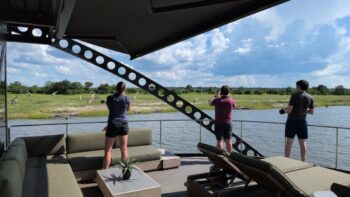
Building on the momentum of the controlled lake trials, the collaboration extended its reach to Namibia, where RAD-powered vessels were already in commercial operation on The Chobe River for Pangolin Photo Safaris, a leading photography safari company. The fleet included their houseboat, The Pangolin Voyager, fitted with four RAD 40 drives and an electric custom-built photo boat powered by a single RAD 40.
UCL used this unique opportunity to study the real world effects of underwater noise on local wildlife, including hippopotamuses, which are believed by some researchers to use a form of echolocation, though this remains unproven. Direct comparisons were made between the RAD powered hotel boat and hotel boats from other operators, again demonstrating a significant reduction in underwater noise from the RAD propulsion systems.
Commenting on the research, Peter Byford, chief technology officer said: “We have always believed that how an electric drive is engineered matters enormously, not just for performance, but for its true environmental benefit. This research validates that belief with rigorous science. We are incredibly proud to support UCL with the study and what it means for the future of quieter, more sustainable marine operations worldwide.”

The research team also wishes to acknowledge the significant contribution of Dr Charlotte Findlay at Heriot Watt University, whose expertise on the impacts of underwater noise on marine life has been central to understanding the real-world conservation benefits of these findings.
The study provides valuable insights for policymakers, conservationists, and the marine industry, reinforcing the importance of quieter technologies in preserving aquatic ecosystems.



Related News.

Navigating the Multi-Orbit Era: In Conversation with Intellian’s Jon Harrison at SMM 2026
At SMM 2026 in Hamburg, the rapid evolution of maritime satellite communications took centre stage. Across the exhibition halls, discussions among…

Cyprus ports need joint energy and investment strategy, shipping agents chief says
Cyprus needs a coordinated strategy for shipping, energy and environmental protection to support port investment and modernisation, Cyprus shipping…

MASO Public Affairs introduces MASO Regulatory Intelligence
A new subscription service helping businesses understand what is changing and what it means for them MASO Public Affairs introduces MASO Regulatory…

Anglo-Eastern helps turn CMBTECH’s ammonia ambition into an operational reality
From early feasibility study and risk-based design to newbuilding supervision, crew readiness and technical management, Anglo-Eastern drew on its…

Escalation of attacks threatens to derail recovery in Middle East oil exports
World oil demand is forecast to fall by 2.5 mb/d y-o-y in 4Q26 and 2.6 mb/d on average in 2026. As the Iran war manifests itself through restricted…

New study finds shipping pays twice its share to EU ETS earmarked revenues should triple to help build market for sustainable fuels and technologies
Shipping is responsible for around 10% of EU ETS emissions but pays almost 20% of the ETS bill. Unlike other sectors, it has never received free…

MSARC strengthens maritime mass rescue readiness through training and national live exercise off Dakar, Senegal
Joint MSARC–FHAS programme combines three days of SAR training with a national multi-agency live exercise The Maritime Search and Rescue Council ,…

Sogese report deliveries are still being delayed as container freight rates fluctuate
FOR IMPORTERS Spot rates into the Mediterranean are back at January levels, Far East to Europe reliability sits at pandemic lows, and nearly…

Glencore begins trading on Australian Securities Exchange
Glencore has begun trading on the Australian Securities Exchange under the ASX code GLC. Gary Nagle, Glencore’s CEO, said it was an exciting day for…

BIMCO Shipping Number of the Week
Suez Canal container ship transits exceed 50% of pre-disruption levels "During the first two weeks of October, weekly container ship capacity…
Subscribe to our newsletter!
if you dont want to swim alone in the ocean of news, sign up for the newsletter, and you will receive daily all the important news of world shipping!
