Uncertainty complicates efforts to prioritise shipping investments amid today’s decarbonisation regulations – yet delaying action is not a viable strategy, Wärtsilä survey finds

Shipping companies are entering a more complex and capital-intensive phase as decarbonisation regulations begin to translate emissions targets into direct operating costs and long-term investment pressure. This is according to a new global survey of senior maritime executives commissioned by technology group Wärtsilä.
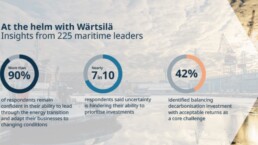
The study, based on responses from 225 maritime leaders, found that more than 90 percent of respondents remain confident in their ability to lead through the energy transition and adapt their businesses to changing conditions. At the same time, uncertainty around technology pathways, fuel availability, talent retention and regulatory developments is making strategic decision making more difficult. Nearly seven in ten respondents said uncertainty is hindering their ability to prioritise investments, while 42 percent identified balancing decarbonisation investment with acceptable returns as a core challenge. Despite these challenges, the report makes clear that delaying action is not a viable strategy. Rather than waiting for full regulatory or technological clarity, maritime leaders need to build flexibility and optionality into their investment plans – ensuring they can adapt as the transition progresses.
With measures, such as the European Union’s Emissions Trading System and FuelEU Maritime, turning emissions performance into a financial variable, the report highlights growing execution risk for vessel owners and operators. Investment timing, fuel choices, and asset utilisation are increasingly being determined under regulatory pressure, fluctuating fuel costs and evolving technology options. Missteps in these areas could affect long-term competitiveness and asset value.
The findings are outlined in Wärtsilä’s new report, At the helm in shipping – how to navigate regulation, risk and ROI, which examines how ship owners and operators are responding to increasing regulatory complexity and the pressure to balance compliance, investment and day-to-day operational demands.
The report highlights how long-term partnerships between operators and original equipment manufacturers can help reduce uncertainty by providing access to operational data, technical expertise and lifecycle insights. Such collaboration enables predictive maintenance and more data-driven asset management, helping to protect vessel performance and long-term asset value.
As environmental frameworks continue to evolve – and as emissions performance becomes more closely tied to commercial outcomes – improving vessel efficiency and operational performance will remain essential to managing both compliance risks and return on investment.
Roger Holm, President of Wärtsilä Marine and Executive Vice President at Wärtsilä Corporation, says: “Maritime leaders remain confident in their ability to adapt to the energy transition, but the decisions they face are becoming more complex. With tighter regulation and evolving fuel choices reshaping investment decisions, ship owners and operators cannot wait. They need to take proactive steps now – prioritising data, collaboration and future‑proof solutions to protect competitiveness over the long-term. Ultimately, the most resilient operators are those preparing for multiple pathways – creating flexibility today so they can respond quickly as the regulatory and fuel landscape develops.”



Related News.

Greece has the most to lose from delays in shipping’s green transition, new analysis finds
UCL and WWF Greece report finds the IMO Net-Zero Framework offers Greek ship owners the clarity they need, and the best protection against a…

Snow Land joins Cool Carriers as the world’s first reefer with a gate rudder, a new chapter for sustainable and efficient reefer shipping
Cool Carriers, the world’s largest operator of specialised reefer vessels, took delivery of Snow Land from Kitanihon Shipbuilding in Japan on 12…

IBIA launches Marine Energy Outlook Survey as Annual Convention in New York
IBIA - The International Bunker Industry Association officially launched its Marine Energy Outlook Survey during the IBIA Annual Convention in New…

Why did ITF staff vote to strike again?
Staff at the International Transport Workers’ Federation (ITF) headquarters in London have voted to give their union a strike mandate. According to…

Nearly half of maritime crew tickets booked a week ahead are cancelled
Two new C Teleport reports show when maritime and aircrew teams book crew flights, how often they cancel, and what late booking costs, with a…

Kpler completes $1.5bn+ Sixth Street investment and continues accelerating growth
Investment backs Kpler's bold ambition to shape the future of global trade intelligence. Kpler, a leading provider of global physical trade…

How SAL and DNV are strengthening heavy-lift shipping
From classification and newbuilding support to operational tools and advisory expertise, SAL and DNV have been collaborating for decades. The…

PSA Singapore breaks ground on Tuas Port Phase Two to strengthen Global Trade Connectivity
PSA Singapore marked the groundbreaking of Tuas Port Phase Two, a significant step in the development of the world’s largest fully automated…

 …

BIFA welcomes UK–EU trade progress and calls for clarity on implementation
The British International Freight Association (BIFA) has welcomed progress made at today's UK–EU Summit in Brussels, highlighting the potential…
Subscribe to our newsletter!
if you dont want to swim alone in the ocean of news, sign up for the newsletter, and you will receive daily all the important news of world shipping!
