“Seawing” automated kite system obtains third-party review certifications for tension performance from two classification societies
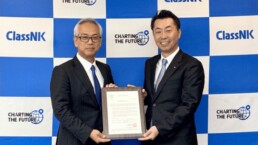

Kawasaki Kisen Kaisha announced that third-party reviews of the “Seawing” automated kite system, which utilizes wind power, being developed by OCEANICWING S.A.S. , a subsidiary of “K” LINE in France, have been successfully conducted by Bureau Veritas Marine & Offshore and Nippon Kaiji Kyokai, analyzing the tension performance of the system. OCEANICWING continues to conduct onshore and offshore demonstration experiments, moving toward the practical use of “Seawing” systems by around 2027.
About “Seawing”
Harnessing wind power, “Seawing” can be installed on any type of vessel, including existing vessels. It is expected that there will be synergy between “Seawing” and the efforts to transition away from conventionally used heavy fuel oil to other fuels such as liquified natural gas (LNG), and that the performance of “Seawing” will increase in terms of the reduction of CO2 emissions. Several wind-assisted propulsion systems (WAPS) are being developed, but compared to other WAPS, “Seawing” is able to generate a comparatively large amount of thrust using high-altitude wind.
Phase one of “Seawing” ’s development was completed in June 2025, and OCEANICWING verified the tension and performance of the “Seawing” system using a 300 m2 kite at an onshore test site. OCEANICWING has confirmed that the results of these tests have been good.*1
About the third-party reviews
BV and ClassNK based their reviews on the test results obtained during phase one of the development project, and they confirmed the appropriateness of the validation process used in the demonstration tests with the 300 m2 kite. In the reviews, it was confirmed that the theoretical tension from the 300 m2kite used in phase one of the development project is 25 tons, and if the size of the kite were doubled to 600 m², it is expected the theoretical tension would also double to 50 tons. This can be validated through further testing.
This 50-ton tension is equivalent to the towing force of a typical tugboat.*2 The tension generated by “Seawing” will depend on wind conditions, but it is expected that it will achieve an annual average fuel consumption reduction of more than 10% for large bulk carriers.
Actual energy savings will vary depending on ship type, speed, route and season. In certain combinations of these factors, fuel consumption may be reduced by significantly more than 10%.
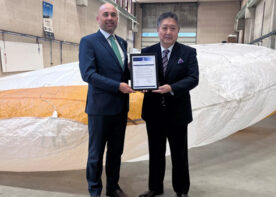
Left: Julien Boulland, Sustainability Strategy Leader, Bureau Veritas Marine & Offshore
Right: Shingo Kameyama, CEO, OCEANICWING
Future of the project
“Seawing” has now entered phase two of its development, in which OCEANICWING will increase the size of the kite and verify the operability and safety of the “Seawing” system at its onshore test site, in preparation for the shipboard use of the system. OCEANICWING will also conduct offshore demonstration experiments using a large bulk carrier owned and operated by “K” LINE to verify tensile strength and reliability. The goal is to complete the tests by around 2027 and move toward the practical use of “Seawing”.
Comment from the Board of Directors
Takenori Igarashi, the President & CEO of “K” LINE, said, “ “Seawing” ’s effectiveness has been reviewed by BV and Class NK, who are third parties. It has been confirmed that by increasing the size of the kite, it is theoretically possible to achieve significant tension that will result in the reduction of fuel consumption by more than 10%. We will continue to develop the system so that it can be used on ships. We plan to develop this innovative energy saving device that harnesses wind power into a great solution that helps achieve the decarbonization of the shipping industry.”
The “K” LINE Group will continue to work to contribute to the sustainable development of society and the economy and increase its corporate value based on “K” LINE Environmental Vision 2050, the Group’s long-term environment management vision, as it moves toward 2050. “K” LINE will maximize the use of wind, a renewable source of energy, in the propulsion of the vessels to contribute to the low-carbon initiatives of not only “K” LINE, but also “K” LINE’s customers and society as a whole.



Related News.

Poland’s additional national requirements distort competition says Danish Shipping
Poland has introduced a national survey requirement for smaller foreign-flagged vessels operating in Polish waters. This creates significant…

Battery Vessels could help electrify most of Global Shipping Emissions
Battery-electric ships are economical only if the pack is cycled frequently, so they have been confined to short-sea, ferry and harbour vessels…

Mintra and Ledgid explore collaboration to connect Maritime digital identity, learning and workforce development
Mintra® and LEDGID are exploring opportunities to bring together complementary capabilities in digital learning, maritime training, professional…

World Shipping Council calls for global agreement on shipping emissions as industry investment surpasses $200 billion USD
The World Shipping Council (WSC) is calling on governments to agree on binding global greenhouse gas regulations for international shipping without…

What happened to the ITF whistleblower’s complaint?
In January 2026, a whistleblower complained that International Transport Workers’ Federation (ITF) General Secretary Stephen Cotton had manipulated…

Growing regulatory scrutiny puts seafarer wellbeing firmly on maritime safety agenda, VIKAND warns
Seafarer wellbeing is coming under greater regulatory scrutiny as international rules and guidance increasingly recognise crew health and welfare as…

Good Times Bad Times the Premium Stays with the Strait
In October, we wrote that if the transfer network off Oman kept pace, Gulf crude would carry China's refill and keep drawing tonnage east,…

Allied Weekly Market Review Week 47
Pls find below the Allied - Weekly Market Review - Week 47 ALLIED - Weekly Market Report- Week 47


Climate TRACE releases September 2026 Emissions Data
Climate TRACE reported that global greenhouse gas (GHG) emissions for the month of September 2026 totaled 4.7 billion tonnes CO₂e. This remains…
Subscribe to our newsletter!
if you dont want to swim alone in the ocean of news, sign up for the newsletter, and you will receive daily all the important news of world shipping!
