Maritime Defense Weekly: Maritime enforcement accelerates across Global Energy Routes Enforcement is expanding beyond a single Theater

Western maritime enforcement is no longer confined to designation, monitoring, or administrative friction. Recent activity indicates a growing reliance on physical constraints at sea, including boardings, safety-based interventions, and access denial, applied across multiple regions rather than within a single sanctions theater.
This approach shifts how risk manifests for vessels operating in gray or illicit networks. Exposure is no longer defined solely by sanctions status, but by whether a vessel can withstand scrutiny when challenged on flag legitimacy, insurance coverage, safety compliance, or ownership transparency. Vessels that rely on obscurity, dormancy, or regulatory ambiguity are increasingly vulnerable once they enter high-consequence maritime environments.
Dormancy, Reflagging, and Interdiction in the Pacific
In January 2026, French naval forces interdicted a 41-meter pontoon vessel carrying illicit drugs in French Polynesian waters. Operating under the name RAIDER and sailing under the Togo flag, the vessel’s significance lay primarily in its historical behavior rather than the interdiction itself.
RAIDER disappeared from tracking in August 2021 while operating in the Honduras EEZ and remained dormant for more than four years. When it resurfaced on November 13, 2025, it did so with a new name, a new MMSI, and a new flag (Togo). Within weeks, its altered identity, pattern-of-life deviations, and weak ownership signals had elevated its risk profile. By November 29, 2025, it was flagged by Windward as a Moderate Risk for Border Security. The vessel later crossed the Panama Canal for the first time and continued into the Pacific, where it was interdicted on January 16.
The case shows why historical vessel behavior now matters as much as real-time signals. Vessels that disappear, reflag, and quietly re-enter traffic are no longer invisible once their full movement and identity history is assessed. Interdiction is increasingly the result of accumulated behavioral risk, not a single aumonolous act, meaning past dormancy and identity cahnge can be decisive long before any overt violation occurs.
Safety Failures as an Enforcement Pathway
Chariot Tide (IMO 9323376), a sanctions-linked tanker that signaled “not under command” for nearly 72 hours near the Strait of Gibraltar, illustates how safety sailures are now becoming enforcement triggers. The vessel exhibited prolonged low-speed deviation outside standard traffic patterns and was accompanied by tug activity in a congested and environmentally sensitive corridor.
Reported operation under a fraudulent Mozambique registry immediately raised questions around flag legitimacy, insurance validity, and liability should the situation escalate into collision, grounding, or pollution. In such contexts, routine safety governance becomes inseparable from enforcement pressure. When a vessel cannot credibly demonstrate compliance, assistance itself becomes a risk event for surrounding states, ports, and operators.
Operational fragility is now enough to create exposure for shadow fleet vessels, even without a deliberate interdicition decision. Mechanical failure and regulatory noncompliance are increasingly sufficient to draw scrutiny and force intervention in high-consequence maritime corridors.
Strait of Hormuz Risk Without Physical Disruption
Oil markets reacted sharply this week to Iranian warnings of upcoming military drills in the Strait of Hormuz, despite the absence of confirmed disruption to maritime traffic. Brent crude rose above $71 per barrel, up nearly $3 intraday, following reports that Iran intends to conduct live-fire exercises in the strait, a corridor through which approximately 20% of global oil flows.
The reaction reflects sensitivity to risk rather than operational change. Tensions escalated after President Trump warned publicly that a “massive armada” was heading toward Iran, while Iran’s drill notice – first reported by EOS Risk Group and confirmed by Pakistani military officials – fueled market concern.
Operational indicators have not shifted. As of January 29, the JMIC, UKMTO, and U.S. Fifth Fleet had issued no alerts or navigational warnings, and Windward’s Maritime AI™ shows 54 tankers over 160 meters signaling in the strait the same day, consistent with baseline traffic.
The signal remains one of price volatility driven by threat perception, not constrained access. The inflection point to watch is a transition from rhetoric to incidents that materially affect navigation or vessel safety.
The Baltic Is Tightening Around High-Risk Vessels
The UK and several European states have announced measures that will effectively restrict Baltic transit for “unsafe vessels,” a category that in practice captures much of the dark fleet. The Baltic is shifting from a permissive transit zone to a conditional access environment.
The requirements are structural, not procedural. Vessels are expected to maintain continuous AIS and LRIT transmission, carry valid insurance and flag-state documentation, comply with MARPOL rules for ship-to-ship (STS) transfers, maintain SOLAS-level safety certifications, and communicate consistently with VTS and reporting systems. These are conditions that many sanctioned or falsely flagged vessels cannot meet by design.
The exposure is substantial. Over the past 180 days, Windward has tracked 337 fraudulent-flag or dark fleet vessels transiting the Baltic nearly 10,000 times. With roughly 50% of Russia’s oil exports moving through Baltic routes, enforcement consistency will determine whether these measures function as effective access controls rather than symbolic restrictions. These measures coincide with sustained pressure on Venezuelan and Iranian oil flows, reinforcing that enforcement activity is no longer compartmentalized by theater but increasingly cumulative across global energy routes.
Recent UK signaling around inspections and boardings suggests these standards are intended to be enforced operationally, not merely declared, aligning London more closely with France’s demonstrated willingness to act. Russia’s response – including potential naval protection, rerouting, or escalation – will be a key variable shaping the next phase.
Russia’s Response as a Developing Variable
Despite increased pressure on Russia-linked maritime activity, Moscow has thus far avoided overt retaliation. The absence of an immediate response suggests a preference for limiting escalation that could further harden Western enforcement posture.
However, there have been recent hints of a shift toward direct naval protection, escorted lift, or structured route substitution that would materially alter the operating environment. Such a move would raise the stakes for high-seas interdictions, encourage redistribution through blending and ship-to-ship transfer models, and complicate escalation management for enforcement authorities. The trajectory of Russian response will likely shape the next phase of maritime risk more than interdiction volume alone.
Source: Windward



Related News.
Intelligent Skies, Secure Seas: Navigating Connectivity, Cyber Resilience, and AI Liability at the 5th CSN Greece ICT Conference
The 5th CSN Greece ICT Conference, held on 19th November 2026 at the Ploes Floating Venue in Paleo Faliro, Athens, successfully convened maritime…

EU moves to ban tankers insured in Russia, repair services at Russian refineries
EU targets Russian-insured tankers, refineries Von der Leyen announces 22nd sanctions package All 27 member states must approve new…
IMO tackling fraudulent registries together
Strong national systems and international information sharing are crucial to tackling fraudulent registries and fraudulent ship registration…
Open letter on freedom of navigation and the protection of seafarers
Dear High Representative Kallas, Dear Foreign Affairs Ministers, European Shipowners | ECSA, BIMCO, the Cruise Lines International Association…

Davies Turner warns of Rising Asia-UK Container Disruption and European Port Congestion
Davies Turner, one of the UK’s largest independent freight forwarding and logistics companies, says that disruption to container shipments from Asia…
Disruptions still dominate tanker market outlook
"This year, tanker markets have been affected by disruption to transits through the Strait of Hormuz, the Houthi blockade of Saudi Arabian Red Sea…
Panama’s President called on to match COP31 Heroism with action at shipping climate talks
As a series of crucial meetings tasked with cutting greenhouse gas emissions from global shipping takes place this week and next, environmental NGOs…

Trafigura appoints Helio Cumbi as Executive Director, Mozambique
Trafigura has appointed Helio Cumbi as Executive Director, Mozambique, and Business Development Lead for East and Southern Africa Oil. Helio is a…

“K” LINE holds FY2026 Global Dry Bulk Meeting
Kawasaki Kisen Kaisha, announces that it held a global meeting for its dry bulk business at the company’s head office on November 9 and 10. The…
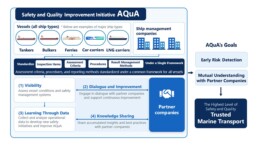
MOL launches ‘AQuA’ safety and quality improvement initiative
Standardizing Group-wide Safety and Quality Assessment Criteria to Enhance Vessel Safety and Quality Mitsui O.S.K. Lines, announced the launch of…
Subscribe to our newsletter!
if you dont want to swim alone in the ocean of news, sign up for the newsletter, and you will receive daily all the important news of world shipping!
