Shipbuilder develops generators for remote operations
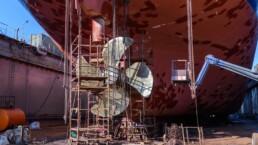

Engineers at China State Shipbuilding Corporation, the world’s largest shipbuilder, have used their expertise in ship propulsion systems to develop a portfolio of portable power generators suitable for emergency response and field operations in remote areas.
Luan Yongjun, a project manager at Harbin Marine Boiler and Turbine Research Institute, a CSSC subsidiary based in the capital of Heilongjiang province, said that engineers have used their knowledge and experience in marine gas turbines to advance the research and development of mobile power stations.
A gas turbine is a type of internal combustion engine that uses compressed gas to generate mechanical energy. An internal generator connected to the shaft of the turbine converts that energy into electrical power.
Luan said the Harbin institute started developing mobile gas turbine generators, especially high-capacity ones, several years ago in an attempt to end the absolute dominance of foreign manufacturers in the domestic market.
“These machines were needed for fieldwork and emergency response operations. At that time, only a handful of enterprises in the United States and Germany were able to build them,” he said.
After years of effort, engineers at the institute overcame a host of technical difficulties to build high-performance mobile gas turbine generators with a wide range of power outputs.
One of the institute’s gas turbine generator models, with a power output of 25 megawatts, has been sold to a foreign country and has accumulated about 80,000 operational hours, according to the project manager.
“Our mobile power stations can be transported by road, rail, air and sea, and can be deployed in plateaus, mountainous areas and islands, promising users exceptional operational flexibility,”Luan said.
Engineers conducted a full-system trial run of the 25 MW machine in Harbin before delivering it to the foreign client, and the results show that it works very well even in extremely cold conditions.
“These portable machines feature modular designs and compact structures, occupying on average less than 20 percent of the floor space taken by conventional fixed power stations. They also have the advantage of rapid start and load adjustment, which allows operators to deliver power to users within a short time once the demand arises,”Luan said.
He pointed out that these mobile power stations can be used for many purposes such as emergency rescue and disaster relief, resource exploration, building construction and power grid peak regulation.
“A 25 MW machine is capable of powering about 50,000 households in a township for a certain period of time,” Luan said.
This range of machines can also provide emergency backup power for data centers in various industries, including telecommunications and banking, or give backup power support to large-scale conferences and sports events, he said.
In case of emergencies, such as a sudden power outage or an electrical failure, the mobile gas turbine generators can respond quickly to ensure uninterrupted electricity supply for critical equipment and premises, effectively avoiding negative impacts and heavy losses, Luan said.
For areas with unstable power supply or significant power shortages, the machines can serve as a supplementary source of electricity to buffer local power supply pressures, he added.
Source: China Daily



Related News.

Poland’s additional national requirements distort competition says Danish Shipping
Poland has introduced a national survey requirement for smaller foreign-flagged vessels operating in Polish waters. This creates significant…

Battery Vessels could help electrify most of Global Shipping Emissions
Battery-electric ships are economical only if the pack is cycled frequently, so they have been confined to short-sea, ferry and harbour vessels…

Mintra and Ledgid explore collaboration to connect Maritime digital identity, learning and workforce development
Mintra® and LEDGID are exploring opportunities to bring together complementary capabilities in digital learning, maritime training, professional…

World Shipping Council calls for global agreement on shipping emissions as industry investment surpasses $200 billion USD
The World Shipping Council (WSC) is calling on governments to agree on binding global greenhouse gas regulations for international shipping without…

What happened to the ITF whistleblower’s complaint?
In January 2026, a whistleblower complained that International Transport Workers’ Federation (ITF) General Secretary Stephen Cotton had manipulated…

Growing regulatory scrutiny puts seafarer wellbeing firmly on maritime safety agenda, VIKAND warns
Seafarer wellbeing is coming under greater regulatory scrutiny as international rules and guidance increasingly recognise crew health and welfare as…

Good Times Bad Times the Premium Stays with the Strait
In October, we wrote that if the transfer network off Oman kept pace, Gulf crude would carry China's refill and keep drawing tonnage east,…

Allied Weekly Market Review Week 47
Pls find below the Allied - Weekly Market Review - Week 47 ALLIED - Weekly Market Report- Week 47


Climate TRACE releases September 2026 Emissions Data
Climate TRACE reported that global greenhouse gas (GHG) emissions for the month of September 2026 totaled 4.7 billion tonnes CO₂e. This remains…
Subscribe to our newsletter!
if you dont want to swim alone in the ocean of news, sign up for the newsletter, and you will receive daily all the important news of world shipping!
