Demands of AI supercycle spur cross-industry consensus to evolve US and European network infrastructure – new study


- New research commissioned by Nokia surveying more than 2,000 technology and business decision-makers in the U.S. and Europe shows strong demand for AI solutions – and a clear industry consensus that connectivity and network infrastructure must evolve to support the next wave of AI growth.
- In the U.S., 88% of telecommunications providers and enterprises said that infrastructure limitations could restrict future AI scaling, with 78% of respondents in Europe voicing the same concern.
- Findings point to a shared transatlantic opportunity for industry and policymakers to modernize networks together and ensure the U.S. and Europe fully capture the benefits of the AI supercycle.
An overwhelming majority of technology and business leaders in the U.S. and Europe believe that current networks will require substantial evolution and investment to meet the demands of the AI supercycle, according to research commissioned by Nokia and released today. The research surveyed around 2,000 technology and business decision-makers in the U.S. and Europe, including telecommunication and data center infrastructure providers, as well as businesses and organizations planning to adopt and integrate AI into their operations.
The findings highlight a shared recognition across the connectivity ecosystem that next-generation network capabilities are essential and must modernize to support increasingly complex AI workloads. This presents an opportunity for collective action across industry and government to strengthen the digital foundation on which future AI innovation depends.
“The first wave of the AI supercycle has already reshaped industries and accelerated innovation. This research shows a clear understanding across the ecosystem that future waves will demand more advanced, AI-native networks and substantial investment to strengthen network requirements. Connectivity, capacity, and low-latency performance are becoming ever more essential ingredients for transforming how devices interact, industries operate, and people live and experience technology as AI moves forward,” said Pallavi Mahajan, Chief Technology and AI Officer, Nokia.
The research explains why this evolution matters, with AI redefining network requirements: workloads are becoming more uplink-heavy, data flows are more distributed, and expectations around latency, throughput, resilience, security, and energy efficiency are rising. These changes carry implications not only for telecommunication providers, AI and cloud providers, and mission-critical enterprises, but for national competitiveness and long-term digital leadership.
AI applications – from autonomous vehicles and smart manufacturing lines to surveillance drones and remote health care diagnostics – generate large volumes of data at the edge that must be transmitted upstream for processing, making them uplink-intensive. This stresses today’s networks, which were originally engineered for downlink-focused consumer use, such as browsing websites and video streaming.
Nokia is encouraging collaboration across the network ecosystem and support for more simplified and predictable regulatory environments that enable timely network investment. The research commissioned by Nokia includes perspectives from operators, enterprises, and partners about the capabilities they need from next-generation infrastructure to scale AI effectively. The research is broken down into separate geographic reports.
United States
While the U.S. continues to lead global AI deployment and mass-market adoption, 88% of U.S. respondents expressed concern that the expansion of network infrastructure may not keep pace with AI investment.
Respondents identified bi-directional data flow optimization, expanded fiber capacity, real-time training feedback, and low-latency edge infrastructure as essential priorities and building blocks for modernizing network architecture and powering the next phase of AI growth.
The U.S.-focused report, “Infrastructure First Is the New America First”, can be found here.
Europe
In Europe, 86% of enterprise respondents said current networks are not yet equipped to handle widespread AI adoption. Two-thirds of those surveyed said they already have AI in live use, and more than half have already experienced challenges such as downtime, latency, and throughput constraints associated with increasing data demands.
To address these challenges, respondents emphasized the need for consistent regulatory simplification and alignment across markets, timely spectrum availability, adjustments in competition policy to enable market consolidation, and industry-wide investment in energy-efficient, AI-ready networks.



Related News.

Navigating the Multi-Orbit Era: In Conversation with Intellian’s Jon Harrison at SMM 2026
At SMM 2026 in Hamburg, the rapid evolution of maritime satellite communications took centre stage. Across the exhibition halls, discussions among…

Cyprus ports need joint energy and investment strategy, shipping agents chief says
Cyprus needs a coordinated strategy for shipping, energy and environmental protection to support port investment and modernisation, Cyprus shipping…

MASO Public Affairs introduces MASO Regulatory Intelligence
A new subscription service helping businesses understand what is changing and what it means for them MASO Public Affairs introduces MASO Regulatory…

Anglo-Eastern helps turn CMBTECH’s ammonia ambition into an operational reality
From early feasibility study and risk-based design to newbuilding supervision, crew readiness and technical management, Anglo-Eastern drew on its…

Escalation of attacks threatens to derail recovery in Middle East oil exports
World oil demand is forecast to fall by 2.5 mb/d y-o-y in 4Q26 and 2.6 mb/d on average in 2026. As the Iran war manifests itself through restricted…
New study finds shipping pays twice its share to EU ETS earmarked revenues should triple to help build market for sustainable fuels and technologies
Shipping is responsible for around 10% of EU ETS emissions but pays almost 20% of the ETS bill. Unlike other sectors, it has never received free…

MSARC strengthens maritime mass rescue readiness through training and national live exercise off Dakar, Senegal
Joint MSARC–FHAS programme combines three days of SAR training with a national multi-agency live exercise The Maritime Search and Rescue Council ,…
Sogese report deliveries are still being delayed as container freight rates fluctuate
FOR IMPORTERS Spot rates into the Mediterranean are back at January levels, Far East to Europe reliability sits at pandemic lows, and nearly…

Glencore begins trading on Australian Securities Exchange
Glencore has begun trading on the Australian Securities Exchange under the ASX code GLC. Gary Nagle, Glencore’s CEO, said it was an exciting day for…
BIMCO Shipping Number of the Week
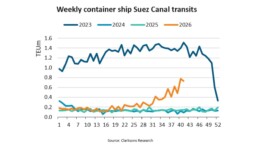
Suez Canal container ship transits exceed 50% of pre-disruption levels "During the first two weeks of October, weekly container ship capacity…
Subscribe to our newsletter!
if you dont want to swim alone in the ocean of news, sign up for the newsletter, and you will receive daily all the important news of world shipping!
