Andaman discovery injects new hope into India’s deepwater exploration sector


India’s latest gas discovery in the under-explored Andaman-Nicobar Basin could prove to be a valuable stepping stone towards increased domestic upstream production and greater energy security for the country – but whether the basin can become a significant contributor to India’s domestic gas supply and pull in more long-term national and international oil company interest will hinge on several factors, not least the size of the reserves.
India’s latest gas discovery in the under-explored Andaman-Nicobar Basin could prove to be a valuable stepping stone towards increased domestic upstream production and greater energy security for the country – but whether the basin can become a significant contributor to India’s domestic gas supply and pull in more long-term national and international oil company interest will hinge on several factors, not least the size of the reserves. The presence of hydrocarbons within the Oil India-led Sri Vijayapuram-2 well in the Andaman deepwater region was confirmed at last week’s Basin Analysis conference in Mumbai.
The well – part of a three-well exploration campaign that Oil India kickstarted last year within Andaman Block AN-OSHP-2018/1, awarded under the Open Acreage Licensing Policy (OALP) Bid Round II in 2019 – was drilled on the east coast of the Andaman Islands at a water depth of 295 meters and to a target depth of 2,650 meters. Hardeep Singh Puri, India’s Minister of Petroleum and Natural Gas, also confirmed that “initial production testing of the well in the range of 2,212 to 2,250 meters has established the presence of natural gas with intermittent flaring, with approximately 87% methane”.
This deepwater discovery and Oil and Natural Gas Corporation’s (ONGC) dual announcement last year – Konark and Utkal in the Mahanadi Basin, off the east coast of India – signal the maturing of India’s offshore exploration efforts, reflect policy success, collaborative efforts from governing bodies such as the Ministry of Petroleum and Natural Gas, the Directorate General of Hydrocarbons (DGH), and the national oil companies (NOC). However, how transformative these discoveries become will depend on the size of the reserves, how fast they can be developed, cost, environmental management, and how they fit within India’s long-term energy-transition strategy.

This new gas discovery in the Andaman basin could be transformative, both for the basin itself and for India’s broader energy strategy, as the country undertakes Prime Minister Narendra Modi’s ‘Samudra Manthan’ (‘Churning of the Ocean’) mission – an initiative to explore the unexplored deepwater oil and gas potential. The Andaman deepwater region, which includes many others such as Krishna-Godaveri and Mahanadi, remains under-explored primarily due to associated costs and technical challenges, and it is significantly crippled by the lack of high-quality deepwater seismic data. Despite its geological promise, and significant discoveries in the analogue basins, the Andaman-Nicobar Basin has seen only a handful of exploration wells over several decades. The sparse drilling activity underscores the historically limited industry interest, with operators reluctant to commit capital in the absence of proven success. This lack of sustained well campaigns highlights the basin’s frontier status and the cautious approach companies have taken toward its exploration.

However, the announcement of this discovery will help validate the hydrocarbon potential of India’s deepwater region and encourage further investments and exploration drilling, likely triggering the development of new offshore infrastructure, including production platforms, pipelines and possibly floating liquefied natural gas (LNG) facilities. This could turn the basin into a significant contributor to India’s domestic gas supply, but it remains to be seen whether the size of the reservoir and its production potential will make it economically viable.
As domestic production continues to slump, new gas discoveries are increasingly critical to India’s energy landscape. They offer a pathway to enhanced energy security, economic growth and a smoother transition to a low-carbon future – but, more importantly, can help move the country transition from its heavy reliance on imports. Moreover, natural gas serves as a relatively cleaner fossil fuel, supporting the country’s climate goals by enabling a shift away from coal in power generation and industrial use. Additionally, for a nation heavily dependent on its NOCs, the establishment of deepwater potential combined with relevant fiscal terms could help stimulate investment in infrastructure, technology, and offshore exploration, primarily attracting international oil companies (IOC) to invest in the nation’s under-explored basins.

Deepwater exploration is technologically demanding and capital-intensive, therefore continuous efforts by the NOCs could help attract IOCs with better technologies, which in turn could accelerate discovery and extraction. Additionally, the Andaman find will likely spur more high-quality 3D seismic surveys and exploration drilling, not just in the Andaman-Nicobar Basin but in other under-explored deepwater areas and help ramp up the country’s reserves base. Nonetheless, above-ground risk such as environmental challenges will play a key role as deepwater operations and exploration offshore Andaman-Nicobar will need to carefully manage environmental risks, including impacts on marine ecosystems, potential spill risks and greenhouse gas implications. Hence, beyond a supply of energy, the new gas reserves could provide a strategic buffer, strengthen negotiating power in global markets, and support industrial growth by ensuring stable feedstock for industrial growth and stable domestic supplies, laying the foundation for sustainable, secure and economically efficient energy development.
India continues to see a growing interest from IOCs – showcased by the July 2025 memorandum of understanding (MoU) between ONGC and BP to collaborate on drilling stratigraphic wells in the Indian offshore sedimentary basins of Andaman, Mahanadi, Saurashtra and Bengal – aiming to enhance geological understanding and unlock untapped hydrocarbon potential, thereby strengthening the country’s long-term energy security. As such partnerships continue to mature, announcements of new discoveries could act as a catalyst for an influx of foreign investments. However, India’s dependence on its NOCs, such as ONGC and Oil India, is undeniable and will continue to be a defining feature of its energy sector. Enticing IOCs to actively engage in exploring the nation’s frontier basins will require a significant upgrade in the regulations and transparency in data sharing so, until then, these NOCs will remain indispensable partners in securing the country’s hydrocarbon future, even as collaborations with private and foreign entities expand.
Source: Rystad Energy



Related News.

The Swedish Club marks official opening of New York office
The Swedish Club has officially opened its new office in New York City, marking an important step in the Club’s continued development across the…
Port of Long Beach breaks all-time cargo record in September
The Port of Long Beach achieved its busiest month in its 115-year history by moving nearly 1 million container units in September, a milestone fueled…

TD34 Forward Freight Agreement trades outpace TD3C in debut week as market seeks greater Gulf freight cover
The launch of the Forward Freight Agreement for the Baltic’s TD34 route by Intercontinental Exchange (ICE) has seen near-record volumes since its…
Black Sea Steel Flows Weaken as Shipping Risks Rise
Recorded Black Sea steel loadings declined sharply in Q3 2026. Volumes, including scrap, fell 65.6% y/y to 0.65 Mt across 51 voyages, compared with…
Fincantieri accelerates Robotics and Physical AI to Build the Shipyard of the Future
Fincantieri, a global leader in high-complexity shipbuilding, is accelerating the transformation of its shipyards through the integration of…

Advanced Navigation is bringing the World’s Most Complex Navigation Technology to Huntsville, Alabama
The race to deploy autonomous systems is exposing a critical constraint: production of the vital navigation technology required is not keeping pace…

GT Wings expands product range with launch of new lightweight AirWingTMS to reduce emissions for smaller vessels
GT Wings has announced the latest addition to its wind- assisted propulsion product range, AirWingTMS, a new compact and lightweight Jet Sail…
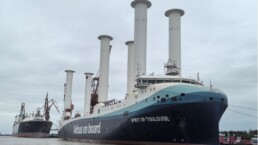
LD Armateurs’ world’s largest wind-propelled cargo vessel fitted with Norsepower Rotor sails™
LD Armateurs and Norsepower are proud to announce the completed installation of six Norsepower Rotor Sails™ on board Spirit of Toulouse, the lead…
DEME wins contract for wind turbine installation at the Zeevonk Offshore wind farm
DEME has signed a sizable1 contract for the transportation and installation of 69 wind turbines at the Zeevonk offshore wind farm in the…
MOL Group inaugurated its first biomethane plant in Szarvas
MOL Group has inaugurated its first biomethane plant in Szarvas. As a result of the investment of more than HUF 2.7 billion, the facility can now…
Subscribe to our newsletter!
if you dont want to swim alone in the ocean of news, sign up for the newsletter, and you will receive daily all the important news of world shipping!
