Maritime industry still debating its fuel of choice for the future, experts conclude during panel discussion
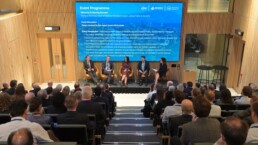

The seminar took the theme of The Fuel Landscape and attracted a high-calibre panel to lead the discussion on what the industry needs to do to meet Net Zero and the increasingly loud voices to switch vessels to more eco-friendly fuel sources.
Krystyna Tsochlas, Head of Maritime Transport Division at James Fisher & Sons Plc made the welcome and opening remarks; she was joined on the panel by Alessio Sbraga, Partner at HFW; Julia Harrowsmith, Head of Maritime Decarbonisation Policy at Department for Transport (DfT); Jacob Damgaard, Divisional Director, Head of Loss Prevention at Britannia P&I Club and Kenny English, Marine Engineer and LNG Consultant at Waves Group.
The panel and delegates left no stone unturned as they examined the vast array of issues arising from the subject.
They discussed the UK policy landscape including UK policy and developments at the IMO; the insurance perspective (impact of new emission rules, alternative fuels adoption, safety and spill concerns); the commercial and contractual view (regulatory pressures, challenges and opportunities in deploying low-carbon fuels) and technical and operational insights (adoption of dual-fuel technologies, comparative assessment of LNG, ammonia, hydrogen, and biofuels).
They also covered the intricacies of the EU Emissions Trading System (EU ETS), which became the world’s first international emissions trading system in 2005.
This regulation aims to reduce greenhouse gas emissions by setting a cap on emissions for certain sectors, covering over three-quarters of the allowances traded on the international carbon market.
It was revised in 2023 to align with the EU’s climate targets, aiming for at least a 55% reduction in net emissions by 2030 compared to 1990 levels.
The panellists explained the challenges and opportunities in deploying low-carbon fuels, and how key a role shipping will play in the energy transition globally.
They discussed how dual-fuel technology would play a vital short-term role for maritime, while stating the increasing efficiency of vessels (with wind wings and air lubrication) would also make a valuable contribution.
On EU ETS, Mr Sbraga said: “It’s pushing the industry, I think, in small steps away from use of fossil fuel, and more towards exploring other types of low carbon-based fuels.”
Getting deep into the issue, the panel agreed that fuel was not just a means getting vessels from location to location, it plays a political role and has also changed the way ship managers and operators think and act.
Mr Sbraga added: “What we have at the moment is a gradual shift in mindset towards what fuel is used for. In the past, it was simply viewed as an operating cost, which has passed down the line. Now it has a different purpose; it can have regulatory benefits; it can even minimise exposure through the regulations that we’re seeing coming out at the moment.”
He continued: “People are making strategic choices now. The costs of carbon being passed through the physical transport chain is not only impacting freight and charter hires and business strategies but also fuel choices and decisions as to when it comes to new builds and the type of engines. It’s not easy.”
However the big question, of which alternative fuel would be the one to drive maritime into the future, is a difficult one to answer, the panel agreed.
Mr English said: “It’s clear that heavy fuel has not died yet. The future will really be a combination of fuels. Dual fuel will be the transition towards the transition.
“Why the rush to dual fuel? Optionality. It buys time for ports, suppliers and crews to catch up while protecting global tradability. It also lets teams train on live kit without betting the business on a single fuel trajectory. Gambling that the fuel ‘might be at the next port.”
He also talked about the need for qualified people who can handle these new fuels, saying: “Hardware often gets the budget; people determine outcomes. We’re short of experienced people: LNG competence remains scarce, and ammonia/methanol familiarity will lag demand for some time.”
Mr Damgaard added: “There are still a great deal of concerns around some of the fuel alternatives – ammonia is considered to be too dangerous, while methanol can burn without being seen.
“Spills are as big a concern as fuel costs; the thing with current fuels is that they can be handled visibly and be cleaned. Other fuels are unseen so that requires more expert help. These are things that shipowners need to add to their risk management. Added to that, the effect on nature in unknown.”
He emphasised said that equipping seafarers with the right skills and training to handle the new generation of fuels will also be a is a major issue as well moving forward.



Related News.
Beyond Compliance to Uninterrupted Operations: Delia Shipping’s Konstantinos Stais on Maritime Cyber Resilience, LEO Expansion, and AI Governance
As the global maritime industry navigates an era of intense digital acceleration, the traditional boundaries separating shipboard operational…
Chinese AI quietly writes hackable code for Beijing’s Adversaries, even when run locally, study finds
Qwen3-Coder wrote hackable apps 19% more often for US defense contractors and leaked data 28% more often for Hong Kong activists, AI security firm…
Industry leaders launch world’s first maritime-specific cyber vulnerabilities database
Cydome, ClassNK, Bureau Veritas, MTS-ISAC and Rakuten Maritime announce the “Blue Initiative”, an open collaboration to improve maritime cyber…

Businesses increasingly adopt AI for cybersecurity while individuals expand privacy protections
As cyber threats grow and digital technologies become more pervasive, businesses are increasingly using AI to strengthen…
EmissionLink calls for EU ETS revenues to fund maritime carbon capture trials and port infrastructure
Maritime emissions specialist, EmissionLink, has called for a dedicated proportion of EU Emissions Trading System (EU ETS) revenues to be invested…
Port of Antwerp-Bruges sees strong recovery in container throughput in volatile trading environment
In the first nine months of 2026, Port of Antwerp-Bruges handled 200.9 million tonnes of goods, 0.8% less than in the same period last year.…

Sanctions risks reshape commodity trading
Traders face sanctions challenge “odyssey” as geopolitical risks reformat global markets Commodity traders are operating in an increasingly…
Titan analysis shows FuelEU pooling propelled liquefied biomethane demand
- Clean fuel supplier evaluates compliance for 8,000 TEU containership operating in Northern Europe - FuelEU Maritime balances competitiveness…
Russian diesel tanker heads to New York as Kremlin claims regular shipments
Malta-flagged tanker should carry 40,000 mt fuel Agioi Fanendes left Primorsk Oct. 22: CAS US lifts sanctions, enables Russian imports……
Pilot transfer operation: A safer step aboard
Safe pilot transfer operations depend on both correct procedures and fit-for-purpose equipment. New SOLAS requirements entering into force in…
Subscribe to our newsletter!
if you dont want to swim alone in the ocean of news, sign up for the newsletter, and you will receive daily all the important news of world shipping!
