Every last drop: AI-powered analysis reveals oil industry’s trillion-barrel opportunity in existing fields

The oil industry possesses a trillion-barrel opportunity within existing fields that could meet global demand through 2050 without major new discoveries, according to groundbreaking analysis from Wood Mackenzie.
“The oil industry’s challenge is enormous,” said Andrew Latham, SVP Energy Research at Wood Mackenzie. “Total liquids demand under our base-case Energy Transition Outlook scenario is just less than 1 trillion barrels through 2050. Without upgrades to current development plans, today’s onstream fields are set to fall short by almost 300 billion barrels. This deficit would grow by another 50 billion barrels under our delayed transition scenario.”
Wood Mackenzie’s proprietary Synoptic AI-powered analysis of oilfield performance shows existing fields are far from exhausted. The new AI-powered Analogues feature enables efficient, unbiased assessment of Wood Mackenzie’s already industry-leading data to deliver previously overlooked insights into recovery upside.
In one of the first deployments of the Analogues feature, it was revealed that better recovery from producing fields could yield an additional 470 billion to over 1,000 billion barrels. This potential only requires the application of established best practices already deployed successfully across the industry, not unproven technologies.
National oil companies control almost 70% of recovery upside
Using proprietary data on reservoir geology, hydrocarbon quality, in-place resources, operator access to finance and technology, costs and fiscal terms, Wood Mackenzie estimates upside oil recovery factors. The analysis examined over 30,000 fields worldwide using machine learning to identify similar analogues across 60+ parameters.
The research reveals that national oil companies (NOCs) and state-controlled enterprises operate fields containing more than 320 billion barrels of upside potential if top-quartile recovery factor is achieved and 700 billion barrels on a best-in-class recovery basis – representing almost 70% of the global opportunity.
Iran, Venezuela, Iraq and Russia stand out with the largest recovery upside potential of any countries. By contrast, major international oil companies, despite operating above-average quality fields, control just 6% of global upside potential due to their already strong performance levels.
“The future of oil supply will be increasingly onshore and NOC-operated,” adds Latham. “While Majors have demonstrated superior recovery factors, they’ve become victims of their success with limited remaining portfolio upside.”
Technology partnerships essential for unlocking reserves
The analysis reveals a critical mismatch between opportunity locations and expertise. NOCs currently achieve recovery factors slightly below the industry average of 29%, despite operating fields with geological potential for best-in-class performance of 39%. This performance gap creates substantial opportunities for international oil companies and service providers to forge deeper partnerships with state enterprises.
Success depends on NOCs improving technology and capital access whilst offering attractive commercial terms to international partners. More opportunities exist in producing fields than available capital. Host governments seeking optimal resource development need attractive terms to secure the best operators. This dynamic positions well-capitalised international players to capture significant value through strategic partnerships.
AI transforms analysis of oil field upside potential
By analysing reservoir lithology, porosity, oil gravity, viscosity, fiscal terms and development costs, Wood Mackenzie’s AI-powered Analogues feature ranks each field’s closest analogues using machine learning similarity scores.
This approach identifies four reserve scenarios for over 2,500 conventional oil fields. These range from most likely reserves under current plans to best-in-class potential based on top-performing analogues. The unbiased methodology ensures lessons derive from truly similar fields rather than superficial matches.
Upside potential lies almost exclusively within onshore and shallow offshore fields, accounting for 63% and 31% of best-in-class opportunities, respectively. Deepwater fields, typically operated by well-funded companies with excellent technological access, hold less than 6% of remaining upside.
Meeting demand without new oil field discoveries
The findings challenge conventional wisdom about major new oil discoveries. Since the 1980s, the industry has met growing demand primarily through upward revisions to existing fields rather than new finds. The discovery-production gap has widened each decade.
Exploration will continue to add value by finding advantaged resources to displace higher-cost or otherwise disadvantaged barrels. However, new discoveries alone cannot come close to bridging a gap of this size.
While the industry maintains nearly 2 trillion barrels in undeveloped greenfield resources, barely 10% appears commercially viable under current conditions. Most resources will remain stranded due to challenging economics or technical constraints.
“Security of supply need not depend on unpredictable exploration results or unproven technologies,” the analysis concludes. “Existing fields and proven recovery methods can meet the challenge with the right partnerships and investment approaches.”
Achieving top-quartile performance industry-wide would boost average recovery factors from 29% to 34%, adding 470 billion barrels of reserves and fundamentally reshaping global energy security prospects.
“Improved recovery factors will be essential to meeting future demand for oil as there are unlikely to be anywhere near enough new fields to offset the natural decline of existing supply,” concludes Latham. “Using AI to help understand the potential of existing fields and gauge how much the world will need new fields in future represents a significant advance from traditional field analogue methods based on filtering that produce biased results.”
Source: Wood Mackenzie



Related News.

Intelligent Skies, Secure Seas: Navigating Connectivity, Cyber Resilience, and AI Liability at the 5th CSN Greece ICT Conference
The 5th CSN Greece ICT Conference, held on 19th November 2026 at the Ploes Floating Venue in Paleo Faliro, Athens, successfully convened maritime…

EU moves to ban tankers insured in Russia, repair services at Russian refineries
EU targets Russian-insured tankers, refineries Von der Leyen announces 22nd sanctions package All 27 member states must approve new…

IMO tackling fraudulent registries together
Strong national systems and international information sharing are crucial to tackling fraudulent registries and fraudulent ship registration…
Open letter on freedom of navigation and the protection of seafarers
Dear High Representative Kallas, Dear Foreign Affairs Ministers, European Shipowners | ECSA, BIMCO, the Cruise Lines International Association…

Davies Turner warns of Rising Asia-UK Container Disruption and European Port Congestion
Davies Turner, one of the UK’s largest independent freight forwarding and logistics companies, says that disruption to container shipments from Asia…

Disruptions still dominate tanker market outlook
"This year, tanker markets have been affected by disruption to transits through the Strait of Hormuz, the Houthi blockade of Saudi Arabian Red Sea…
Panama’s President called on to match COP31 Heroism with action at shipping climate talks
As a series of crucial meetings tasked with cutting greenhouse gas emissions from global shipping takes place this week and next, environmental NGOs…

Trafigura appoints Helio Cumbi as Executive Director, Mozambique
Trafigura has appointed Helio Cumbi as Executive Director, Mozambique, and Business Development Lead for East and Southern Africa Oil. Helio is a…

“K” LINE holds FY2026 Global Dry Bulk Meeting
Kawasaki Kisen Kaisha, announces that it held a global meeting for its dry bulk business at the company’s head office on November 9 and 10. The…
MOL launches ‘AQuA’ safety and quality improvement initiative
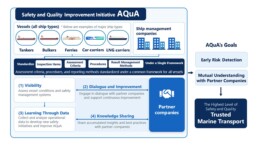
Standardizing Group-wide Safety and Quality Assessment Criteria to Enhance Vessel Safety and Quality Mitsui O.S.K. Lines, announced the launch of…
Subscribe to our newsletter!
if you dont want to swim alone in the ocean of news, sign up for the newsletter, and you will receive daily all the important news of world shipping!
