Rystad Energy publishes definitive study on marine LNG well-to-tank WtT emissions
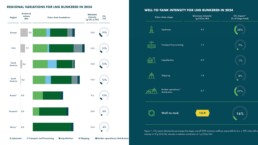

13.9 g CO2eq / MJ (LHV) WtT emissions for LNG used as a marine fuel in 2024
Independent research and energy intelligence firm Rystad Energy has published the results of a landmark study on the greenhouse gas (GHG) emissions from the LNG bunker supply chain, commissioned by SEA-LNG. This is the most accurate and up-to-date certified data on LNG as a marine fuel designed to help guide the International Maritime Organization’s (IMO’s) Net-Zero Framework and future fuel policy.
The implications for policy makers developing regulations to decarbonise shipping resulting from this study are:
- Regulations should incentivise participants in the LNG bunker supply chain to continue to reduce GHG emissions, particularly in relation to natural gas production and liquefaction.
- Policy makers should introduce a process to regularly update WtT default emissions factors used in regulation, in particular those relating to methane emissions.
- This report highlights that the EU WtT default of 18.5 gCO2e/MJ (in FuelEU Maritime) is too conservative and a lower number is justified.
The study analyses the emissions originating from the five key fuel lifecycle stages: upstream, transportation & processing, liquefaction, shipping, and distribution & bunkering operations. It was conducted in line with the IMO WtT lifecycle analysis guidelines, the Intergovernmental Panel on Climate Change’s (IPCC) AR5 GHG definitions, and is based on asset-specific 2024 data.
The study finds that the global well-to-tank emissions intensity for LNG bunkering fuel in 2024 is 13.9g CO2e/MJ (LHV). Carbon dioxide dominates global WtT emissions, responsible for 84% of emissions. Carbon dioxide emissions were most prevalent in the liquefaction stage, responsible for 99% of the stage’s 5.9 g CO2e/MJ.
Methane emissions were responsible for 16% of total WtT emissions, equivalent to 2.2 g CO2e/MJ. They were most prevalent in upstream gas production lifecycle stage, responsible for 38% of total emissions from that stage.
On a global basis, upstream gas production and liquefaction were responsible for the majority of bunker supply chain emissions at 30% and 43% respectively. Consequently, these two stages should be the focus for most future decarbonisation efforts. From the upstream perspective, methane mitigation is best poised to deliver the greatest emissions reduction benefits. Improvements in liquefaction emissions have been observed over recent years, tied to greater utilisation of more efficient technologies. It is likely this trend will continue when coupled with key electrification projects using renewable energy such as hydro and solar power.
With around 95% of vessels still powered by oil-based marine fuels, LNG represents the leading alternative and already accounts for nearly 20% of the vessel orderbook. As the industry transitions toward net-zero and prepares for a rapidly expanding fleet of LNG-fuelled vessels, understanding the real-world lifecycle emissions of LNG is critical to shaping effective regulation and guiding future investment decisions.
Results also show wide variation between regions and cargoes, reflecting differences in gas sources, liquefaction technologies, and shipping distances. In some cases, emissions intensities differed by as much as 6.6 g CO2e/MJ, highlighting that a single global average does not capture the full picture and risks leading to poorly informed regulatory choices.
Patrick King, Vice President Emissions Research, Rystad Energy commented: “Our analysis is based on asset-level data that ties specific gas fields to liquefaction facilities. This approach, supported by satellite-detected methane plume data and reported asset information, gives a more accurate picture of the LNG actually used for bunkering, rather than relying on outdated or overly broad averages.”
Steve Esau, Chief Operating Officer of SEA-LNG, said: “Policymakers must create regulations that reflect the true carbon intensity of marine fuels, rewarding reductions across the supply chain. Marine regulators should incentivise participants in the LNG bunker supply chain to continue to reduce GHG emissions.”
Peter Keller, Chairman of SEA-LNG, concluded: “This landmark report sets the high standards the IMO should demand on such a key topic as alternative fuel emissions and performance within the Net-Zero Framework. Decisions must be based on real and recent data or risk undermining the significant progress already made along the practical and realistic LNG pathway to decarbonisation.”



Related News.
Navigating the Multi-Orbit Era: In Conversation with Intellian’s Jon Harrison at SMM 2026
At SMM 2026 in Hamburg, the rapid evolution of maritime satellite communications took centre stage. Across the exhibition halls, discussions among…
Cyprus ports need joint energy and investment strategy, shipping agents chief says
Cyprus needs a coordinated strategy for shipping, energy and environmental protection to support port investment and modernisation, Cyprus shipping…

MASO Public Affairs introduces MASO Regulatory Intelligence
A new subscription service helping businesses understand what is changing and what it means for them MASO Public Affairs introduces MASO Regulatory…
Anglo-Eastern helps turn CMBTECH’s ammonia ambition into an operational reality
From early feasibility study and risk-based design to newbuilding supervision, crew readiness and technical management, Anglo-Eastern drew on its…
Escalation of attacks threatens to derail recovery in Middle East oil exports
World oil demand is forecast to fall by 2.5 mb/d y-o-y in 4Q26 and 2.6 mb/d on average in 2026. As the Iran war manifests itself through restricted…
New study finds shipping pays twice its share to EU ETS earmarked revenues should triple to help build market for sustainable fuels and technologies
Shipping is responsible for around 10% of EU ETS emissions but pays almost 20% of the ETS bill. Unlike other sectors, it has never received free…

MSARC strengthens maritime mass rescue readiness through training and national live exercise off Dakar, Senegal
Joint MSARC–FHAS programme combines three days of SAR training with a national multi-agency live exercise The Maritime Search and Rescue Council ,…
Sogese report deliveries are still being delayed as container freight rates fluctuate
FOR IMPORTERS Spot rates into the Mediterranean are back at January levels, Far East to Europe reliability sits at pandemic lows, and nearly…
Glencore begins trading on Australian Securities Exchange
Glencore has begun trading on the Australian Securities Exchange under the ASX code GLC. Gary Nagle, Glencore’s CEO, said it was an exciting day for…
BIMCO Shipping Number of the Week
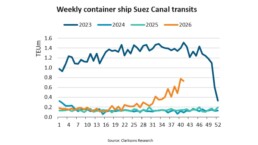
Suez Canal container ship transits exceed 50% of pre-disruption levels "During the first two weeks of October, weekly container ship capacity…
Subscribe to our newsletter!
if you dont want to swim alone in the ocean of news, sign up for the newsletter, and you will receive daily all the important news of world shipping!
