From main street to Low Earth Orbit: How T-Mobile keeps people connected during disasters

T-Mobile is boosting disaster preparedness with expanded technology and a larger deployable fleet, including 50% more drones, helping communities and first responders stay connected when it matters most.
As National Preparedness Month arrives this September, T-Mobile (NASDAQ: TMUS) has expanded technology and resources to support connectivity when communities face natural disasters and severe storms — expanding its drone fleet, launching T-Satellite with Starlink, adding more deployable assets and vehicles and further hardening the network. Together, these investments mean people can better stay in touch with loved ones, receive critical alerts and access essential services. For first responders, the expansions support reliable communications and faster coordination in the field. Ahead of National Preparedness Month, here’s what’s new:
- T-Satellite: Satellite texting, including the ability to text 911, now available almost anywhere the sky is visible, with data use for select apps already available on Pixel 10 with more devices and apps coming this fall.
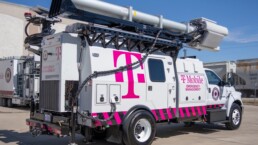
- Larger deployable fleet: T-Mobile’s drone fleet increased by half, 30% more SatCOLTs (Satellite Cell on Light Trucks) and SatCOWs (Satellite Cell on Wheels) and nearly double the number of VSATs (Very Small Aperture Terminals).
- Stronger community support: T-Mobile’s community support vehicles have been upgraded with more robust Wi-Fi and higher-capacity device charging.
- Broader reach: UScellular customers now have access to T-Mobile’s nationwide network and disaster-response resources.
- Florida investment: Network expansion and hardening throughout Florida, a $2 billion project, was completed in July.
“T-Mobile knows that disasters test communities, but connection holds them together,” said Jon Freier, President, T-Mobile Consumer Group. “That’s why we continue to innovate and expand — including a $2 billion network investment in Florida completed this year — so that whether it’s texting a loved one or 911, ensuring first responders have critical connectivity or receiving emergency alerts in real time, people have the peace of mind that comes from staying connected when it matters most.”
From Space: T-Satellite
Officially launched in July, T-Satellite is the first satellite-to-mobile network in the U.S. that automatically connects to almost every modern smartphone, no additional setup required. This means that anyone with a compatible phone can receive Wireless Emergency Alerts via satellite and people with an active T-Satellite subscription can send and receive texts messages, even if terrestrial networks are impacted by severe weather.
During the recent Texas floods, nearly 94,000 people used T-Satellite to send 287,000 SMS messages.
T-Mobile has just begun supporting satellite data, announcing last week that the new Google Pixel lineup will bring early access to T-Satellite-ready popular apps like Google Maps for off-the-grid customers — another step forward as the service continues to expand, with additional features and expansions to come.
From Air: An Expanded Drone Fleet
T-Mobile has increased its emergency drone fleet by 50% to reach more places more quickly with more capability when disasters strike.
- Heavy-lift drones: Multi-mile-range drone that can carry up to 100 pounds to deliver supplies and drop in portable connectivity gear.
- Search and rescue drones: Specialty drones with thermal and high-resolution cameras with LiDAR (laser-based 3D mapping) to locate people, map damage, guide crews and provide scene lighting and one-way broadcast communications — purpose-built for disaster environments.
- Tethered drones: Ground-anchored drones that remain aloft up to about 400 feet, creating a temporary cell-coverage bubble about two miles wide that can run continuously.
During and after the devastating Central Texas floods, T-Mobile’s team embedded with Texas Parks & Wildlife Air Operations to fly search-and-rescue missions, map damage and flag unauthorized drones in restricted airspace.
From Land: More Deployables and Backup Assets
Over the past year, T-Mobile expanded its emergency response fleet to deliver stronger on-the-ground coverage. The fleet now includes 30% more SatCOLTs and SatCOWs, featuring new, larger and tech-loaded XL SatCOWs and XL SatCOLTs, the largest and most capable in T-Mobile’s fleet that provide more coverage than existing trucks. T-Mobile also more than doubled the number of VSAT units, which are satellite antennas that provide temporary wireless service to send and receive data.
Stronger Infrastructure, Smarter Technology
T-Mobile continues to strengthen physical infrastructure with more backup power and fortified sites across the United States, including Puerto Rico. In Florida alone, T-Mobile has made a $2 billion network investment that upgraded 1,350 sites to boost speed, capacity and reliability and hardened 1,375 towers with backup power for improved wind and flood resilience.
T-Mobile proactively prepares its network for disasters by leveraging the AI and automation-driven Self-Organizing Network (SON), which continuously monitors performance and makes real-time adjustments such as rerouting traffic, tilting antennas, managing backup power and extending battery life. Those core capabilities are bolstered by real-time threat detection via our Everbridge–Dataminr feed and Pano AI’s ultra-high-definition wildfire detection cameras integrated into strategic network sites.
T-Mobile’s 5G network also prioritizes first responders through T-Priority, a cutting-edge 5G solution including a dedicated network slice. The slice provides public safety agencies lower latency and faster speeds more consistently with the highest priority across all 5G bands— when seconds matter most.
Community Support
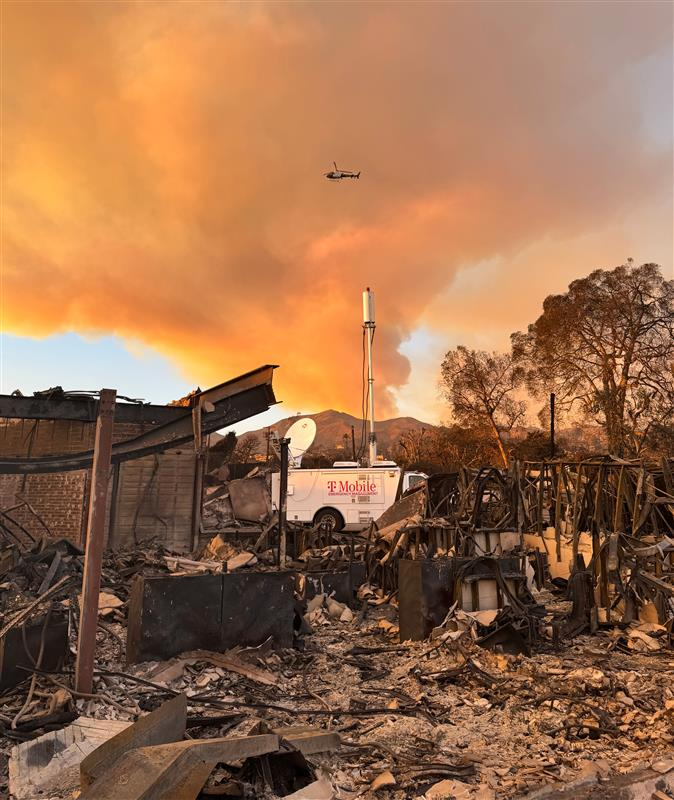
Over the past year, T-Mobile upgraded its Wi-Fi trucks and trailers to provide more reliable connectivity and higher-capacity charging to communities after a disaster hits. Community Support vehicles — including Wi-Fi trucks and trailers, command centers, heavy-duty pickups and Super Class C RVs — are deployed nationwide to shelters and community hubs, providing free Wi-Fi and device charging for anyone who needs it.
For more information on disaster preparedness and T-Mobile’s response capabilities, visit the company’s Emergency Response hub and follow @TMobileNews on X and Instagram.
T-Satellite: Available with compatible device in most outdoor areas in the U.S. where you can see the sky. Satellite service, including text to 911, may be delayed, limited, or unavailable. Included with Experience Beyond; or $10/mo.; auto renews monthly. Cancel anytime. T-Priority features available for eligible emergency response organizations on select plans. Capable device required. Performance baseline commits available network resources to help maintain threshold throughput, even in times of congestion. See 5G device, coverage and access details at T-Mobile.com.
Source: BUSINESS WIRE



Related News.

Poland’s additional national requirements distort competition says Danish Shipping
Poland has introduced a national survey requirement for smaller foreign-flagged vessels operating in Polish waters. This creates significant…

Battery Vessels could help electrify most of Global Shipping Emissions
Battery-electric ships are economical only if the pack is cycled frequently, so they have been confined to short-sea, ferry and harbour vessels…

Mintra and Ledgid explore collaboration to connect Maritime digital identity, learning and workforce development
Mintra® and LEDGID are exploring opportunities to bring together complementary capabilities in digital learning, maritime training, professional…

World Shipping Council calls for global agreement on shipping emissions as industry investment surpasses $200 billion USD
The World Shipping Council (WSC) is calling on governments to agree on binding global greenhouse gas regulations for international shipping without…

What happened to the ITF whistleblower’s complaint?
In January 2026, a whistleblower complained that International Transport Workers’ Federation (ITF) General Secretary Stephen Cotton had manipulated…

Growing regulatory scrutiny puts seafarer wellbeing firmly on maritime safety agenda, VIKAND warns
Seafarer wellbeing is coming under greater regulatory scrutiny as international rules and guidance increasingly recognise crew health and welfare as…

Good Times Bad Times the Premium Stays with the Strait
In October, we wrote that if the transfer network off Oman kept pace, Gulf crude would carry China's refill and keep drawing tonnage east,…

Allied Weekly Market Review Week 47
Pls find below the Allied - Weekly Market Review - Week 47 ALLIED - Weekly Market Report- Week 47


Climate TRACE releases September 2026 Emissions Data
Climate TRACE reported that global greenhouse gas (GHG) emissions for the month of September 2026 totaled 4.7 billion tonnes CO₂e. This remains…
Subscribe to our newsletter!
if you dont want to swim alone in the ocean of news, sign up for the newsletter, and you will receive daily all the important news of world shipping!
