Qatar reinforces LNG leadership, reshapes global energy landscape
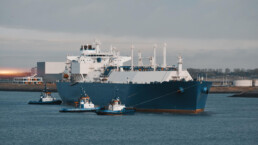

In a strategic move that reinforces its position as a leading global supplier of clean energy and supports global energy security amid rising demand and mounting challenges, the State of Qatar will begin exporting liquefied natural gas (LNG) from the first phase of the North Field East (NFE) expansion project by mid-2026.
Speaking at the Qatar Economic Forum earlier this year, Minister of State for Energy Affairs and President and CEO of QatarEnergy, HE EngSaad bin Sherida Al Kaabi, confirmed that expansion work is progressing on schedule and that the first LNG exports from the North Field East will commence in the middle of next year.
The NFE expansion — the largest project of its kind in the world — is part of Qatar’s ambitious plan to double LNG production capacity. Output will increase from the current 77 million tonnes per year to 110 million tonnes by 2026, and to 126 million tonnes per year by 2027 following completion of the second phase in the North Field South. Upon completion of the North Field West project, which is still in the engineering design phase, Qatar aims to reach 142 million tonnes per year by 2030.
Two experts, speaking exclusively to Qatar News Agency (QNA), highlighted Qatar’s role in bolstering the economy, sustaining growth in the coming years, and reshaping global energy markets. Qatar’s LNG projects are expected to contribute around 40% of total new global LNG supply by 2029.
Chief Business Officer at QNB Group, Yousef Mahmoud Al Neama, described the NFE project as one of the largest capital expenditure ventures in the region and the world’s largest single gas field. He noted that the development of eight new LNG production trains, to be implemented in three phases, will be a major driver of economic growth and a cornerstone of Qatar’s energy strategy.
Al Neama projected that these investments will increase Qatar’s LNG production by 85% by 2030, reaching 142 million tonnes annually. The NFE expansion will also include parallel growth in refining, downstream operations, and petrochemical production, generating returns that will support economic diversification, structural reforms, and growth in the manufacturing and services sectors.
He added that GDP growth remains strong and is set to accelerate with the start of NFE operations, forecasting growth of 2.4% in 2025, 5.6% in 2026, and 7.9% in 2027. This development will strengthen the Qatari banking sector, which will continue to benefit from robust growth, ample liquidity, adequate capitalization, high asset quality, and strong profitability, he said.
In exclusive remarks to QNA, Vice Dean of Business School for Academic and Quality Assurance at Al-Bayt University in Jordan, Dr Omar Khlaif Gharaibeh, said that the State of Qatar is currently investing in one of the largest expansion projects in the history of the gas industry through the development of the North Field, which is the world’s largest natural gas field.
He noted that with this step, the production capacity of liquefied natural gas (LNG) will rise from 77 million to 126 million tonnes per year by 2027, an increase of more than 63%, pointing out that these are not just numbers, but the contours of a new global energy order emerging from Doha.
Dr Gharaibeh pointed out that the energy compass in Europe has shifted in recent years, as the continent has begun seeking reliable partners. In this context, Qatar stands out as a strategic choice through long-term agreements signed with Germany, France, and the Netherlands, he said, explaining that these agreements not only secure gas supply, but also bring stability to markets that sorely lack it in times of geopolitical uncertainty.
He added that economically, Qatar’s expansion will help mitigate global price volatility, as gas prices, currently above $30 per million thermal units, could fall to around $10 15 by the end of the decade.
Dr Gharaibeh emphasized that Qatar is redrawing the map of the global energy industry. As major powers seek to reposition themselves in a multipolar world, energy has emerged as a tool of balance and influence, and Qatar, he said, is a quiet power managing smart investments of more than $45 billion in infrastructure, ports, and LNG carriers.
He also highlighted that in an era where energy security challenges intersect with environmental transition imperatives, Qatar presents a forward-looking model that focuses on sustainable production, global positioning, and long-term partnerships that are reshaping the future from the depths of the Gulf.
The expansion project consists of three phases. Phase One (East Field) includes four mega production lines, each with a capacity of 8 million tonnes per year, totaling 32 million tonnes. Phase Two (South Field) includes two additional lines with a total capacity of 16 million tonnes annually. Phase Three (West Field) is currently under development and is expected to add another 16 million tonnes per year.
The West phase of the expansion project is expected to enter the construction stage by 2027, completing Qatar’s national plan to boost LNG exports.
Total investments in the North Field expansion project have reached approximately $82.5 billion, with QatarEnergy bearing around $59 billion of the cost. Several major global energy companies are participating in the project, including ExxonMobil, TotalEnergies, Shell, Eni, ConocoPhillips, and China’s Sinopec.
Qatar has also signed long-term LNG supply agreements with a number of European and Asian countries, most notably Germany, France, the Netherlands, China, and India. These agreements significantly contribute to the stability of global energy supplies.
Qatar is emerging as a reliable strategic partner, particularly due to its adoption of low-emission liquefaction technologies, making Qatari gas among the cleanest globally.
These massive projects fall under the framework of Qatar National Vision 2030, which aims to diversify the national economy, sustainably invest in natural resources, and strengthen the country’s role as a global energy hub.
Source: Qatar Tribune



Related News.
Navigating the Multi-Orbit Era: In Conversation with Intellian’s Jon Harrison at SMM 2026
At SMM 2026 in Hamburg, the rapid evolution of maritime satellite communications took centre stage. Across the exhibition halls, discussions among…
Cyprus ports need joint energy and investment strategy, shipping agents chief says
Cyprus needs a coordinated strategy for shipping, energy and environmental protection to support port investment and modernisation, Cyprus shipping…
MASO Public Affairs introduces MASO Regulatory Intelligence
A new subscription service helping businesses understand what is changing and what it means for them MASO Public Affairs introduces MASO Regulatory…
Anglo-Eastern helps turn CMBTECH’s ammonia ambition into an operational reality
From early feasibility study and risk-based design to newbuilding supervision, crew readiness and technical management, Anglo-Eastern drew on its…
Escalation of attacks threatens to derail recovery in Middle East oil exports
World oil demand is forecast to fall by 2.5 mb/d y-o-y in 4Q26 and 2.6 mb/d on average in 2026. As the Iran war manifests itself through restricted…
New study finds shipping pays twice its share to EU ETS earmarked revenues should triple to help build market for sustainable fuels and technologies
Shipping is responsible for around 10% of EU ETS emissions but pays almost 20% of the ETS bill. Unlike other sectors, it has never received free…
MSARC strengthens maritime mass rescue readiness through training and national live exercise off Dakar, Senegal
Joint MSARC–FHAS programme combines three days of SAR training with a national multi-agency live exercise The Maritime Search and Rescue Council ,…
Sogese report deliveries are still being delayed as container freight rates fluctuate
FOR IMPORTERS Spot rates into the Mediterranean are back at January levels, Far East to Europe reliability sits at pandemic lows, and nearly…
Glencore begins trading on Australian Securities Exchange
Glencore has begun trading on the Australian Securities Exchange under the ASX code GLC. Gary Nagle, Glencore’s CEO, said it was an exciting day for…
BIMCO Shipping Number of the Week
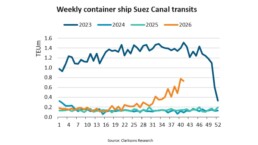
Suez Canal container ship transits exceed 50% of pre-disruption levels "During the first two weeks of October, weekly container ship capacity…
Subscribe to our newsletter!
if you dont want to swim alone in the ocean of news, sign up for the newsletter, and you will receive daily all the important news of world shipping!
