Veson Nautical Shipping Market Outlook Q3 2025 Forecast


Overview
Current global economic and geopolitical landscapes are shaped by several key uncertainties. Tensions between Israel and Iran, particularly regarding the Strait of Hormuz, pose risks to regional stability and energy supply routes. Similarly, Houthi activity in the Red Sea threatens shipping through the Suez Canal. Oil sanctions continue to disrupt global energy markets, while evolving U.S. import tariffs add further complexity to international trade dynamics. Additionally, uncertainties around Chinese GDP growth cast doubt on the strength of global economic recovery.
Based on our forecasting data, our Shipping Market Outlook for Q3 2025 offers a quarterly summary of how this uncertainty could play out across the Tankers, Bulkers, Containers, and Gas industries.
Tankers
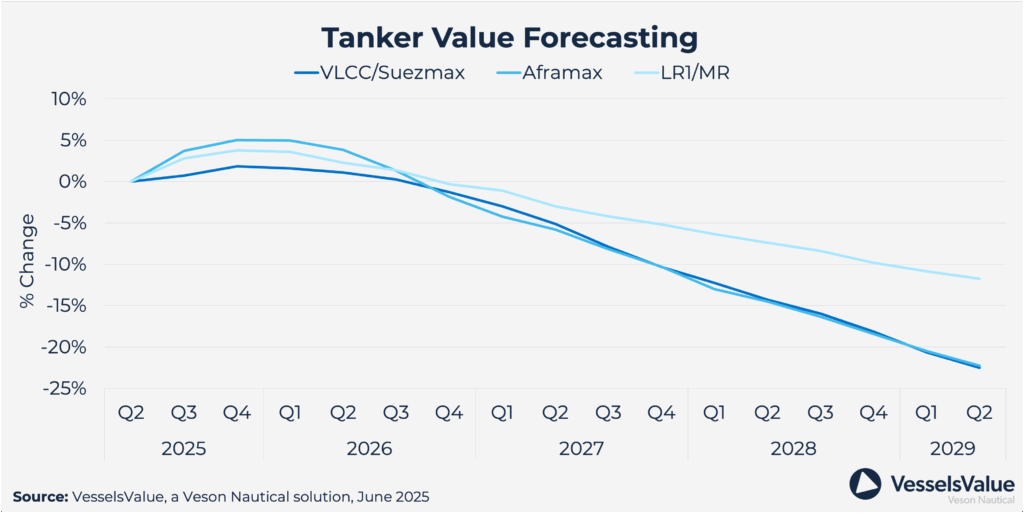
Geopolitical risks, sanctions, and shifts in trade flows, particularly due to Red Sea tensions and EU bans on Russian oil, are driving continued volatility in Tanker rates and elevated ton-mile demand.
Tanker utilisation is supported by rerouted long-haul crude trades from the Atlantic to Asia, but faces headwinds from new vessel deliveries, improving fuel efficiency, and a global transition to lower oil demand.
Fleet growth is expected to outpace demand after 2025 due to low scrapping levels, a rising orderbook, and increased deliveries, although regulatory pressures like the EU ETS and IMO decarbonisation targets may offset this trend.
Oil demand growth faces structural headwinds from electrification, engine efficiency, and behavioural shifts, indicating a longer-term challenge for Tanker trade volumes.
China remains a key swing factor for oil demand and trade volumes, but broader Asian demand, macroeconomic fragility, and inflationary pressures are reshaping global consumption patterns.
While 2024 saw a surge in Container and Tanker orders amid Red Sea disruptions, overall ordering activity has declined sharply in 2025, and newbuilding prices remain high, though likely to ease as shipyard pressure reduces.
Bulkers
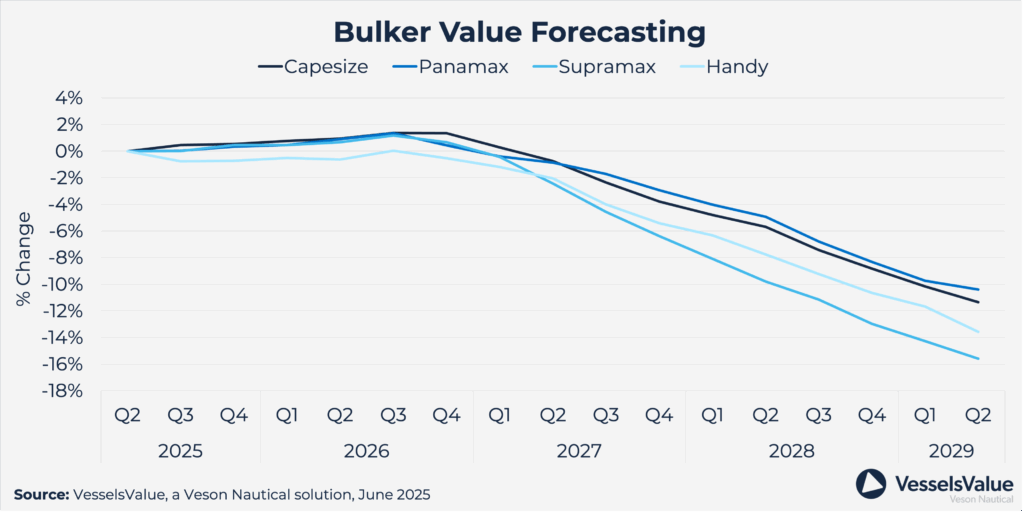
Low ordering activity in recent years has reduced the Bulker sector’s orderbook, supporting relatively low supply growth and a healthier market balance, though demand remains uncertain due to tariffs and trade disruptions.
China’s economic challenges, especially a struggling real estate sector and heavy reliance on exports, are expected to soften dry bulk import demand in 2025, negatively impacting the market balance.
Growth in ton-mile demand is anticipated over the longer term, driven by new trade routes like increased iron ore shipments from Guinea to China following the opening of the Simandou mine in 2026.
Ongoing geopolitical tensions, notably in the Red Sea with potential renewed Houthi attacks, are likely to keep vessel rerouting in place, adding approximately 1% more ton-miles and supporting freight rates.
Container vessel ordering surged dramatically in 2024 due to Red Sea rerouting and a rebound in earnings, setting records and increasing shipyard utilisation, though activity slowed sharply in the first half of 2025.
High orderbook-to-fleet ratios in Containers and LNG, along with elevated newbuilding prices, are expected to slow future ordering volumes, easing shipyard capacity pressures and likely leading to a gradual decline in newbuilding prices.
Containers
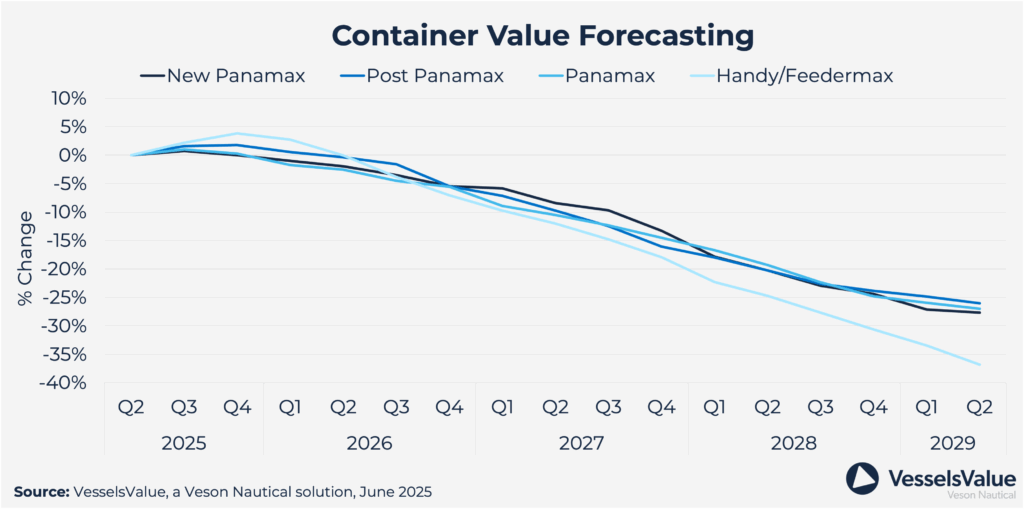
Despite firm freight rates in 2024 and early 2025, rates are forecast to decline steadily from mid-2025 onward as vessel supply growth outpaces demand, and idle capacity is expected to rise.
Net fleet growth was robust at 5.5% in 2023 and 9.7% in 2024, with an expected average of 8.2% annual growth from 2025 to 2028, driven by high ordering activity in recent years.
Record ordering activity in 2024 saw around 4.3 million TEUs ordered, pushing the orderbook-to-fleet ratio to 31.1%, with a recent shift in preference from New-Panamax to ULCVs due to route changes.
Scrapping activity has remained low but is expected to increase moderately, particularly in smaller vessels under 3,000 TEUs, as older ships become less economical to operate amid forecasted freight rate declines.
After surging during the pandemic and again in 2024 due to Red Sea disruptions, Container ordering activity has slowed sharply in 2025, and high orderbook levels combined with elevated newbuilding prices are expected to constrain future ordering and ease shipyard capacity pressures.
Gas
US LPG production grew 5.9% in 2024 and is forecast to grow 4.2% in 2025, with export growth slowing in 2025 due to terminal capacity limits but expected to accelerate from 2026 onward.
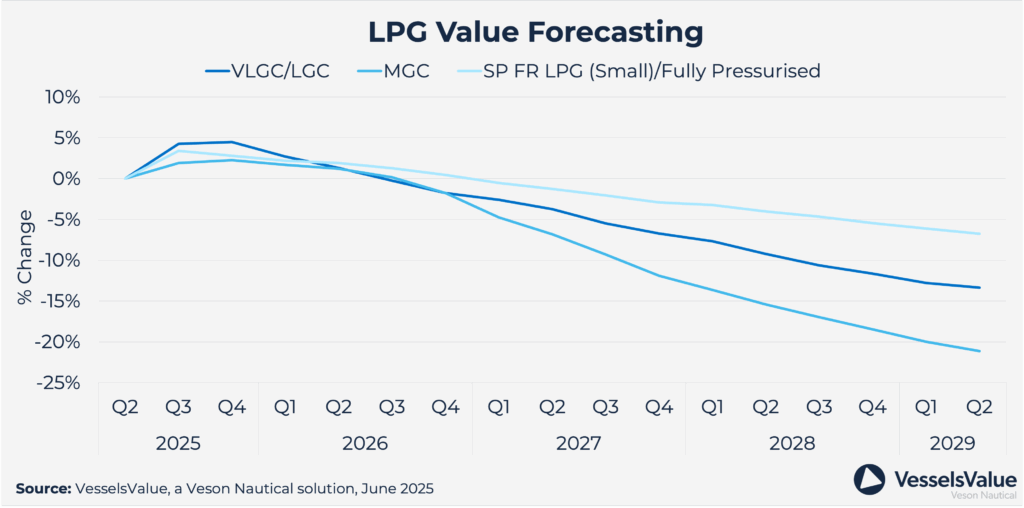
VLGC/VLAC fleet growth was 10.9% in 2024, with average annual growth of 7.3% expected through 2028. Strong recent ordering is expected to put pressure on earnings despite healthy demand, while scrapping remains low due to a young fleet.
Medium-sized LPG vessels show robust fleet growth (c.10.8% annually), while smaller vessels face limited ordering and aging fleets, leading to higher scrapping rates in that segment.
VLGC earnings averaged around 43,300 USD/Day in 2024, expected to decline in 2025 due to slower export growth, briefly rebound in 2026 with terminal expansions, then decline again through 2027-28 due to fleet growth; Panama Canal transit conditions remain stable but sensitive to seasonal water levels.
Petrochemical gas trades face overcapacity and weak demand amid trade uncertainties (notably US-China), though regional intra-Asia trade and macroeconomic improvements may support volume rebounds in the medium.



Related News.

Greece has the most to lose from delays in shipping’s green transition, new analysis finds
UCL and WWF Greece report finds the IMO Net-Zero Framework offers Greek ship owners the clarity they need, and the best protection against a…

Snow Land joins Cool Carriers as the world’s first reefer with a gate rudder, a new chapter for sustainable and efficient reefer shipping
Cool Carriers, the world’s largest operator of specialised reefer vessels, took delivery of Snow Land from Kitanihon Shipbuilding in Japan on 12…

IBIA launches Marine Energy Outlook Survey as Annual Convention in New York
IBIA - The International Bunker Industry Association officially launched its Marine Energy Outlook Survey during the IBIA Annual Convention in New…

Why did ITF staff vote to strike again?
Staff at the International Transport Workers’ Federation (ITF) headquarters in London have voted to give their union a strike mandate. According to…

Nearly half of maritime crew tickets booked a week ahead are cancelled
Two new C Teleport reports show when maritime and aircrew teams book crew flights, how often they cancel, and what late booking costs, with a…

Kpler completes $1.5bn+ Sixth Street investment and continues accelerating growth
Investment backs Kpler's bold ambition to shape the future of global trade intelligence. Kpler, a leading provider of global physical trade…

How SAL and DNV are strengthening heavy-lift shipping
From classification and newbuilding support to operational tools and advisory expertise, SAL and DNV have been collaborating for decades. The…

PSA Singapore breaks ground on Tuas Port Phase Two to strengthen Global Trade Connectivity
PSA Singapore marked the groundbreaking of Tuas Port Phase Two, a significant step in the development of the world’s largest fully automated…

 …

BIFA welcomes UK–EU trade progress and calls for clarity on implementation
The British International Freight Association (BIFA) has welcomed progress made at today's UK–EU Summit in Brussels, highlighting the potential…
Subscribe to our newsletter!
if you dont want to swim alone in the ocean of news, sign up for the newsletter, and you will receive daily all the important news of world shipping!
