Research reveals hidden fatigue risks in offshore wind turbine structures


The case study demonstrates how reliability-based inspection can help manage fatigue-driven risks in offshore wind turbine support structures.
Some offshore wind turbine support structures may fall short of required fatigue life expectations, according to a new Lloyd’s Register report.
The case study evaluated a North Atlantic offshore wind farm of 60–70 turbines (500–600 MW capacity). Offshore wind turbines are typically designed for 25 years of service, using a fatigue design factor of three—implying a minimum required fatigue life of 75 years. However, the study found that a critical joint in the jacket foundation would reach the end of its fatigue life after just 52 years, falling short of this design requirement.
Instead of redesigning the joint, the study took a reliability-based inspection (RBI) approach to identify and mitigate potential failure through targeted, risk-based maintenance.
The study combined a S-N (Stress vs. Number of cycles) model, to estimate when structural safety drops below acceptable thresholds, with Fracture Mechanics (FM) crack growth analysis, to predict the probability of failure over time and inform inspection intervals. This approach incorporates inspection results via Probability of Detection (PoD) curves to allow inspection schedules to be dynamically updated, responding to real-world conditions and inspection findings.
The results suggest that the first inspection should be carried out around year nine. After that, depending on the inspection method, further inspections might be needed every year to maintain acceptable safety margins.
However, the case study highlights the limitations of current inspection methods. Visual and ultrasonic inspections were found to be less effective for fatigue-critical components. More advanced techniques, such as Eddy Current or ACFM, offer greater reliability and allow for longer inspection intervals, but only when operators were willing to adopt slightly lower safety thresholds.
While RBI planning is effective in reducing in-service life costs and ensuring the longevity and safety for OWT structures, it requires expert input, reliable models, and software tools that can handle complex calculations. Ongoing research aims to refine the models and address the challenges during their application. Reliability updating, especially when integrating PoD curves, requires complex modelling and precise calibration of parameters such as initial crack size and stress intensity factors, areas often underdeveloped in practice.
The study calls for wider industry collaboration to refine inspection standards, share real-time monitoring data to refine fatigue predictions, and adopt more flexible definitions of acceptable reliability where appropriate.
Kourosh Parsa, Global Head of Technology – Offshore and Subsea, LR, said: “Many offshore wind assets are designed to a standard fatigue factor, but real-world conditions often expose critical vulnerabilities. Our findings show that using reliability-based methods allows operators to focus inspections where the risks are greatest. By integrating sophisticated models and real-world inspection data, we can extend asset life, reduce costs and, most importantly, maintain safety.”
Manuel Ruiz, Head of Offshore Renewable Solutions, LR, added: “By focusing on the areas with the greatest risk, we can not only help to manage fatigue-related issues more effectively — we’re also enabling developers and operators to make better-informed decisions that optimise asset life and performance. This proactive, risk-based approach is exactly how we support our clients in navigating complexity, controlling costs, and ensuring the long-term viability of their offshore wind investments.”



Related News.

Navigating the Multi-Orbit Era: In Conversation with Intellian’s Jon Harrison at SMM 2026
At SMM 2026 in Hamburg, the rapid evolution of maritime satellite communications took centre stage. Across the exhibition halls, discussions among…
Cyprus ports need joint energy and investment strategy, shipping agents chief says
Cyprus needs a coordinated strategy for shipping, energy and environmental protection to support port investment and modernisation, Cyprus shipping…

MASO Public Affairs introduces MASO Regulatory Intelligence
A new subscription service helping businesses understand what is changing and what it means for them MASO Public Affairs introduces MASO Regulatory…

Anglo-Eastern helps turn CMBTECH’s ammonia ambition into an operational reality
From early feasibility study and risk-based design to newbuilding supervision, crew readiness and technical management, Anglo-Eastern drew on its…

Escalation of attacks threatens to derail recovery in Middle East oil exports
World oil demand is forecast to fall by 2.5 mb/d y-o-y in 4Q26 and 2.6 mb/d on average in 2026. As the Iran war manifests itself through restricted…

New study finds shipping pays twice its share to EU ETS earmarked revenues should triple to help build market for sustainable fuels and technologies
Shipping is responsible for around 10% of EU ETS emissions but pays almost 20% of the ETS bill. Unlike other sectors, it has never received free…

MSARC strengthens maritime mass rescue readiness through training and national live exercise off Dakar, Senegal
Joint MSARC–FHAS programme combines three days of SAR training with a national multi-agency live exercise The Maritime Search and Rescue Council ,…

Sogese report deliveries are still being delayed as container freight rates fluctuate
FOR IMPORTERS Spot rates into the Mediterranean are back at January levels, Far East to Europe reliability sits at pandemic lows, and nearly…

Glencore begins trading on Australian Securities Exchange
Glencore has begun trading on the Australian Securities Exchange under the ASX code GLC. Gary Nagle, Glencore’s CEO, said it was an exciting day for…
BIMCO Shipping Number of the Week
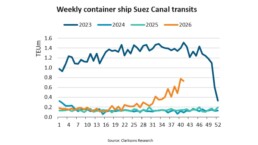
Suez Canal container ship transits exceed 50% of pre-disruption levels "During the first two weeks of October, weekly container ship capacity…
Subscribe to our newsletter!
if you dont want to swim alone in the ocean of news, sign up for the newsletter, and you will receive daily all the important news of world shipping!
