Experts gather to discuss feasibility of modular micro reactors in maritime settings
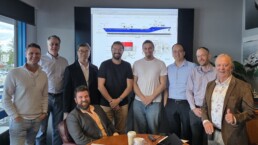

This international workshop explored the integration of a modular micro reactor (MMR) into a stern landing craft vessel.
Lloyd’s Register has successfully conducted a Hazard Identification workshop to evaluate the potential risks and operational factors for modular micro reactor nuclear technology in maritime settings.
This innovative approach could pave the way for propulsion and sustainable energy solutions in remote or off-grid locations using sea-based platforms.
The international workshop, in collaboration with Queensland’s ship design group Seatransport and Houston-based Deployable Energy, brought together multidisciplinary experts at Seatransport’s headquarters on the Gold Coast in Australia.
The session focused on risk management strategies, safety systems, regulatory frameworks, and vessel design implications, aiming to clarify certification pathways and compliance benchmarks. With safety and regulatory integrity at the forefront, the workshop offered key insights into the feasibility and requirements for operational readiness, once the vessel meets nuclear licensing requirements.
The workshop is part of a collaboration between Seatransport, Deployable Energy and LR, a global professional maritime services group, to develop nuclear power generation for different applications, including propulsion and strategic emergency response in remote areas.
Using micro modular reactor (MMR) technology, two MMRs will provide the 73-metre stern loading vessel power enabling the vessel to operate for 8-10 years without refuelling and supply power to shore grids during port docking or in affected zones.
Matt Palmer, Global Nuclear and Naval Submarines Segment Director at LR, said: “MMR technology not only reduces our dependence on traditional fossil fuels but also provides a reliable, long-term energy source that can support both operational and emergency needs in remote and underserved regions.”
Remko Hottentot, LR Commercial Manager – Australasia, said: “By bringing together leading experts in the field, we have not only identified the key challenges but also outlined strategic solutions to overcome them. These will now be incorporated into the vessel design. This collaborative effort has significantly strengthened our partnership and set a clear path for future advancements using MMR technology for sustainable maritime energy solutions.”
Dr Stuart Ballantyne, Chairman of Seatransport, said: “In my many years advocating nuclear propulsion, I believe now for commercial ships it is within reach and will be commonplace by 2030. My thanks for all visionaries working in this space.”
Bobby Gallagher, CEO and CTO Deployable Energy, said: “Deployable Energy is proud to be advancing toward Approval-in-Principle for the hybrid-powered Stern Landing Vessel. Powered by our 1MW Unity Nuclear Battery, this next-generation vessel runs cheaper than conventionally fuelled ships, using safe, standard fuel with no exotic materials. Deployable Energy is delivering clean, scalable energy to transform shipping, resource production, and heavy industry.”



Related News.
Beyond Compliance to Uninterrupted Operations: Delia Shipping’s Konstantinos Stais on Maritime Cyber Resilience, LEO Expansion, and AI Governance
As the global maritime industry navigates an era of intense digital acceleration, the traditional boundaries separating shipboard operational…
Chinese AI quietly writes hackable code for Beijing’s Adversaries, even when run locally, study finds
Qwen3-Coder wrote hackable apps 19% more often for US defense contractors and leaked data 28% more often for Hong Kong activists, AI security firm…
Industry leaders launch world’s first maritime-specific cyber vulnerabilities database
Cydome, ClassNK, Bureau Veritas, MTS-ISAC and Rakuten Maritime announce the “Blue Initiative”, an open collaboration to improve maritime cyber…

Businesses increasingly adopt AI for cybersecurity while individuals expand privacy protections
As cyber threats grow and digital technologies become more pervasive, businesses are increasingly using AI to strengthen…
EmissionLink calls for EU ETS revenues to fund maritime carbon capture trials and port infrastructure
Maritime emissions specialist, EmissionLink, has called for a dedicated proportion of EU Emissions Trading System (EU ETS) revenues to be invested…
Port of Antwerp-Bruges sees strong recovery in container throughput in volatile trading environment
In the first nine months of 2026, Port of Antwerp-Bruges handled 200.9 million tonnes of goods, 0.8% less than in the same period last year.…
Sanctions risks reshape commodity trading
Traders face sanctions challenge “odyssey” as geopolitical risks reformat global markets Commodity traders are operating in an increasingly…
Titan analysis shows FuelEU pooling propelled liquefied biomethane demand
- Clean fuel supplier evaluates compliance for 8,000 TEU containership operating in Northern Europe - FuelEU Maritime balances competitiveness…

Russian diesel tanker heads to New York as Kremlin claims regular shipments
Malta-flagged tanker should carry 40,000 mt fuel Agioi Fanendes left Primorsk Oct. 22: CAS US lifts sanctions, enables Russian imports……
Pilot transfer operation: A safer step aboard
Safe pilot transfer operations depend on both correct procedures and fit-for-purpose equipment. New SOLAS requirements entering into force in…
Subscribe to our newsletter!
if you dont want to swim alone in the ocean of news, sign up for the newsletter, and you will receive daily all the important news of world shipping!
