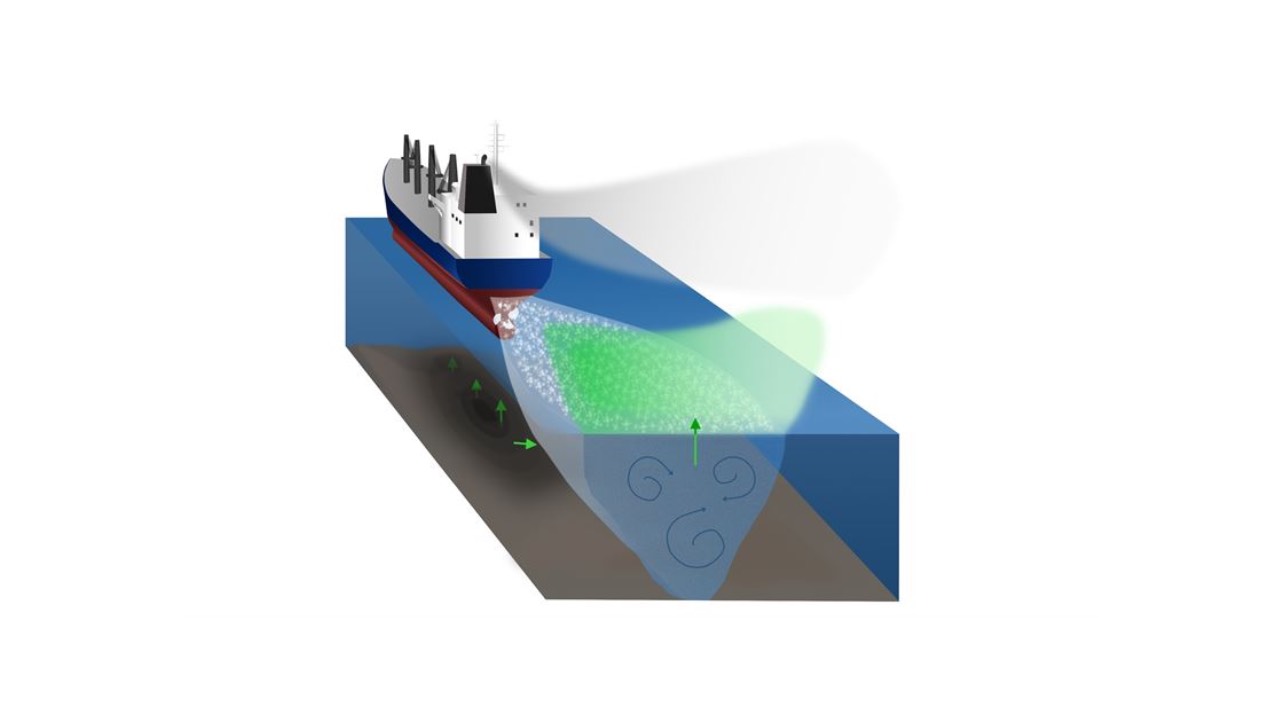

Ship traffic in shallow areas, such as ports, can trigger large methane emissions by just moving through the water. The researchers in a study, led by Chalmers University of Technology in Sweden, observed twenty times higher methane emissions in the shipping lane compared to nearby undisturbed areas. Despite the fact that methane is a greenhouse gas that is 27 times as powerful as carbon dioxide, these emissions are often overlooked with today’s measurement methods.

“Our measurements show that ship passages trigger clear pulses of high methane fluxes from the water to the atmosphere. This is caused by pressure changes and mixing of the water mass. Even if the pulses are short, the total amount during a day is significant,” says Amanda Nylund, researcher at Chalmers University of Technology and the Swedish Meteorological and Hydrological Institute, SMHI.
Methane is a potent greenhouse gas and the concern about methane emissions from the few ships that run on liquefied natural gas (LNG) is a very hot topic. In the current study, the measured methane emissions are completely decoupled from the ships’ choice of fuel. This means that all ships can cause emissions and thus shipping’s contribution to emissions of greenhouse gases has previously been underestimated. The researchers point out that even though methane is found naturally in the sediments, the activity of the ships cause an extensive release into the atmosphere.
The study focuses on shallow marine areas where the sediments are oxygen-free and rich in organic matter. In such environments, methane is formed, and at high production levels, the gas can leak or bubble up into the water above. When a ship passes, the pressure at the seafloor changes and methane bubbles make their way out of the sediments more easily. In combination with the mixing that takes place in the wake of ships, the methane can quickly rise to the surface and escape out into the atmosphere.
The phenomenon was discovered by chance
The article, published in Nature Communications Earth & Environment, is unique in its kind and the result of a broad research collaboration. The phenomenon of the extensive methane emissions in shallow waters was first discovered by chance, in connection with other measurements in the Neva Bay in the Baltic Sea.

“The discovery of the hitherto unknown impact of ships is important for improving global estimates of methane emissions, not least considering that nine of the world’s ten largest ports are located in waters with similar conditions as Neva Bay,” says Johan Mellqvist, Professor of Optical Remote Sensing, Chalmers, whose group made the unexpected discovery that forms the basis for the new results.
Two of the largest ship types, cruise and container ships, triggered the most frequent and largest measured methane releases, but slightly smaller ropax vessels (combined freight and passenger ferries) also account for large methane releases. The larger (compared to ropax and container) vessel type, bulk carriers, accounted for lower emissions. This means that it is more complicated than the size of the ships controlling methane emissions

“A possible explanation for the high emissions of ropax vessels is that they have double propellers,” says Rickard Bensow, Professor of Hydrodynamics, Chalmers, and responsible for the study’s modelling of ship traffic.
Will investigate discharges in large shallow ports
The authors of the current study now emphasise the need to rethink how and where methane measurements are carried out, especially in coastal waters where natural and human factors interact. They place particular focus on further investigating large ports in river deltas.

“The next step is to estimate how large these effects can be globally. Major ports in China, Singapore, and South Korea, as well as European ports such as Rotterdam, Antwerp, and river systems in Germany, have similar conditions to the Neva Bay. It is very likely that we underestimate methane emissions there as well,” says Ida-Maja Hassellöv, Professor of Maritime Environmental Science, Chalmers, who will lead the follow-up project that will start this autumn.



Related News.

ISLAND OIL: Unveiling of the Sculpture “Cyprus’s Journey Through the Ages” in Protaras – A Tribute and Landmark to Cyprus’s Historical Memory and Cultural Heritage
In a modest ceremony marked by a moving atmosphere, the sculpture “Cyprus’s Journey Through the Ages”, created by acclaimed Cypriot sculptor…
World Maritime Day 2026 from Policy to Practice – powering Maritime Excellence
Global regulations will deliver safer, more resilient shipping when they are implemented worldwide. The international maritime community marks…

Diana Shipping announces Time Charter Contract for m/v DSI Polaris with Dai An Ocean Shipping
Diana Shipping , a global shipping company specializing in the ownership and bareboat charter-in of dry bulk vessels, announced that, through a…

Chief Economists Expect Global Economy to Stabilize, but Fiscal Constraints, Rising Living Costs and AI Investment Uncertainty Threaten Growth
The global economy is stabilizing, but the fiscal support that cushioned successive shocks since 2020 is unlikely to play the same role in the year…

V. welcomes its new graduate cohort as programme expands across the group
Twelve graduates from nine nationalities join 11th year of V.’s expanded international management programme. V., the global ship manager and marine…

From Policy to Practice: Why Seafarers Are the Key to Maritime Excellence
The shipping industry is no stranger to regulation. Seafarers and ship operators work within a vast framework of international conventions, national…

Intermodal Report – Week 38 2026
Please find below the Intermodal market report for week 38 2026. Intermodal Report Week 38 2026 Market Insight By Nikos Tagoulis, Head of…

Allied – Weekly Market Review – Week 38
Please find below the Allied Weekly Report for Week 38 | 2026 ALLIED - Weekly Market Report- Week 38

Record year on the Northeast Passage but Arctic shipping remains very limited
In 2025, a record 103 transit voyages were made via the Northeast Passage. However, this is still equivalent to only around a day and a half of…

[xclusiv] S&P Report 21th September 2026
Please find below the [xclusiv] latest Weekly S&P Report [xclusiv] 2026_09_21 Market Commentary: VLCCs: Freight Boom Reprices the Fleet The VLCC…
Subscribe to our newsletter!
if you dont want to swim alone in the ocean of news, sign up for the newsletter, and you will receive daily all the important news of world shipping!
