SMDERI-QET achieves world’s first ship-to-ship LCO₂ transfer
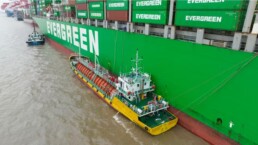

The world’s first ship-to-ship liquified carbon dioxide transfer was successfully completed at the Yangshan Deep-Water Port in Hangzhou Bay, Shanghai.
The project was led by Shanghai Qiyao Environmental Technology , a subsidiary of Shanghai Marine Deisel Engine Research Institute, a unit of the China State Shipbuilding Company . The project was supported by the Shanghai Port Group Energy and the Shanghai Port Group Logistics.
The transfer marks a significant milestone for an industry under growing pressure to comply with increasingly strict local, regional and international regulations on emissions from ships. By completing the industry’s first “end to end” solution, which includes onboard carbon capture, liquefaction, storage, and ship-to-ship offloading to a carbon utilisation facility, the project cements China’s leadership role in decarbonising shipping.
Developed by SMDERI-QET, the Onboard Carbon Capture and Storage System (OCCS) achieved a comprehensive carbon dioxide capture rate of over 80 percent with a liquid carbon dioxide purity of 99.9 percent. And since the delivery of the first full-process OCCS in early 2024, SMDERI-QET has successfully completed multiple end-to-end LCO₂ offloading projects, from capture to recycling, which have allowed participating owners to achieve higher CII ratings: A first for OCCS technology.
However, until now, wider uptake of OCCS technology has been slowed by inadequate port infrastructure. According to Su Yi, General Manager of SMDERI-QET, many ports are not equipped to manage large-scale carbon storage and recovery or do not have the systems required for ship-to-shore offloading capabilities.
“Furthermore, installing the necessary facilities places high requirements on port and terminal infrastructure, which may be limited by draft restrictions and other factors,” he says. “The ship-to-ship LCO₂ transfer project at the Yangshan Deep Water Port not only proves the viability of OCCS it also eliminates the need for terminal facilities for the transfer, storage and recovery of liquified carbon dioxide.”
Su notes that compared with the ship-to-shore connections, ship-to-ship LCO₂ transfer significantly improves operational flexibility, making it possible to manage loading and offloading for vessels operating in terminals with inadequate infrastructure. “The offloaded LCO₂ is transported by ship directly to a storage and utilisation facility, thus removing one of the biggest obstacles for the large-scale application of carbon capture technology,” he says. “This landmark trial represents a critical step towards realising scalable carbon management pathways across shipping and adjacent industries.”
Looking ahead, SMDERI-QET will join hands with domestic and international partners to actively participate in and promote the formulation of relevant regulations and standards for marine carbon capture and transportation. “We are confident that the completion of the world’s first ship-to-ship LCO₂ transfer, together with the further development of onboard carbon capture technologies, will not only lead to rapid development of a global network of shore-based carbon storage and utilisation facilities, but accelerate the decarbonisation of shipping,” says Su.



Related News.
Navigating the Multi-Orbit Era: In Conversation with Intellian’s Jon Harrison at SMM 2026
At SMM 2026 in Hamburg, the rapid evolution of maritime satellite communications took centre stage. Across the exhibition halls, discussions among…
Cyprus ports need joint energy and investment strategy, shipping agents chief says
Cyprus needs a coordinated strategy for shipping, energy and environmental protection to support port investment and modernisation, Cyprus shipping…

MASO Public Affairs introduces MASO Regulatory Intelligence
A new subscription service helping businesses understand what is changing and what it means for them MASO Public Affairs introduces MASO Regulatory…
Anglo-Eastern helps turn CMBTECH’s ammonia ambition into an operational reality
From early feasibility study and risk-based design to newbuilding supervision, crew readiness and technical management, Anglo-Eastern drew on its…

Escalation of attacks threatens to derail recovery in Middle East oil exports
World oil demand is forecast to fall by 2.5 mb/d y-o-y in 4Q26 and 2.6 mb/d on average in 2026. As the Iran war manifests itself through restricted…
New study finds shipping pays twice its share to EU ETS earmarked revenues should triple to help build market for sustainable fuels and technologies
Shipping is responsible for around 10% of EU ETS emissions but pays almost 20% of the ETS bill. Unlike other sectors, it has never received free…
MSARC strengthens maritime mass rescue readiness through training and national live exercise off Dakar, Senegal
Joint MSARC–FHAS programme combines three days of SAR training with a national multi-agency live exercise The Maritime Search and Rescue Council ,…
Sogese report deliveries are still being delayed as container freight rates fluctuate
FOR IMPORTERS Spot rates into the Mediterranean are back at January levels, Far East to Europe reliability sits at pandemic lows, and nearly…
Glencore begins trading on Australian Securities Exchange
Glencore has begun trading on the Australian Securities Exchange under the ASX code GLC. Gary Nagle, Glencore’s CEO, said it was an exciting day for…
BIMCO Shipping Number of the Week
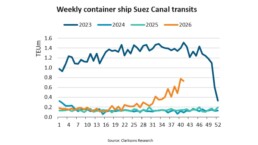
Suez Canal container ship transits exceed 50% of pre-disruption levels "During the first two weeks of October, weekly container ship capacity…
Subscribe to our newsletter!
if you dont want to swim alone in the ocean of news, sign up for the newsletter, and you will receive daily all the important news of world shipping!
