

V., to be attributed to René Kofod-Olsen, CEO, V.Group
“On this Day of the Seafarer 2025, we proudly join the IMO’s global call to action by reinforcing our commitment to creating a positive workplace culture, whether on board a vessel or in one of our offices. This goes beyond any policy – it’s a shared responsibility at every level of our business.
“A truly positive workplace culture empowers people to show up as the best version of themselves. It creates the conditions for collaboration, innovation, and pride in the work we do; qualities that are essential as we navigate the many complexities facing our industry. We therefore cannot afford to make seafarer wellbeing an afterthought when seafarers are, in fact, at the forefront of industry transformation.
“At V. investing in career progression and regular training is key to supporting our seafarers in their ongoing careers and growing our seafarer talent pool.
“We take a proactive approach to developing initiatives that support crew safety, engagement, retention and their future, whilst ensuring strong connectivity between the seafarers and their families.
“We work to create a welcoming, inclusive and open environment where seafarers support each other, take ownership for their teams and feel like they belong.
“Day of the Seafarer 2025 is a powerful reminder that building a strong maritime future begins with creating a safe, respectful and harassment free environment at sea.”

NAPA, to be attributed to Mikko Kuosa, CEO of NAPA
“Behind every net-zero ambition stands a seafarer. And right now, they’re being asked to do more than ever, often with less.
Seafarers are facing greater demands than ever before. As the industry navigates the transition to alternative fuels and adapts to increasingly complex compliance requirements, life at sea is evolving fast, and it’s seafarers who are on the frontlines of this change.
That’s why, on this Day of the Seafarer, we stand with the International Maritime Organization in affirming that crew safety, dignity, and well-being must be non-negotiable at every level- from bridge to engine room and beyond.
Creating a positive workplace culture at sea isn’t just a moral imperative, it’s a business-critical one.
Recent studies by Cardiff University and ISWAN reveal a troubling rise in stress, fatigue and mental distress among crew:
- Over 40% of senior officers report significant mental health distress.
- 54% of seafarers say workloads have increased.
- A third now fear criminalization due to complex reporting requirements.
These are not just human resource concerns: they are operational red flags that affect safety, performance, and retention.
At NAPA, we’ve seen this up close. Despite decades of safety gains, 55% of shipboard accidents still occur during planned work, often in confined or hazardous areas like oil tanks and cargo holds. Why? Because today’s permit-to-work systems still rely too heavily on paper, memory, and good intentions, leaving too much to chance.
That’s why, in 2024, we reimagined the process from the ground up, launching a digital Permit to Work system built with—and for—seafarers. It brings live visibility to high-risk tasks, smart step-by-step guidance, and real-time coordination between ship and shore. When every minute and every decision counts, that kind of support can be the difference between a job well done and an incident.
And it’s not just Permit to Work. From digital logbooks and automated checklists to smart compliance workflows, digital solutions are already reducing administrative burden and boosting safety onboard. In fact, our customer Anthony Veder reports saving 2,000 hours of admin time per vessel after going digital with NAPA Logbook—a 14% drop in paperwork, freeing up time for what matters most.
Because the truth is: as the industry transforms, safety and seafarer empowerment must be non-negotiable. No green transition will succeed if it puts the people who make shipping possible at risk—whether from fatigue, outdated tools, or unclear procedures.
That said, digital tools alone won’t solve everything. But when they’re built with empathy and tested in real working conditions, they become powerful allies, helping crews do their jobs with confidence, clarity, and care.
We must stop viewing seafarers as passive recipients of change; instead, they need to be more actively brought into conversations that affect their day-to-day lives and jobs, so that we can better empower them with human-centred support and solutions that meet their needs. It’s the smartest and easiest way we can build a stronger, safer maritime future.”



Related News.
Navigating the Multi-Orbit Era: In Conversation with Intellian’s Jon Harrison at SMM 2026
At SMM 2026 in Hamburg, the rapid evolution of maritime satellite communications took centre stage. Across the exhibition halls, discussions among…
Cyprus ports need joint energy and investment strategy, shipping agents chief says
Cyprus needs a coordinated strategy for shipping, energy and environmental protection to support port investment and modernisation, Cyprus shipping…

MASO Public Affairs introduces MASO Regulatory Intelligence
A new subscription service helping businesses understand what is changing and what it means for them MASO Public Affairs introduces MASO Regulatory…
Anglo-Eastern helps turn CMBTECH’s ammonia ambition into an operational reality
From early feasibility study and risk-based design to newbuilding supervision, crew readiness and technical management, Anglo-Eastern drew on its…

Escalation of attacks threatens to derail recovery in Middle East oil exports
World oil demand is forecast to fall by 2.5 mb/d y-o-y in 4Q26 and 2.6 mb/d on average in 2026. As the Iran war manifests itself through restricted…
New study finds shipping pays twice its share to EU ETS earmarked revenues should triple to help build market for sustainable fuels and technologies
Shipping is responsible for around 10% of EU ETS emissions but pays almost 20% of the ETS bill. Unlike other sectors, it has never received free…
MSARC strengthens maritime mass rescue readiness through training and national live exercise off Dakar, Senegal
Joint MSARC–FHAS programme combines three days of SAR training with a national multi-agency live exercise The Maritime Search and Rescue Council ,…
Sogese report deliveries are still being delayed as container freight rates fluctuate
FOR IMPORTERS Spot rates into the Mediterranean are back at January levels, Far East to Europe reliability sits at pandemic lows, and nearly…
Glencore begins trading on Australian Securities Exchange
Glencore has begun trading on the Australian Securities Exchange under the ASX code GLC. Gary Nagle, Glencore’s CEO, said it was an exciting day for…
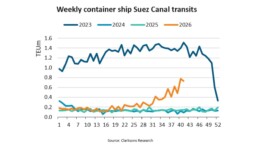
BIMCO Shipping Number of the Week
Suez Canal container ship transits exceed 50% of pre-disruption levels "During the first two weeks of October, weekly container ship capacity…
Subscribe to our newsletter!
if you dont want to swim alone in the ocean of news, sign up for the newsletter, and you will receive daily all the important news of world shipping!
