INTERCARGO Bulk Carrier Casualty Report 2025 safety gains continue but security threats emerge
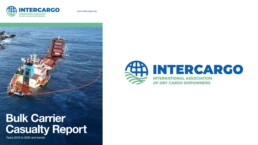

INTERCARGO, the International Association of Dry Cargo Shipowners, reports encouraging progress in bulk carrier safety, with vessel losses and fatalities continuing to decline over the last decade. However, serious security threats in 2024 demand urgent international action to protect seafarers and uphold freedom of navigation.
The Bulk Carrier Casualty Report 2025 identifies the loss of 20 bulk carriers (≥10,000 dwt) between 2015 and 2024, resulting in 89 seafarer fatalities. Groundings remain the leading cause of vessel losses, responsible for 45% of cases, while cargo liquefaction continues to pose the greatest threat to life, accounting for 55 deaths, which is more than 60% of the total. Cargo shifting (distinct from liquefaction) caused the loss of two ships and 12 lives, highlighting an additional area of concern.
Although only one operational casualty was recorded in 2024, the year was marked by three separate attacks on bulk carriers in the Red Sea – Rubymar, True Confidence and Tutor – involving missiles, drones and uncrewed surface vessels. These incidents, which resulted in four seafarer deaths, are documented separately from the statistical analysis but underscore a dangerous deterioration in maritime security.

Credit: INTERCARGO
John Xylas, Chairman of INTERCARGO, commented: “The dry bulk sector should take pride in the improved safety performance reflected in this year’s report. But the unacceptable attacks on merchant ships in 2024 have reminded us that safety today extends beyond seamanship and regulatory compliance; it is fundamentally about protecting human life. Seafarers must never be placed in harm’s way for simply doing their jobs.”
The report also shows that bulk carrier losses now average just two per year, with a notable decline in average fatalities per casualty over successive 10-year periods. These gains are attributed to improved ship design, better crew training, and stronger regulatory frameworks. Nevertheless, INTERCARGO emphasises that significant risks persist, particularly those related to improperly declared cargoes, navigational failures and delays in the submission of accident investigation reports by flag States. The average reporting time to the IMO GISIS platform remains over two years, severely hindering the industry’s ability to learn and implement timely corrective actions.
With more than 12,500 bulk carriers in service globally and demand for dry cargo trade continuing to grow, INTERCARGO reiterates its call for a collective industry commitment to achieving zero loss of life and zero loss of ships. The Association will continue to work with its members, international bodies and wider stakeholders to advance this goal, while also advocating for immediate measures to ensure the security of seafarers in high-risk regions.



Related News.

Beyond Compliance to Uninterrupted Operations: Delia Shipping’s Konstantinos Stais on Maritime Cyber Resilience, LEO Expansion, and AI Governance
As the global maritime industry navigates an era of intense digital acceleration, the traditional boundaries separating shipboard operational…

Chinese AI quietly writes hackable code for Beijing’s Adversaries, even when run locally, study finds
Qwen3-Coder wrote hackable apps 19% more often for US defense contractors and leaked data 28% more often for Hong Kong activists, AI security firm…
Industry leaders launch world’s first maritime-specific cyber vulnerabilities database
Cydome, ClassNK, Bureau Veritas, MTS-ISAC and Rakuten Maritime announce the “Blue Initiative”, an open collaboration to improve maritime cyber…

Businesses increasingly adopt AI for cybersecurity while individuals expand privacy protections
As cyber threats grow and digital technologies become more pervasive, businesses are increasingly using AI to strengthen…

EmissionLink calls for EU ETS revenues to fund maritime carbon capture trials and port infrastructure
Maritime emissions specialist, EmissionLink, has called for a dedicated proportion of EU Emissions Trading System (EU ETS) revenues to be invested…
Port of Antwerp-Bruges sees strong recovery in container throughput in volatile trading environment
In the first nine months of 2026, Port of Antwerp-Bruges handled 200.9 million tonnes of goods, 0.8% less than in the same period last year.…
Sanctions risks reshape commodity trading
Traders face sanctions challenge “odyssey” as geopolitical risks reformat global markets Commodity traders are operating in an increasingly…
Titan analysis shows FuelEU pooling propelled liquefied biomethane demand
- Clean fuel supplier evaluates compliance for 8,000 TEU containership operating in Northern Europe - FuelEU Maritime balances competitiveness…
Russian diesel tanker heads to New York as Kremlin claims regular shipments
Malta-flagged tanker should carry 40,000 mt fuel Agioi Fanendes left Primorsk Oct. 22: CAS US lifts sanctions, enables Russian imports……
Pilot transfer operation: A safer step aboard
Safe pilot transfer operations depend on both correct procedures and fit-for-purpose equipment. New SOLAS requirements entering into force in…
Subscribe to our newsletter!
if you dont want to swim alone in the ocean of news, sign up for the newsletter, and you will receive daily all the important news of world shipping!
