Veson Nautical Global shipping industry in mid-cycle transition

Veson Nautical white paper urges industry to study the past to prepare for the future
The current market conditions in the global shipping industry resemble the mid-cycle transition seen in previous shipping cycles – a phase where the market appears stable on the surface, but underlying pressures are quietly building. That’s the central message of a new white paper from Veson Nautical, a global leader in maritime data and freight management solutions.
Titled ‘The Anatomy of Shipping Cycles: What History Can Tell Us About Tomorrow’s Market’, the white paper argues that as fleet deliveries increase, global trade slows, and regulatory constraints tighten, the risk of tipping into overcapacity is mounting.
“Looking back at the history of previous shipping cycles, we’re likely in the mid-phase of the transition from the high point to the low,” says Matt Freeman, white paper co-author and VP of Valuation & Analytics at Veson Nautical. “To navigate this fragile equilibrium successfully will require not only operational discipline, but a deep understanding of the structural patterns that have shaped previous cycles.”
What past shipping cycles reveal
The paper explores how cyclical patterns have repeated across decades of maritime history, shaped by different macroeconomic forces, yet following a familiar arc: overconfidence, overcapacity, and correction.
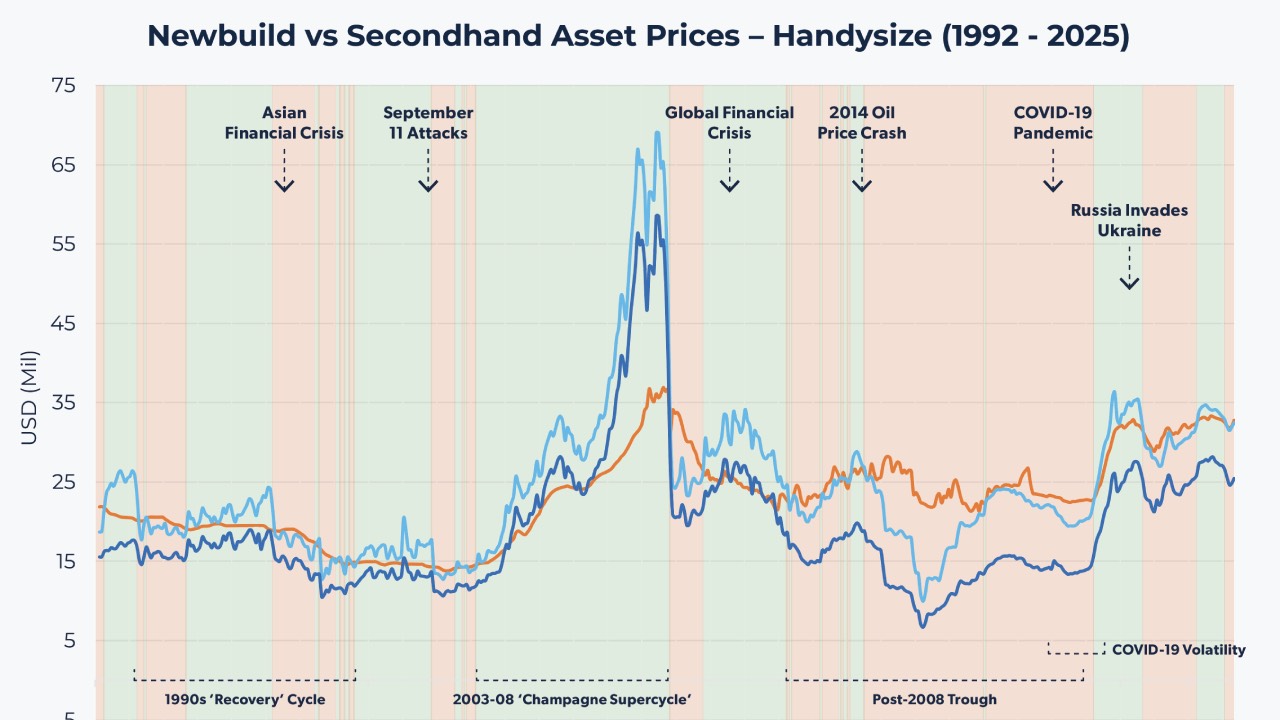
It cites the 2003–2008 “Champagne Supercycle,” driven by China’s industrial boom. At its peak, Capesize rates surged from $20,000 to nearly $200,000 per day in just five years. This spike triggered a global ordering frenzy, with the orderbook swelling to 60% of the active fleet.
“When the world was engulfed by the 2008 financial crisis, earnings collapsed almost overnight, but deliveries continued for years, compounding the downturn,” says Freeman. “If you look at examples like this, you start to see patterns that can help companies prepare for when the market inevitably turns.”
The paper also examines the COVID-19 disruption in 2020, noting that although freight rates soared, most vessel owners resisted over-ordering. The result was temporary volatility – not a full structural cycle – thanks to a more measured, disciplined response.
Reading the current signals
While no two cycles unfold in exactly the same way, the paper identifies a set of recurring markers that often precede inflection points. One of the clearest is newbuild parity – a condition where five-year-old or zero-year-old vessels begin trading at or above the cost of newbuilds. This signal, which reflects urgency outweighing asset fundamentals, has historically appeared at market peaks, including before the 2008 crash, the 2014 oil price collapse, and the post-COVID container rate spike.
“Today, the return of newbuild parity in several market segments is a warning sign,” says Felix Tordoff, co-author and Junior Valuation Analyst at Veson. “It suggests a market where urgency is outweighing discipline, and an environment where short-term opportunity may cloud long-term judgment.”
The white paper notes that scheduled fleet deliveries are rising, particularly in the bulker segment, peaking in 2027–2028. At the same time, global trade growth is slowing, with the WTO revising its 2025 forecast down to 2.2%, well below the post-2010 average.
While new environmental regulations such as EEXI and CII may reduce effective fleet capacity, the authors argue this will not be enough to counterbalance incoming tonnage.
“Taken together, these signals suggest the industry is at an inflection point, where the next shift could come without warning,” Tordoff says. “As in previous cycles, the balance may hold for a time before tipping suddenly.”
Cycles can’t be avoided, but they can be navigated
The white paper concludes that shipping cycles are not anomalies to be feared, but recurring patterns that can be understood and strategically managed. While predicting their exact timing remains elusive, recognizing their structure and signals offers operators a powerful decision advantage.
“In today’s complex environment where sentiment is rising, supply is building, and demand is softening, you need to be able to read the signals,” Freeman concludes. “The ability to step back, assess the full cycle, and make informed decisions isn’t just smart. It’s essential.”



Related News.

ISLAND OIL: Unveiling of the Sculpture “Cyprus’s Journey Through the Ages” in Protaras – A Tribute and Landmark to Cyprus’s Historical Memory and Cultural Heritage
In a modest ceremony marked by a moving atmosphere, the sculpture “Cyprus’s Journey Through the Ages”, created by acclaimed Cypriot sculptor…

World Maritime Day 2026 from Policy to Practice – powering Maritime Excellence
Global regulations will deliver safer, more resilient shipping when they are implemented worldwide. The international maritime community marks…

Diana Shipping announces Time Charter Contract for m/v DSI Polaris with Dai An Ocean Shipping
Diana Shipping , a global shipping company specializing in the ownership and bareboat charter-in of dry bulk vessels, announced that, through a…

Chief Economists Expect Global Economy to Stabilize, but Fiscal Constraints, Rising Living Costs and AI Investment Uncertainty Threaten Growth
The global economy is stabilizing, but the fiscal support that cushioned successive shocks since 2020 is unlikely to play the same role in the year…

V. welcomes its new graduate cohort as programme expands across the group
Twelve graduates from nine nationalities join 11th year of V.’s expanded international management programme. V., the global ship manager and marine…

From Policy to Practice: Why Seafarers Are the Key to Maritime Excellence
The shipping industry is no stranger to regulation. Seafarers and ship operators work within a vast framework of international conventions, national…

Intermodal Report – Week 38 2026
Please find below the Intermodal market report for week 38 2026. Intermodal Report Week 38 2026 Market Insight By Nikos Tagoulis, Head of…

Allied – Weekly Market Review – Week 38
Please find below the Allied Weekly Report for Week 38 | 2026 ALLIED - Weekly Market Report- Week 38

Record year on the Northeast Passage but Arctic shipping remains very limited
In 2025, a record 103 transit voyages were made via the Northeast Passage. However, this is still equivalent to only around a day and a half of…

[xclusiv] S&P Report 21th September 2026
Please find below the [xclusiv] latest Weekly S&P Report [xclusiv] 2026_09_21 Market Commentary: VLCCs: Freight Boom Reprices the Fleet The VLCC…
Subscribe to our newsletter!
if you dont want to swim alone in the ocean of news, sign up for the newsletter, and you will receive daily all the important news of world shipping!
