Delivery of uncrewed vessel for remote-controlled subsea work
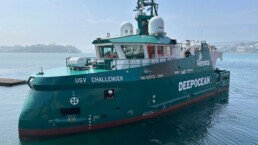

The vessel – named USV Challenger – will shortly arrive at DeepOcean’s subsea base at Killingøy, Haugesund. Here it will test its innovative launch and recovery system for the onboard ROV, and get maritime authority approval for its remote operating capabilities before entering a long-term charter agreement with DeepOcean.
The owner of the vessel is USV AS, which is a joint venture company established by Solstad Offshore, Østensjø Rederi and DeepOcean. The company’s main purpose is to invest and own uncrewed vessels.
Solo or supplementary vessel
The USV Challenger will be remotely controlled from shore and will be equipped with multiple autonomous features. It can operate and endure remotely in severe weather conditions.
During operations, both the USV maritime crew and ROV operators will be co-located in the same remote operating centre (ROC) at Killingøy, near Haugesund.
“Needless to say, the USV is fully capable of deploying offshore and conducting subsea operations independently. However, it can also serve as a highly cost-effective supplement to larger subsea vessels. Rather than mobilizing large vessels for every offshore task, operators can leverage the USV and its onboard ROV for parts of subsea installation, survey, or IMR scope. By reducing the need for repeated transits of larger vessels, the USV offers significant cost savings. The value proposition is clear – the USV represents a more economical and efficient alternative for a wide range of offshore operations,” says Øyvind Mikaelsen, CEO of DeepOcean.
Broad subsea service scope
The USV Challenger will be equipped with a fully electric work class ROV with hydraulic capabilities that is capable of operating down to 1,500 metres water depth, plus a sizeable tool package that will allow the ROV to perform a wide range of subsea operations.
The ROV is outfitted with survey sensors for pipeline survey, seabed mapping and annual inspection work including measurements and cleaning operations. It can also interface a fly-out ROV to offer visual inspection support for a larger host ROV in busy, congested and high-risk operating environments. The ROV can also perform 3D scanning of the subsea assets.
To facilitate highly efficient subsea inspection work, the ROV has been outfitted with the same software as DeepOcean’s autonomous inspection drone (AID). This allows the ROV to perform pre-programmed inspections of subsea assets. A key enabler for this is DeepOcean’s proprietary digital twin platform where a model of the ROV is controlled. In seabed areas with low visibility, the ROV operator can instead fly and operate the ROV in the digital twin.
The ROV can also perform maintenance and repair work subsea, including light lifting operations, as it is equipped with powerful thrusters and has a through-frame lifting capacity. The ROV can open hatches on subsea templates, conduct repair work, use torque tools on subsea equipment, or run cleaning tools and conduct leak measurement work. It can also connect and disconnect flying leads, perform general commissioning support on subsea equipment, and provide touchdown support for cable-laying operations.
“The USV provides a highly cost-efficient transport and launch platform for the ROV, and the well-equipped ROV enables efficient subsea operations. We expect that this combination will provide substantial cost benefits for operators of subsea equipment in both the oil and gas and renewable energy industries,” adds Øyvind Mikaelsen.
Unique Launch and recovery system
To increase its workable weather window, the USV is equipped with a novel launch and recovery system (LARS) that has been designed by DeepOcean. The LARS consists of an electrical winch, a sheave wheel trolley, kicker and rear hatch.
Launch and recovery of the ROV is conducted over the stern of the USV. When launching, the ROV is simply pushed in, while the USV moves forward. When recovering, the ROV is pulled in like a trawl, while the boat moves forward.
The USV is also equipped with a gyro stabilizer that reduces vessel movements during launch and recovery operations. The combination of the unique LARS and the USV’s other features, will allow DeepOcean to launch and recover the onboard ROV in significant wave heights.
“We have designed the USV around the LARS. We know from conventional vessels what the challenges and limitations are with moonpool or A-frame solutions. So we have chosen a solution that is inspired by fishing and trawling. We have conducted scale tests in rough seas and we firmly believe that the operating potential of our LARS is higher than what a conventional solution would be on such a small vessel,” says Øyvind Mikaelsen.
30 days offshore operating capacity without supplies
The USV Challenger is 24 metres long and 7.5 metres wide. It is equipped with a hybrid diesel-electric propulsion system and a battery package that allows the uncrewed vessel to operate offshore for up to 30 days without charging or refuelling.
The USV solution will reduce CO2 emissions with more than 90 percent compared to a conventional offshore vessel when conducting subsea IMR operations. Remotely controlled operations from shore are part of this calculation. Further, DeepOcean and its JV partners have developed the vessels’ remote system by integrating equipment from many maritime suppliers along the Norwegian coastline. The vessel was delivered by the Astilleros Gondán shipyard in Spain.
“Around 25 technology suppliers have delivered equipment to us that are prepared for future adaptation to remote controlled operations. We are proud of this initiative which contributes to lifting the entire maritime supply chain,” adds Øyvind Mikaelsen.
The USV Challenger is also equipped with a wheelhouse and is certified for having four crew members on board for operations within 20 nautical miles off the Norwegian coastline. This is a useful solution, during inshore testing of the USV, LARS, remote technology and future new technologies.
Collaborative trials with North Sea operators
DeepOcean and operator Aker BP have agreed to pioneer the use of the USV for subsea inspection, maintenance and repair (IMR) and survey work. Aker BP and DeepOcean already cooperate under a frame agreement for subsea IMR and survey work, and Aker BP has contributed to the development of the USV. The two companies share a long-term ambition to move 30 percent of IMR work from traditional vessels to USVs.
DeepOcean is also in dialogue with other Norwegian Continental Shelf (NCS) operators regarding utilizing the USV for demonstration projects. Vår Energi is among the participants in a project to demonstrate the USV’s operability and capabilities in 2025. The vessel will spend the next 4-5 months in Haugesund to undergo various installation work and conduct an inshore test period.
“We are experiencing strong interest from operators who recognize the cost and environmental advantages of integrating the USV as part of their subsea operations,” concludes Øyvind Mikaelsen.



Related News.

Navigating the Multi-Orbit Era: In Conversation with Intellian’s Jon Harrison at SMM 2026
At SMM 2026 in Hamburg, the rapid evolution of maritime satellite communications took centre stage. Across the exhibition halls, discussions among…
Cyprus ports need joint energy and investment strategy, shipping agents chief says
Cyprus needs a coordinated strategy for shipping, energy and environmental protection to support port investment and modernisation, Cyprus shipping…

MASO Public Affairs introduces MASO Regulatory Intelligence
A new subscription service helping businesses understand what is changing and what it means for them MASO Public Affairs introduces MASO Regulatory…
Anglo-Eastern helps turn CMBTECH’s ammonia ambition into an operational reality
From early feasibility study and risk-based design to newbuilding supervision, crew readiness and technical management, Anglo-Eastern drew on its…
Escalation of attacks threatens to derail recovery in Middle East oil exports
World oil demand is forecast to fall by 2.5 mb/d y-o-y in 4Q26 and 2.6 mb/d on average in 2026. As the Iran war manifests itself through restricted…
New study finds shipping pays twice its share to EU ETS earmarked revenues should triple to help build market for sustainable fuels and technologies
Shipping is responsible for around 10% of EU ETS emissions but pays almost 20% of the ETS bill. Unlike other sectors, it has never received free…
MSARC strengthens maritime mass rescue readiness through training and national live exercise off Dakar, Senegal
Joint MSARC–FHAS programme combines three days of SAR training with a national multi-agency live exercise The Maritime Search and Rescue Council ,…
Sogese report deliveries are still being delayed as container freight rates fluctuate
FOR IMPORTERS Spot rates into the Mediterranean are back at January levels, Far East to Europe reliability sits at pandemic lows, and nearly…
Glencore begins trading on Australian Securities Exchange
Glencore has begun trading on the Australian Securities Exchange under the ASX code GLC. Gary Nagle, Glencore’s CEO, said it was an exciting day for…
BIMCO Shipping Number of the Week
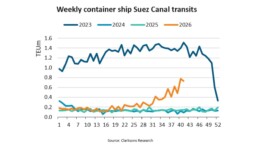
Suez Canal container ship transits exceed 50% of pre-disruption levels "During the first two weeks of October, weekly container ship capacity…
Subscribe to our newsletter!
if you dont want to swim alone in the ocean of news, sign up for the newsletter, and you will receive daily all the important news of world shipping!
