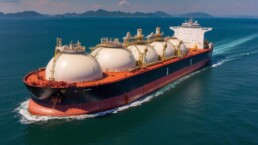

European governments may have a rare window of opportunity to build up strategic gas stockpiles in the coming years to help manage supply shocks that could become more common if geopolitical tensions keep rising.
Europe has long been dependent on energy imports, particularly natural gas. North Sea production, primarily in Norway, is the main regional source but accounts for only around a third of consumption.
The dangers of this acute dependency were laid bare when Moscow started reducing its huge volume of supplies to Europe in the lead up to its 2022 invasion of Ukraine, plunging the region into its biggest energy crisis in decades.
Europe has successfully reduced Russian pipeline imports to near zero since then, but it has consequently become highly dependent on liquefied natural gas imports, at a huge cost to businesses, consumers and governments.
LNG today makes up over a third of European supplies, with 45% coming from the United States and another 19% from Russia in 2024. Beyond LNG, Europe imports gas from Norway, North Africa and Turkey via pipeline.
This might seem like a relatively diversified supply matrix.
But it isn’t hard to imagine scenarios that could severely disrupt supplies: physical or cyberattacks on North Sea infrastructure, civil war in Algeria or Libya, Gulf Coast hurricanes, or war with Iran and subsequent disruption in the Straits of Hormuz, a choke point for 20% of the world’s oil and gas.
In another scenario, which might have seemed far-fetched only a few months ago, the United States could restrict exports of oil and gas in order to lower domestic prices under the 1950 Defense Production Act, which grants the president control over supply of critical materials and services.
STRATEGIC THINKING
Given the growing list of potential risks, Europe would be wise to create a comprehensive plan for storing and managing natural gas to avoid a repeat of the 2022 shock.
Several major economies, including the United States, Britain, EU members, China and Australia, today hold strategic oil reserves, typically equivalent to 90 days of their fuel consumption.
These strategic petroleum reserves, created following the 1973 Arab oil embargo, have been tapped several times to help with severe disruptions, including in the wake of the Ukraine war, the 2011 civil war in Libya and Hurricane Katrina in 2005.
Europe already has huge gas storage facilities in underground salt caverns and aquifers that have capacity to hold around a quarter of Europe’s annual consumption of around 400 billion cubic metres, when combining the EU and Britain. These inventories are regularly filled during the summer months to be drawn on in winter. LNG import terminals also offer a modest amount of additional storage capacity.
These are commercial inventories that are mostly governed by market forces. The European Union has tried to centrally manage reserves since 2022, introducing rules that require countries to fill 90% of storage capacity by November 1.
But the requirements have led to rising prices, thus complicating traders’ effort to refill storage. The EU has also tried to jointly buy LNG in large volumes in order to reduce costs, but had little traction in the market.
Therefore, a government-run storage system that buys and sells gas independently and with state financing appears to be a more viable solution to prepare for emergencies.
RIDE THE WAVE
How much gas can and should Europe store? Those are complex questions given costs and technical restrictions.
Europe could emulate its oil SPR system, which holds at least three months-worth of demand, but that seems a tall order given the significant cost it would entail of around $34 billion at today’s prices and the storage capacity currently available.
Such scale might not be required, however.
Holding just two months’ worth of LNG imports in strategic reserves, or around 20 bcm, would offer the European market a significant buffer against a rupture in supplies, buying precious time to reroute LNG cargoes to the region, similar to how the SPR helped deal with oil market disruption. A transatlantic tanker voyage typically lasts around two weeks.
European governments could use some of the many depleted oil and gas fields dotted across the North Sea to store strategic gas reserves.
Such a programme would certainly not be cheap: 20 bcm of gas is valued at $7 billion at today’s benchmark TTF prices, and then there is the cost of building the infrastructure.
But a wave of new LNG supply is set to come on stream in the next few years, mostly in the United States and Qatar, which should help keep gas prices relatively low and steady compared to recent volatility.
Taking advantage of these favourable conditions to build up a comprehensive gas storage mechanism would leave the region much better prepared for whatever emergency is next coming down the pike.
Source: Reuters



Related News.
India joins ISF Verify, bringing trusted digital certification within reach of 30 per cent of the global seafarer workforce
Agreement with the world’s second-largest seafarer supply country marks a major milestone for global digital certification. The Directorate General…

OpenGate Capital to acquire Maersk Training, the Global Safety Training and Gas-Safety Services Business of Maersk
OpenGate Capital, a global private equity firm, announced today that it has signed a definitive agreement to acquire Maersk Training and its…

Can AI Save the Planet? Planet Classroom examines AI’s Climate Impact, Energy Demands and Clean Energy Solutions
C. M. (Cathy) Rubin and The Nest Campus CEO Peter Gilmer explore AI's growing environmental footprint, billions in climate investment, and the…

Smart Port Market Size to be valued at USD 23.10 Billion by 2034; Increasing Volume of International Maritime Trade to Boost Market Development: Fortune Business Insights™
The global smart port market size was valued at USD 3.4 billion in 2025 and is expected to be worth USD 4.2 billion in 2026. The market is projected…

Closer cooperation with India can strengthen Danish shipping
Minister of Business and Competitiveness Martin Lidegaard is leading a Danish business delegation to India. Green shipping is among the…

IRClass Academy and PIP Makassar strengthen Executive Maritime Capability through IMPDP 2026
Indian Register of Shipping , through its professional training and development arm IRClass Academy, has further strengthened its engagement in…

MOL, Sharp, IOM Implement Solar Panel Donation Project
Move Will Enhance Living Conditions in Power-short Areas of Kenya Mitsui O.S.K. Lines, announced the donation of solar power panels to communities in…

Intermodal Report Week 44 2026
Pls find below the Intermodal Report - Week 44 2026 Intermodal Report Week 44 2026

Allied Weekly Market Review Week 44
Pls find below the Allied - Weekly Market Review - Week 44 ALLIED - Weekly Market Report- Week 44

Nor-Shipping partners with Marketing in Maritime to deliver Marketing & Communications day and awards in 2027
Nor-Shipping is partnering with Marketing in Maritime to deliver a dedicated Marketing & Communications Day and awards initiative at the 2027…
Subscribe to our newsletter!
if you dont want to swim alone in the ocean of news, sign up for the newsletter, and you will receive daily all the important news of world shipping!
