10th Our Ocean Conference in Busan, Korea, mobilizes over 9.1 billion of commitments to sustainable ocean action
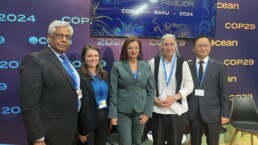

60 countries and organizations announce 277 new commitments across ocean action areas ranging from sustainable fisheries and marine pollution to marine protected areas and the blue economy
As the 10th Our Ocean Conference in Busan, Republic of Korea, comes to a close, it has been confirmed that 277 new commitments to sustainable ocean action have been mobilized, equivalent to $9.1 billion.
Since its inaugural meeting in 2014, OOC has become a leading platform for governments, businesses and civil society to make commitments advancing marine conservation, ocean-based climate solutions and sustainable blue economy initiatives. This will add to the $160 billion mobilized over the past decade.
Commitments were made by more than 60 different countries and organizations across six key ocean action areas: Ocean Climate Nexus, Marine Pollution, Marine Protected Area, Sustainable Blue Economy, Sustainable Fisheries, and Maritime Security.
Some key themes have come to the fore, reflecting the theme of the Conference – Our Ocean, Our Action. The Republic of Korea announced “digital oceans” as the priority cross-cutting theme, placing a special emphasis on exploring how digital technology is driving new ocean actions and discussing international cooperation to accelerate these advancements. Nearly 10% of OOC10 commitments address this theme, ranging from the use of AI to monitor fisheries and marine protected areas, to enhancing satellite and drone imagery, and deploying eDNA techniques that can help better catalogue marine biodiversity.
Developing the sustainable blue economy has been highlighted as a key priority for the global ocean community, generating the highest single financial commitment of any action area by far – USD $4.5 billion – and the second-highest overall number of commitments (59). From supporting ocean entrepreneurship and developing businesses, developing blue economy frameworks, and enhancing sustainable small-scale fisheries and aquaculture operations, to deploying digital technologies that can support economic development, blue economy commitments were diverse in scope and scale.
Investment in research and development was a clear priority for OOC10 commitment makers, with over 30 commitments related to funding for research that will improve understanding of the ocean-climate nexus, polar regions, fisheries, biodiversity, marine pollution, emerging technologies, and more.
While the ocean-climate nexus is an ongoing and crucial focus of the OOC, green shipping and nature-based solutions were two topics which took center stage at the 10th anniversary Conference, each accounting for about 15% of climate commitments which will support the transition to green fuels, sustainable port operations, and reducing vessel emissions. A notable number of commitments were announced for the financing of marine nature-based climate solutions – nearly $150 million in finance – with work focusing on restoring and better enhancing coastal blue carbon ecosystems such as kelp forests.
This year’s conference generated a wide variety of capacity-building commitments across six OOC action areas, including nearly 20 commitments focused on improving maritime security capacity and counter-IUU efforts around the world (predominantly in the Pacific and West Africa), and more than 10 commitments that establish or expand marine and environmental education or career training programs. Diverse, sector-specific capacity building programs were also announced, from waste management and plastics reduction, to coastal resilience and MPA management.
For ten years, the Our Ocean Conference has been an effective and consistent mechanism for generating marine conservation ambition. At OOC10, over 45 commitments focused on identifying and assessing new sites for future marine protected areas (MPAs), expansion and improvement of management of existing MPAs, and new protections for key habitats such as turtle nesting grounds. In order to meet ambitious international goals and commitments, including climate and biodiversity targets, and protecting 30% of land and sea by 2030 (30×30), increasing and expanding MPAs and other conservation measures is critical.
The Biodiversity Beyond National Jurisdiction (BBNJ) Agreement provides an opportunity for large-scale protections of marine ecosystems of the high seas, and governments at OOC10 made progress toward the ratification and implementation of the BBNJ. Commitments announced finance to support ratification and implementation of the Agreement, and policy steps to identify target locations for MPAs on the high seas.
Marine pollution, especially plastic pollution, remains a key area of focus for the international community. Over 20% of marine pollution commitments addressed plastic pollution specifically, demonstrating its prominence in current ocean policy. These commitments include new programs to support plastic recycling, comprehensive national plastic pollution plans, and education and community engagement initiatives. Other issues relating to marine pollution, including noise, wastewater, land-based pollution, and ghost gear were also addressed in a range of commitments.



Related News.

Greece has the most to lose from delays in shipping’s green transition, new analysis finds
UCL and WWF Greece report finds the IMO Net-Zero Framework offers Greek ship owners the clarity they need, and the best protection against a…

Snow Land joins Cool Carriers as the world’s first reefer with a gate rudder, a new chapter for sustainable and efficient reefer shipping
Cool Carriers, the world’s largest operator of specialised reefer vessels, took delivery of Snow Land from Kitanihon Shipbuilding in Japan on 12…

IBIA launches Marine Energy Outlook Survey as Annual Convention in New York
IBIA - The International Bunker Industry Association officially launched its Marine Energy Outlook Survey during the IBIA Annual Convention in New…

Why did ITF staff vote to strike again?
Staff at the International Transport Workers’ Federation (ITF) headquarters in London have voted to give their union a strike mandate. According to…

Nearly half of maritime crew tickets booked a week ahead are cancelled
Two new C Teleport reports show when maritime and aircrew teams book crew flights, how often they cancel, and what late booking costs, with a…

Kpler completes $1.5bn+ Sixth Street investment and continues accelerating growth
Investment backs Kpler's bold ambition to shape the future of global trade intelligence. Kpler, a leading provider of global physical trade…

How SAL and DNV are strengthening heavy-lift shipping
From classification and newbuilding support to operational tools and advisory expertise, SAL and DNV have been collaborating for decades. The…

PSA Singapore breaks ground on Tuas Port Phase Two to strengthen Global Trade Connectivity
PSA Singapore marked the groundbreaking of Tuas Port Phase Two, a significant step in the development of the world’s largest fully automated…

 …

BIFA welcomes UK–EU trade progress and calls for clarity on implementation
The British International Freight Association (BIFA) has welcomed progress made at today's UK–EU Summit in Brussels, highlighting the potential…
Subscribe to our newsletter!
if you dont want to swim alone in the ocean of news, sign up for the newsletter, and you will receive daily all the important news of world shipping!
