New study confirms barnacle biofouling is a big burden for the shipping industry
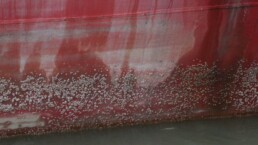

Nearly one-fifth of a sample group comprising 685 vessels inspected in dry dock were found to have more than 20% of their underwater hull surface covered by barnacles, and as much as one-third of the sample had more than 10% coverage, a new study has found. High levels of barnacle biofouling on underwater hulls across the global shipping fleet can significantly drag down decarbonisation efforts and increase fuel costs.
The reality of barnacle biofouling burden on the global shipping fleet has been determined with findings from extensive analysis of hull condition across a large group of ships, of varying type and age, confirming that the presence of barnacle biofouling is extremely common.
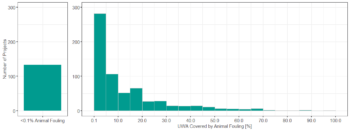
A new research study titled, ‘How much could barnacles limit shipping’s decarbonisation?’ published by I-Tech, developers of the barnacle repelling antifouling technology, Selektope, details how over one third of vessels in a 685-sample group sailed into dry dock with barnacles covering more than 10% of their hull surface.
More alarmingly, more than one fifth of vessels inspected in the sample group were found to have over 20% of their underwater hull surface covered with barnacle biofouling; whereas only 140 vessels inspected had the optimal condition of less than 0.1% barnacle biofouling coverage.
The extensive data analysis that sits at the core of the new research study was conducted by an independent marine coatings consultancy group based on data collected from 685 vessel hull condition inspections undertaken between 2015-2025 on the majority of vessel types, with a range of trading activity levels.
While this sample group is relatively small in comparison to the 55,000 merchant ships trading internationally, the high prevalence of barnacle biofouling found on this sample group of vessels gives indicative insight that should be of great concern to the industry considering the immense negative impact barnacle biofouling has on increasing vessel emissions.
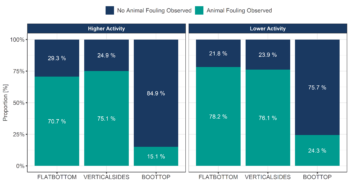
Barnacle biofouling was found on all vessel types however; it was present on tankers more than other ship types. For example, almost 90% of tankers were found to have barnacle biofouling present on their underwater hull with varying intensity, compared to around 70% of pure car carriers and container ships inspected.
It was also clear that lower activity vessels are at greater risk and barnacle biofouling is more prevalent on the flat bottom area compared to vertical sides or boottop hull areas.
Variations in barnacle biofouling between vessel types can be attributable to a certain degree to different root causes; different paint systems, speed, activity and route. However, the presence of more than 10% barnacle biofouling coverage can result in significant added resistance, with 36% more shaft power required to maintain the same speed through water. This has a significant negative impact on a vessel’s fuel use and subsequent emissions to air.
Extrapolating from published data taken from a 2011 study by Michael P. Schultz, this level of hard biofouling could be responsible for at least 110 million tonnes of excess carbon emissions per year, and an additional US $15 billion spend for the global commercial fleet. The true figure is likely to be higher, as this is a conservative calculation based on today’s low sulphur fuel oil prices and only assumes a 10% coverage of hard biofouling.
Therefore, the significant extent of hard fouling found across this sample of group of 685 vessels in the research study demonstrates the magnitude of unnecessary demand being placed on engines because of barnacle biofouling, increasing fuel consumption and emissions, and exacerbating speed losses due to increased hydrodynamic drag.
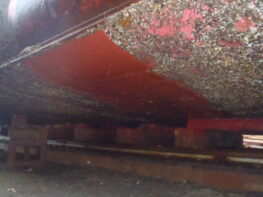
Dr Markus Hoffmann, Technical Director at I-Tech says: “The findings that more than one fifth of vessels in this study had more than 20% barnacle biofouling is concerning. This reinforces the fact that antifouling coating systems with good static performance, boosted by the presence of biocides that target hard fouling, even under extended static conditions, are an absolute necessity if barnacle fouling is to be reduced to much lower levels on a global fleet scale.”
“Data analysis on a sample group of vessels using coatings containing Selektope, conducted by the independent coatings consultants, showed that, in the majority, no barnacle biofouling was present. This confirms that good barnacle fouling protection is always worth the investment, not least because these organisms can really drag a vessel’s Carbon Intensity indicator (CII) down and thrust greenhouse gas (GHG) emissions up,” concludes Dr Hoffmann.
From the conclusions drawn in the ‘How much could barnacles limit shipping´s decarbonisation?’ research study, I-Tech’s advice for ship owners and/or operators includes using careful consideration of hard biofouling protection components during antifouling coating selection process. Ensuring adequate hard biofouling protection, for all vessels, but particularly those at risk of longer idling periods while in-service, is essential for the adequate protection of the global shipping fleet from barnacle biofouling.



Related News.

Navigating the Multi-Orbit Era: In Conversation with Intellian’s Jon Harrison at SMM 2026
At SMM 2026 in Hamburg, the rapid evolution of maritime satellite communications took centre stage. Across the exhibition halls, discussions among…
Cyprus ports need joint energy and investment strategy, shipping agents chief says
Cyprus needs a coordinated strategy for shipping, energy and environmental protection to support port investment and modernisation, Cyprus shipping…

MASO Public Affairs introduces MASO Regulatory Intelligence
A new subscription service helping businesses understand what is changing and what it means for them MASO Public Affairs introduces MASO Regulatory…
Anglo-Eastern helps turn CMBTECH’s ammonia ambition into an operational reality
From early feasibility study and risk-based design to newbuilding supervision, crew readiness and technical management, Anglo-Eastern drew on its…

Escalation of attacks threatens to derail recovery in Middle East oil exports
World oil demand is forecast to fall by 2.5 mb/d y-o-y in 4Q26 and 2.6 mb/d on average in 2026. As the Iran war manifests itself through restricted…
New study finds shipping pays twice its share to EU ETS earmarked revenues should triple to help build market for sustainable fuels and technologies
Shipping is responsible for around 10% of EU ETS emissions but pays almost 20% of the ETS bill. Unlike other sectors, it has never received free…
MSARC strengthens maritime mass rescue readiness through training and national live exercise off Dakar, Senegal
Joint MSARC–FHAS programme combines three days of SAR training with a national multi-agency live exercise The Maritime Search and Rescue Council ,…
Sogese report deliveries are still being delayed as container freight rates fluctuate
FOR IMPORTERS Spot rates into the Mediterranean are back at January levels, Far East to Europe reliability sits at pandemic lows, and nearly…
Glencore begins trading on Australian Securities Exchange
Glencore has begun trading on the Australian Securities Exchange under the ASX code GLC. Gary Nagle, Glencore’s CEO, said it was an exciting day for…
BIMCO Shipping Number of the Week
Suez Canal container ship transits exceed 50% of pre-disruption levels "During the first two weeks of October, weekly container ship capacity…
Subscribe to our newsletter!
if you dont want to swim alone in the ocean of news, sign up for the newsletter, and you will receive daily all the important news of world shipping!
