The relationship between the pilot and the bridge team
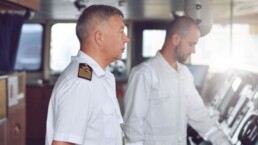

Serious incidents during pilotage are continuing, and one of the main contributing factors is a lack of good communication between the pilot and the vessel bridge team.
The relationship between the vessel bridge team and the pilot can be complex, especially in high-pressure situations. Authority issues and disagreements between the pilot and the vessel bridge team can create confusion and lead to poor decisions.
It is important to remember that the master still holds the ultimate authority and is legally responsible for the ship, including the actions taken by the pilot.
Master pilot information exchange
Discussing the passage and the planned manoeuvre with the pilot is essential. This will give the master an opportunity to give his inputs well ahead of the planned manoeuvres.
The pilot shall have a completed pilot card describing the vessel’s condition, propulsion, and manoeuvring characteristics. The pilot card should always be voyage-specific, not generic.
The pilot might not be familiar with all the vessel’s manoeuvring characteristics. Therefore, it is crucial to communicate any information not explicitly stated on the pilot card, such as how the vessel responds to specific orders under certain conditions, so the pilot is aware and can adjust the plan if necessary.
During passage
It is imperative that the vessel’s bridge team monitors every action taken by the pilot. The bridge team should never be reluctant to speak up. Overreliance on the pilot can be dangerous; if the bridge team assumes that the pilot has complete control and becomes disengaged, they may overlook critical errors. The bridge team must remain vigilant and monitor the passage and manoeuvres. Not remaining vigilant creates a potential single-point failure.
Rather than challenging the pilot, the P.A.C.E. model is often a better system.
P – Probe (Seeking clarification, non-confrontational)
- “Mr Pilot, I notice that we are slightly off our planned track. Is this intentional?”
A – Alert (Pointing out a potential issue)
- “Mr Pilot, our track shows we are veering 10 degrees off course, and we’re moving closer to the shallows.”
C – Challenge (Firmly requesting corrective action)
- “Mr Pilot, we are too close to the shallows, and I strongly recommend correcting our course now.”
E – Emergency (Taking action if the pilot does not respond or correct the issue)
- “Mr Pilot, I am taking control. Helmsman, hard to port! We need to avoid grounding.”
Not going straight to a challenge mode fosters a better relationship, as a challenge can be more of a confrontation and cause friction between the bridge team and the pilot.
Continuous communication during transit is essential to ensure everyone remains on the same page. The bridge team should request explanations from the pilot regarding their actions throughout the passage. This will allow the bridge team to assess these actions in a timely manner and determine whether they are appropriate.
Summary
Ultimately, the relationship between the pilot and the vessel’s bridge team comes down to teamwork and communication. Careful planning and clear communication can ensure the safest possible voyage. Pilots do sometimes make mistakes, and the bridge team must do everything in its power to alert the pilot of any potential issues or misunderstandings and resolve the issues before it is too late.
Never Assume – Anyone can make a mistake!
If in Doubt – ASK!
Risk has No Memory – Remain Vigilant!



Related News.

Greece has the most to lose from delays in shipping’s green transition, new analysis finds
UCL and WWF Greece report finds the IMO Net-Zero Framework offers Greek ship owners the clarity they need, and the best protection against a…

Snow Land joins Cool Carriers as the world’s first reefer with a gate rudder, a new chapter for sustainable and efficient reefer shipping
Cool Carriers, the world’s largest operator of specialised reefer vessels, took delivery of Snow Land from Kitanihon Shipbuilding in Japan on 12…

IBIA launches Marine Energy Outlook Survey as Annual Convention in New York
IBIA - The International Bunker Industry Association officially launched its Marine Energy Outlook Survey during the IBIA Annual Convention in New…

Why did ITF staff vote to strike again?
Staff at the International Transport Workers’ Federation (ITF) headquarters in London have voted to give their union a strike mandate. According to…

Nearly half of maritime crew tickets booked a week ahead are cancelled
Two new C Teleport reports show when maritime and aircrew teams book crew flights, how often they cancel, and what late booking costs, with a…

Kpler completes $1.5bn+ Sixth Street investment and continues accelerating growth
Investment backs Kpler's bold ambition to shape the future of global trade intelligence. Kpler, a leading provider of global physical trade…

How SAL and DNV are strengthening heavy-lift shipping
From classification and newbuilding support to operational tools and advisory expertise, SAL and DNV have been collaborating for decades. The…

PSA Singapore breaks ground on Tuas Port Phase Two to strengthen Global Trade Connectivity
PSA Singapore marked the groundbreaking of Tuas Port Phase Two, a significant step in the development of the world’s largest fully automated…

 …

BIFA welcomes UK–EU trade progress and calls for clarity on implementation
The British International Freight Association (BIFA) has welcomed progress made at today's UK–EU Summit in Brussels, highlighting the potential…
Subscribe to our newsletter!
if you dont want to swim alone in the ocean of news, sign up for the newsletter, and you will receive daily all the important news of world shipping!
