Lloyd’s Register analysis from the ISWG-GHG 19 meeting on mid-term GHG measures


Analysis from Lloyd’s Register’s Regulatory Affairs experts of the main outcomes from the IMO ISWG-GHG 19 meeting on mid-term GHG measures this week.
The International Maritime Organization (IMO) has advanced its commitment to tackling greenhouse gas (GHG) emissions, with significant developments emerging from the latest meeting of the Intersessional Working Group on GHG emissions (ISWG-GHG 19).
Meeting over two days, the Working Group considered the draft IMO Net-Zero Framework, aiming to meet the targets set out in the 2023 IMO Strategy on Reduction of GHG Emissions from Ships.
A key development saw the Chair present a text which proposes a system of tiered GHG Fuel Intensity requirements for ships. Under this proposal, vessels must meet a direct compliance target for their GHG intensity or balance any non-compliance through a two-tier system of purchasing or transferring compliance units. This text notably removes a previously proposed flat rate contribution or levy as the primary economic element.
The proposal includes the possibility of transfering and banking surplus compliance units and the establishment of an IMO GFI Fund to manage finances generated by the scheme. Furthermore, the text introduces provisional thresholds for zero or near-zero GHG fuels. The proposed framework anticipates data collection commencing on 1 January 2028, with the first data verification and compliance assessment in 2029.
Despite this progress, negotiations on compliance unit costs are ongoing with many proposals still being discussed. The proposed text would require ships to reduce their GHG intensity through to 2050, meeting base and direct compliance targets. Ships exceeding direct compliance would earn surplus units for transfer, banking, or cancellation. Conversely, those with deficits would need to use surplus units or buy remedial ones, with different prices proposed for differing tiers of compliance deficit. A key incentive within the scheme aims to encourage the adoption of very low GHG emissions fuels and technologies.
However, achieving consensus among Member States remains a significant challenge. Considerable work is still needed to refine the text, with Small Island Developing States (SIDS) expressing disappointment in the current proposals. The largest points of contention revolve around the inclusion of a standalone economic contribution or levy, the specific reduction trajectories, the prices for remedial units, and potential exceptions for ships serving ports in SIDS and Least Developed Countries (LDCs).
The next crucial step will be at MEPC 83, meeting next week (7-11 April), where Member States will further negotiate the proposed text with the aim of final agreement by 11 April. The intention is to adopt the finalised regulations at an extraordinary session of MEPC in October 2025, leading to a potential entry into force in March 2027.
The coming days will be critical for IMO Member States to bridge their differences and reach a consensus on the regulatory text. The maritime industry faces significant adjustments as these mid-term measures progress towards adoption and entry into force, impacting fuel choices, technology adoption, and operational practices.
Read the full analysis at: IMO ISWG-GHG 19 outcomes v.1 1.pdf
Join LR’s MEPC 83 Webinar: Your Guide to the Mid-term GHG measures: https://www.lr.org/en/knowledge/webinars/mepc-83-webinar-your-guide-to-the-mid-term-ghg-measures/



Related News.

ECB keeps rates on hold as Christine Lagarde announced her resignation
With still very little knock-on effects from higher energy prices and headline inflation on the rest of the economy, the ECB kept interest rates on…
ASA SC highlights geopolitical risks to seafarers while tackling workforce and regulatory challenges
The 33rd Interim Meeting of the Asian Shipowners’ Association (ASA) Seafarers Committee (SC) convened online on 16 October 2026, hosted by the China…

US awards $498m to 35 port projects across 19 states
The round uses the last US$450 million of the infrastructure law's port grant commitment. Alaska's Whittier receives US$50.6 million to replace the…

Maritime leaders push for stronger action on global shipping rules in Busan
World Maritime Day Parallel Event spotlights theme “From Policy into Practice: Powering Maritime Excellence”. International delegates meeting in…
Hapag-Lloyd strengthens its position in Italian ports
Italian export volumes of Hapag-Lloyd continue its upward trend, with a further relevant growth expected in 2026 compared with 2025, bringing…
 Fujairah…

DORIC MONTHLY CHINA BAROMETER OCTOBER 2026
Pls find below the DORIC MONTHLY - CHINA BAROMETER OCTOBER 2026 CHINA_BAROMETER_OCTOBER_2026
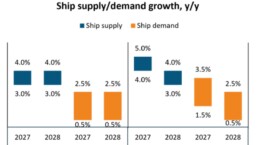
BIMCO Dry Bulk Shipping Market Overview & Outlook
Escalating attacks on ships heighten uncertainty "Geopolitical disruptions continue to cloud the dry bulk market outlook. The effective closure of…

Nor-Shipping aims to demystify ship recycling with new conference for 2027
With industry estimates suggesting more than 15,000 vessels will need to be recycled by 2032*, more than double the number recycled in the previous…
San Pedro Bay Ports outline path for Cleaner Marine Fuels
The ports of Long Beach and Los Angeles have released a comprehensive report identifying promising clean marine fuels for oceangoing vessels and…
Subscribe to our newsletter!
if you dont want to swim alone in the ocean of news, sign up for the newsletter, and you will receive daily all the important news of world shipping!
