

Lloyd’s Register’s Global Maritime Trends 2025 Barometer warns that fragmented regulation is undermining progress in decarbonisation and limiting investment.
The global shipping industry risks falling short of its net-zero and digital transformation ambitions without sufficient regulatory support enacted at a global level, according to the inaugural Global Maritime Trends 2025 Barometer by Lloyd’s Register and Lloyd’s Register Foundation.
Launched today (26 March) at Sea Asia, the Barometer presents the first-of-its-kind data-driven assessment of the maritime industry’s energy and digital transition progress across five key components: maritime trade, energy, vessels, ports, and people.
Its findings reveal that despite promising developments in alternative fuel technologies and digital innovations, widespread adoption of green fuels is unlikely without robust and coordinated regulation.
The report highlights that regulatory uncertainty is deterring shipowners from making the necessary long-term investments, resulting in a “delayed transition” that threatens to derail decarbonisation targets and digital parity with land-based industries. Regulatory mechanisms such as carbon pricing, emissions mandates, and incentives for green investments will be essential to accelerate adoption worldwide.
Despite the orderbook for alternative-fuelled ships growing by over 50% in 2024, the 2025 Barometer reveals that global energy production remains heavily reliant on fossil fuels. Energy transition scores ranged from just 24% to 30% alignment with decarbonatisation targets.
On the digital front, the maritime industry is making progress (32-48% alignment) but still lags behind land-based industries. The Digital Transition Barometer includes data derived from LR’s Digital Maturity Index and identifies data standardisation, interoperability, widespread lack of digital skills among seafarers and shore-based teams as major barriers to progress.
One of the report’s most concerning findings is the critical gaps in workforce development, impacting both transitions – the People component scored only 27% alignment on energy transition and 32% alignment on digital transition. Training programmes remain insufficient to prepare seafarers for safely operating vessels powered by alternative fuels and implementing new digital technologies. Recruitment struggles persist because of an ageing workforce and declining interest in maritime careers.
Despite these challenges, the Barometer highlights areas of progress. Major ports are accelerating decarbonisation initiatives, enhanced connectivity and autonomy are improving productivity, energy efficiency measures are gaining traction, and momentum is building for alternative-fuelled ship adoption.
However, the report makes it clear that voluntary action alone is not enough—policy must step in to create the conditions for large-scale transformation across the five key components of both transitions.
James Frew, LR Advisory Director, said: “This is a critical moment for the maritime sector. The industry has demonstrated its commitment to change, but the reality is that without regulatory clarity and global alignment, investment and innovation will remain hesitant. The Global Maritime Trends Barometer serves as a call to action—policymakers must step up to ensure regulation provides the certainty the industry needs to accelerate its transition.”
The Barometer is part of LR and Lloyd’s Register Foundation’s Global Maritime Trends research programme, which aims to address major maritime challenges up to 2050. Launched in 2023 with the Global Maritime Trends 2050 Report, it includes ‘deep dive’ reports providing expert analysis on critical maritime issues. The first report on seafarers’ sustainability will be released at Sea Asia on Thursday 27 March.



Related News.

Navigating the Multi-Orbit Era: In Conversation with Intellian’s Jon Harrison at SMM 2026
At SMM 2026 in Hamburg, the rapid evolution of maritime satellite communications took centre stage. Across the exhibition halls, discussions among…
Cyprus ports need joint energy and investment strategy, shipping agents chief says
Cyprus needs a coordinated strategy for shipping, energy and environmental protection to support port investment and modernisation, Cyprus shipping…

MASO Public Affairs introduces MASO Regulatory Intelligence
A new subscription service helping businesses understand what is changing and what it means for them MASO Public Affairs introduces MASO Regulatory…
Anglo-Eastern helps turn CMBTECH’s ammonia ambition into an operational reality
From early feasibility study and risk-based design to newbuilding supervision, crew readiness and technical management, Anglo-Eastern drew on its…

Escalation of attacks threatens to derail recovery in Middle East oil exports
World oil demand is forecast to fall by 2.5 mb/d y-o-y in 4Q26 and 2.6 mb/d on average in 2026. As the Iran war manifests itself through restricted…
New study finds shipping pays twice its share to EU ETS earmarked revenues should triple to help build market for sustainable fuels and technologies
Shipping is responsible for around 10% of EU ETS emissions but pays almost 20% of the ETS bill. Unlike other sectors, it has never received free…
MSARC strengthens maritime mass rescue readiness through training and national live exercise off Dakar, Senegal
Joint MSARC–FHAS programme combines three days of SAR training with a national multi-agency live exercise The Maritime Search and Rescue Council ,…

Sogese report deliveries are still being delayed as container freight rates fluctuate
FOR IMPORTERS Spot rates into the Mediterranean are back at January levels, Far East to Europe reliability sits at pandemic lows, and nearly…
Glencore begins trading on Australian Securities Exchange
Glencore has begun trading on the Australian Securities Exchange under the ASX code GLC. Gary Nagle, Glencore’s CEO, said it was an exciting day for…
BIMCO Shipping Number of the Week
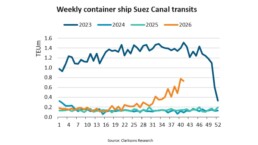
Suez Canal container ship transits exceed 50% of pre-disruption levels "During the first two weeks of October, weekly container ship capacity…
Subscribe to our newsletter!
if you dont want to swim alone in the ocean of news, sign up for the newsletter, and you will receive daily all the important news of world shipping!
