BAR Technologies urges Shipping Industry to recognise wind as a key fuel in decarbonisation debate
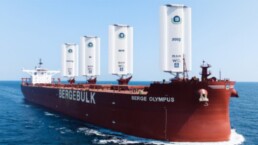

In response to a new study by UMAS and the UCL Energy Institute’s Shipping and Oceans Research Group, which highlights the challenges faced by developing nations in accessing affordable financing for e-fuel production, BAR Technologies is calling for a broader, more inclusive debate on the future of shipping fuels. While we welcome the ongoing conversations around the development of alternative fuels such as e-ammonia, we believe there is one fuel source that is consistently overlooked and must be seen as an integral part of the fuel mix: wind.
The report released today underscores the financial disparities that will drive the cost of e-fuels in developing nations significantly higher than in developed economies, even when they have superior renewable energy resources such as onshore wind and solar. As the shipping industry grapples with the cost of capital challenges in the global south, BAR Technologies insists that wind propulsion, a zero-emission, self-sufficient, and abundant energy source, should play a key role in helping close the energy transition gap.

John Cooper, CEO of BAR Technologies, said: “As the debate on new fuels heats up, it’s important not to overlook the most readily available energy source we have at our disposal: wind. While e-fuels hold promise, they come with significant costs and financing challenges that could hinder the global effort to decarbonise the shipping industry, especially in developing economies. Wind-assisted propulsion systems (WAPS) like WindWings® will provide a scalable and commercially viable solution that not only helps meet decarbonisation targets but does so in a way that is accessible to all nations, regardless of their economic status.”
The study by UMAS and the UCL Energy Institute found that countries in the global south, despite having some of the best renewable resources, could face an additional financial barrier that would prevent them from competing with projects in developed economies. By 2030, the IMO’s strategy for achieving zero or near-zero emission fuels in shipping will require an estimated $1.6 trillion in investment, with $400 billion needed by 2030 alone. If left unaddressed, the financial constraints identified in the study could exacerbate the existing inequalities in the shipping industry’s transition to greener fuels.
Cooper continues: “The solution isn’t to put all our eggs in one basket with costly e-fuels that will further disadvantage developing nations. Instead, we need to leverage the wind that’s already available and deploy technologies like WindWings®, which deliver immediate fuel savings and emissions reductions without the need for complex and expensive new infrastructure. Wind-assisted propulsion offers a low-cost, scalable alternative that can be part of the broader mix, complementing the transition to cleaner fuels.”
Our WindWings® technology is a proven solution for reducing fuel consumption and emissions, already helping ships worldwide achieve significant operational cost savings. BAR Technologies offers a range of WindWings® models in three sizes: 37.5m, 24m, and 20m, designed to meet the diverse needs of the shipping industry. This is made possible by our award-winning design patented three-element rigid wing inspired by aerospace engineering and optimised for modern wind-assisted propulsion. Harnessing the power of wind, this eco-friendly and reliable fuel source helps vessels reduce their reliance on costly and volatile fossil fuels.
While the debate on new fuels and their financial implications continues, BAR Technologies remains committed to the wider adoption of wind-assisted propulsion as a critical component of the shipping industry’s decarbonisation strategy. With the IMO’s 2030 emissions targets fast approaching, we urge both the industry and participants at MEPC 83 in April to fully recognise wind’s potential as a key part of the solution. This is essential to ensuring that the transition to a zero-emission future is not only achievable but fair for all stakeholders. Now is the time to embrace wind propulsion as an integral element of shipping’s sustainable future.
Cooper concludes: “The winds of change are already here, and it’s time the shipping industry harnesses this abundant resource. We welcome all debate on the future of shipping fuels. Still, it’s crucial that wind propulsion is recognised as an essential, viable, affordable option to reduce emissions and cut fuel dependency to be able to achieve a just transition for all nations.”



Related News.

Navigating the Multi-Orbit Era: In Conversation with Intellian’s Jon Harrison at SMM 2026
At SMM 2026 in Hamburg, the rapid evolution of maritime satellite communications took centre stage. Across the exhibition halls, discussions among…
Cyprus ports need joint energy and investment strategy, shipping agents chief says
Cyprus needs a coordinated strategy for shipping, energy and environmental protection to support port investment and modernisation, Cyprus shipping…

MASO Public Affairs introduces MASO Regulatory Intelligence
A new subscription service helping businesses understand what is changing and what it means for them MASO Public Affairs introduces MASO Regulatory…
Anglo-Eastern helps turn CMBTECH’s ammonia ambition into an operational reality
From early feasibility study and risk-based design to newbuilding supervision, crew readiness and technical management, Anglo-Eastern drew on its…

Escalation of attacks threatens to derail recovery in Middle East oil exports
World oil demand is forecast to fall by 2.5 mb/d y-o-y in 4Q26 and 2.6 mb/d on average in 2026. As the Iran war manifests itself through restricted…
New study finds shipping pays twice its share to EU ETS earmarked revenues should triple to help build market for sustainable fuels and technologies
Shipping is responsible for around 10% of EU ETS emissions but pays almost 20% of the ETS bill. Unlike other sectors, it has never received free…

MSARC strengthens maritime mass rescue readiness through training and national live exercise off Dakar, Senegal
Joint MSARC–FHAS programme combines three days of SAR training with a national multi-agency live exercise The Maritime Search and Rescue Council ,…
Sogese report deliveries are still being delayed as container freight rates fluctuate
FOR IMPORTERS Spot rates into the Mediterranean are back at January levels, Far East to Europe reliability sits at pandemic lows, and nearly…

Glencore begins trading on Australian Securities Exchange
Glencore has begun trading on the Australian Securities Exchange under the ASX code GLC. Gary Nagle, Glencore’s CEO, said it was an exciting day for…
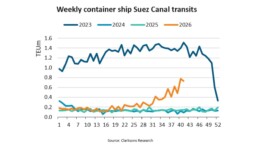
BIMCO Shipping Number of the Week
Suez Canal container ship transits exceed 50% of pre-disruption levels "During the first two weeks of October, weekly container ship capacity…
Subscribe to our newsletter!
if you dont want to swim alone in the ocean of news, sign up for the newsletter, and you will receive daily all the important news of world shipping!
