WinGD X-DF cuts methane slip in final VCR technology shop tests

Swiss marine power company WinGD has completed shop tests of its groundbreaking variable compression ratio technology. The results confirm that methane reductions from new X-DF engines with VCR technology deliver similar ship greenhouse gas emissions to high-pressure dual-fuel technologies, while delivering a total system cost and fuel cost advantage for several vessel applications.
The VCR shop test was completed at Mitsui E&S DU (MESDU) facilities in Japan, where the first
X-DF2.0 engines with VCR are being built for bulk carriers owned by NYK Lines. The six-cylinder, 62-bore engine achieved around 30% fewer methane emissions than the same engine without VCR, taking total slip to around 0.83% of gas consumption. This is less than half the EU (and provisional IMO) default slip attributed to low-pressure, low-speed dual-fuel engines in maritime regulations. The reduction is expected to be even greater for engines with a larger bore.

WinGD Vice President Product Centre, Peter Krähenbühl, said: “Over the past decade we’ve worked to ensure that the unmatched reliability and low capital expenditure of X-DF engines are supported by the lowest possible overall GHG emissions. The fuel consumption and methane slip reductions achieved by VCR bring us to that point. Low GHG emissions will be fundamental for shipowners as carbon pricing measures take effect, which is why we have already seen strong uptake, with well over 100 new X-DF engines ordered with VCR so far.”
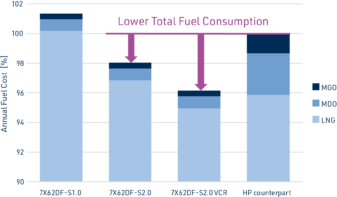
The significant reduction in methane slip was achieved alongside a fuel reduction of up to 5.8% in gas mode and up to 6.9% in diesel mode. The charts below show how those improvements affect the fuel cost and CO2 equivalent emissions compared to previous X-DF engine technologies and a high-pressure engine counterpart, for a typical car carrier operating profile
VCR technology allows engine compression ratio to be adjusted automatically to optimise combustion based on engine load, fuel type and ambient conditions. The solution can be applied to all new X-DF engines and a retrofit package has already been designed and installed on a pilot case vessel, yielding promising early results.
Both European and IMO regulations will include mechanisms to update default methane slip factors and to allow shipping companies to supply their actual methane slip measurements – meaning that ship operators can reduce carbon costs based on any improvement in methane slip. WinGD is supporting the development of these mechanisms through various associations that contribute to the regulatory process.
X-DF engines bring added certainty on fuel consumption and emissions thanks to their inherently low-NOx design and the long-established use of rational emission control strategies, as explicitly required in recent updates to IMO’s NOx Technical Code. This means that WinGD does not need to adjust brake specific fuel consumption figures or tolerances to meet the new requirements.
As previously stated, WinGD envisions a transitional pathway for LNG as a marine fuel, with fossil LNG steadily being replaced by zero or near-zero emissions variants from biomass and ultimately synthetic sources. Reducing methane emissions supports reduced GHG impact regardless of the source of LNG. WinGD’s efforts to further improve its LNG engine platform come alongside its ammonia- and methanol-fuelled engines, ensuring that ship operators are able to choose the most cost-effective fuel to support their selected decarbonisation pathway.



Related News.

Greece has the most to lose from delays in shipping’s green transition, new analysis finds
UCL and WWF Greece report finds the IMO Net-Zero Framework offers Greek ship owners the clarity they need, and the best protection against a…

Snow Land joins Cool Carriers as the world’s first reefer with a gate rudder, a new chapter for sustainable and efficient reefer shipping
Cool Carriers, the world’s largest operator of specialised reefer vessels, took delivery of Snow Land from Kitanihon Shipbuilding in Japan on 12…

IBIA launches Marine Energy Outlook Survey as Annual Convention in New York
IBIA - The International Bunker Industry Association officially launched its Marine Energy Outlook Survey during the IBIA Annual Convention in New…

Why did ITF staff vote to strike again?
Staff at the International Transport Workers’ Federation (ITF) headquarters in London have voted to give their union a strike mandate. According to…

Nearly half of maritime crew tickets booked a week ahead are cancelled
Two new C Teleport reports show when maritime and aircrew teams book crew flights, how often they cancel, and what late booking costs, with a…

Kpler completes $1.5bn+ Sixth Street investment and continues accelerating growth
Investment backs Kpler's bold ambition to shape the future of global trade intelligence. Kpler, a leading provider of global physical trade…

How SAL and DNV are strengthening heavy-lift shipping
From classification and newbuilding support to operational tools and advisory expertise, SAL and DNV have been collaborating for decades. The…

PSA Singapore breaks ground on Tuas Port Phase Two to strengthen Global Trade Connectivity
PSA Singapore marked the groundbreaking of Tuas Port Phase Two, a significant step in the development of the world’s largest fully automated…

 …

BIFA welcomes UK–EU trade progress and calls for clarity on implementation
The British International Freight Association (BIFA) has welcomed progress made at today's UK–EU Summit in Brussels, highlighting the potential…
Subscribe to our newsletter!
if you dont want to swim alone in the ocean of news, sign up for the newsletter, and you will receive daily all the important news of world shipping!
