Skuld liquefaction alert Nickel ore in the Solomon Islands

General
With Indonesia’s export restrictions on nickel ore and a recent decline in exports from the Philippines, shipping activity for nickel ore to the South Pacific islands, including the Solomon Islands and New Caledonia, has increased.
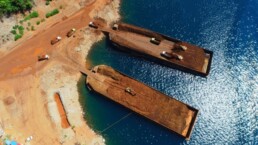
Loading nickel ore in the Solomon Islands carries significant risks, particularly related to cargo liquefaction. Recently, a liquefaction incident occurred on a covered bulk carrier loading nickel ore at two locations in Noro and Siruka Bay. Shortly after departure, the vessel experienced liquefaction in two holds and had to divert to the nearest port for refuge. This incident underscores the urgent need for rigorous risk assessment and proper loading procedures in the region.
Cargo Condition and Risks
The Solomon Islands, near the equator, have a tropical climate with heavy rainfall nearly every month. This can cause cargo to retain water when exposed to rain, increasing the risk of liquefaction.
The nickel ore from this region is mainly Direct-Shipped Ore (DSO), which has minimal processing and varies in particle size. It contains significant amounts of sand, silt, and clay. These components influence the material’s behaviour and liquefaction risk under different moisture levels and loading stresses, with higher clay content typically increasing that risk due to its moisture retention and impact on stability.
Traditional testing methods, like the flow table for Transportable Moisture Limit (TML), may not accurately reflect the materials due to clay strength and other factors.
A remote survey was conducted because local surveyors were unavailable. However, several issues arose during cargo operations: shippers provided visibly wet cargo, and some barges were rejected based on can test results. Additionally, can tests performed by crew members were of poor quality, with some results appearing marginal.
Recommendations
Skuld has published several loss prevention articles on nickel ore shipments from 2009 and onwards, each providing practical recommendations. In addition to those suggestions, the following points are emphasised:
- Preloading survey: Notify Skuld to arrange an onsite physical preloading survey. If this is not possible, a remote survey must be conducted.
- Reject wet cargo: Any cargo that appears soft, wet, or sticky should be rejected. If water is detected during loading, operations must stop immediately.
- Modified can test methodology: The crew should follow a specific can test procedure to assess cargo saturation, which includes:
– Selecting representative samples from a depth of approximately 500 mm on the barge.
– Performing an oven-dry test to determine and compare the moisture content of the cargo with the MC/TML certificates.
– Conducting a can test, meticulously recording the results, and documenting any changes in density or moisture during excavation.
– Conducting a grab test and inspecting the cargo in each hold; any signs of splattering or slumping would indicate that the cargo is unacceptable.
- Direct communication: Establish direct communication between the master, crew, and surveyors to ensure timely and accurate reporting of conditions.
Loading nickel ore in the Solomon Islands requires careful attention to detail and proactive risk management. By adhering to these recommendations and complying with the IMSBC Code, vessels can significantly reduce the risk of cargo liquefaction and ensure the safety of both the vessel and crew.
Source: Skuld



Related News.

Greece has the most to lose from delays in shipping’s green transition, new analysis finds
UCL and WWF Greece report finds the IMO Net-Zero Framework offers Greek ship owners the clarity they need, and the best protection against a…

Snow Land joins Cool Carriers as the world’s first reefer with a gate rudder, a new chapter for sustainable and efficient reefer shipping
Cool Carriers, the world’s largest operator of specialised reefer vessels, took delivery of Snow Land from Kitanihon Shipbuilding in Japan on 12…

IBIA launches Marine Energy Outlook Survey as Annual Convention in New York
IBIA - The International Bunker Industry Association officially launched its Marine Energy Outlook Survey during the IBIA Annual Convention in New…

Why did ITF staff vote to strike again?
Staff at the International Transport Workers’ Federation (ITF) headquarters in London have voted to give their union a strike mandate. According to…

Nearly half of maritime crew tickets booked a week ahead are cancelled
Two new C Teleport reports show when maritime and aircrew teams book crew flights, how often they cancel, and what late booking costs, with a…

Kpler completes $1.5bn+ Sixth Street investment and continues accelerating growth
Investment backs Kpler's bold ambition to shape the future of global trade intelligence. Kpler, a leading provider of global physical trade…

How SAL and DNV are strengthening heavy-lift shipping
From classification and newbuilding support to operational tools and advisory expertise, SAL and DNV have been collaborating for decades. The…

PSA Singapore breaks ground on Tuas Port Phase Two to strengthen Global Trade Connectivity
PSA Singapore marked the groundbreaking of Tuas Port Phase Two, a significant step in the development of the world’s largest fully automated…

 …

BIFA welcomes UK–EU trade progress and calls for clarity on implementation
The British International Freight Association (BIFA) has welcomed progress made at today's UK–EU Summit in Brussels, highlighting the potential…
Subscribe to our newsletter!
if you dont want to swim alone in the ocean of news, sign up for the newsletter, and you will receive daily all the important news of world shipping!
