Veson widening gap in average speed between new and old vessels shows bulker fleet heading for two-tier market


Veson Nautical report says multiple factors causing average vessel speeds to decline overall
The global bulker fleet is facing a significant slowdown, driven by a combination of factors that are not only causing a decline in average speeds, but also setting the stage for the emergence of a two-tier market according to Veson Nautical, a global leader in maritime data and freight management solutions.
A new report: ‘Why is the bulker fleet slowing down? The impact of an ageing fleet in the era of efficiency’states that ageing vessels, stricter emissions regulations, and evolving market dynamics are all factors in the lower average speeds being witnessed.
The report cites data that suggests that older vessels, particularly those built before the Energy Efficiency Design Index (EEDI) criteria was enforced in 2013, have seen a noticeable decrease in speeds, relative to newer vessels and that this is the single largest contributory factor to the slowdown of the global bulker fleet.
Bulker average speed by vessel build year
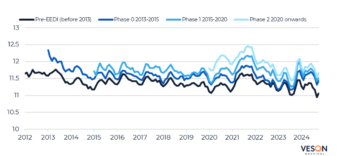
Source: VesselsValue, a Veson Nautica solution, Feb 2025
“We can conclude that a surplus of older, inefficient vessels in the fleet, which are now penalised by efficiency regulations for sailing at higher speeds, are a driving factor in declining average speed overall,” says report author Oliver Kirkham, Senior Valuation Analyst at Veson Nautical. “However, the decline in average speeds is not just a matter of operational efficiency; it’s a sign of a deeper shift in the bulker market, where modern, compliant vessels are set to command a premium as older ships struggle to keep pace.”
The report adds that the massive expansion of the bulker fleet during the mid-2000s, spurred by China’s economic growth, has left a large portion of the fleet increasingly inefficient. These vessels are now struggling to meet modern efficiency standards, creating a growing divide between newer, more efficient vessels and older ships that are nearing the end of their operational lives.
Average speed of bulkers by fixed age category
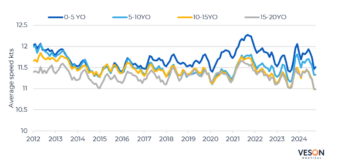
Source: VesselsValue, a Veson Nautical, Feb 2025
“The difference in terms of efficiency between new bulker vessels and vessels even from five years ago is significant as improved design, fuel efficiency and compliance with green regulations really start to make an impact,” Kirkham says. “These modern vessels are expected to command a premium especially in markets such as the US and Europe that have stringent age restrictions and carbon regulations.”
The report concludes that a declining number of transactions of modern bulker vessels in the sales and purchase (S&P) market is evidence that new bulker vessels are providing commercial advantage and emissions compliance which enables owners to command a premium for their charter. However, some markets are still open to ageing vessels, especially when transporting cargoes with negligible time constraints.
“As emissions regulations continue to tighten globally it is clear that ageing vessels will be pushed into niche markets while newer vessels will dominate more profitable routes,” Kirkham says. “However, the shipping industry as a whole is currently lacking a standardised and transparent system to offer precise and conclusive proof of a vessels’ fuel and carbon efficiency, and this will need to be resolved as the market evolves.”
Source:Veson



Related News.

Greece has the most to lose from delays in shipping’s green transition, new analysis finds
UCL and WWF Greece report finds the IMO Net-Zero Framework offers Greek ship owners the clarity they need, and the best protection against a…

Snow Land joins Cool Carriers as the world’s first reefer with a gate rudder, a new chapter for sustainable and efficient reefer shipping
Cool Carriers, the world’s largest operator of specialised reefer vessels, took delivery of Snow Land from Kitanihon Shipbuilding in Japan on 12…

IBIA launches Marine Energy Outlook Survey as Annual Convention in New York
IBIA - The International Bunker Industry Association officially launched its Marine Energy Outlook Survey during the IBIA Annual Convention in New…

Why did ITF staff vote to strike again?
Staff at the International Transport Workers’ Federation (ITF) headquarters in London have voted to give their union a strike mandate. According to…

Nearly half of maritime crew tickets booked a week ahead are cancelled
Two new C Teleport reports show when maritime and aircrew teams book crew flights, how often they cancel, and what late booking costs, with a…

Kpler completes $1.5bn+ Sixth Street investment and continues accelerating growth
Investment backs Kpler's bold ambition to shape the future of global trade intelligence. Kpler, a leading provider of global physical trade…

How SAL and DNV are strengthening heavy-lift shipping
From classification and newbuilding support to operational tools and advisory expertise, SAL and DNV have been collaborating for decades. The…

PSA Singapore breaks ground on Tuas Port Phase Two to strengthen Global Trade Connectivity
PSA Singapore marked the groundbreaking of Tuas Port Phase Two, a significant step in the development of the world’s largest fully automated…

 …

BIFA welcomes UK–EU trade progress and calls for clarity on implementation
The British International Freight Association (BIFA) has welcomed progress made at today's UK–EU Summit in Brussels, highlighting the potential…
Subscribe to our newsletter!
if you dont want to swim alone in the ocean of news, sign up for the newsletter, and you will receive daily all the important news of world shipping!
