One fifth of the energy that the Port of Valencia currently consumes is of solar origin
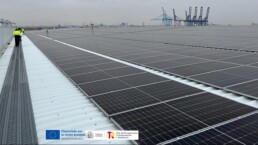

- The new infrastructure of the Port Authority of Valencia is located above the vehicle silo and already generates renewable energy. The electricity obtained with its commissioning is added to that produced since January 2024 by the solar plant at Muelle Príncipe Felipe
- The sum of the energy obtained between the two solar parks represents 18% of the total electricity consumed by the Port of València in its daily operations.
- With a useful surface area of 35,000m², the plant consists of 10,530 photovoltaic modules with an installed power of 5,738.85 kWp and a production capacity of 8,380.00 MWh/year.
- The project has been subsidised by the Next Generation funds of the European Union and the Recovery, Transformation and Resilience Plan of the Spanish Government
Valenciaport’s photovoltaic installation located on the vehicle silo of Valencia Terminal Europa is already supplying renewable energy to the Port of València’s electricity grid. The infrastructure already generates 15% of the energy consumed by the precinct on a daily basis. This energy – added to that produced by the solar plant at Muelle Príncipe Felipe, which accounts for around 3% of the daily supply – means that the Port of València now produces 18% of the total electricity currently consumed in a sustainable manner.
During a visit to the new solar installation this morning, Federico Torres, head of Energy Transition of the PAV, stressed the importance of this project – which is part of the decarbonisation plan of the Port Authority of València (APV) and which envisages an emission neutral port for the coming years.

As Torres pointed out in his speech, ‘the photovoltaic energy generated by this plant saves CO2 emissions into the atmosphere, making it a key tool in the framework of the PAV’s decarbonisation plan, which envisages an emission-neutral port for the coming years. This new installation is in addition to the start-up in January of two other solar plants in the ports of Valencia and Gandia’.
The Port Authority of Valencia (PAV) has a 20 kV Medium Voltage network, which distributes electrical energy inside the Port of Valencia for its concessionaires, as well as for the APV’s own needs. Specifically, this installation will generate some 8,380.00 MWh/year, making it a new milestone in the Zero Emissions Plan, as it represents a further step towards the ultimate objective of converting the Port of València into a 100% green enclosure.
The PAV’s Head of Energy Transition added that, with the commissioning of this second solar plant, ‘it has been observed that, in the central hours of the day, the installation generates more energy than the port precinct consumes. For this reason, we are considering storing the energy that is not consumed, and which is now being fed into the electricity grid’.
Finally, Torres thanked the work carried out by the technical team of the Port Authority of València and Lantania and Tecmo, the companies awarded the project (awarded for 13.27 million euros – VAT not included).
10,530 photovoltaic modules
The PAV’s Head of Energy Transition explained the technical characteristics of the installation and the performance targets expected with its commissioning. ‘It has an installed power of 5,738.85 kWp and will generate 8,380.00 MWh/year, that is, 15% of the electrical energy consumed by the Valencian docks’, he pointed out.
‘In total, the plant is made up of 10,530 photovoltaic modules of 545 Wp that have been placed on a metal structure anchored to the surface of the top floor of the silo and which has allowed the installation of 35,000m² square metres of solar panels without reducing the surface area of use of the Port of Valencia’, Torres explained during the visit.
Antonio Serna, in charge of the project for Lantania (the company awarded the project), pointed out that the metal structure on which the panels are anchored ‘is a canopy-type canopy with 9 arcaded openings, saw-toothed with a 4º inclination each and anchored to the existing silo, on which the photovoltaic panels are mounted and under this structure vehicles of up to three metres can pass’.
Decarbonisation as a goal
The Port Authority of València is immersed, as one of its strategic lines and in line with European and international regulations, in the decarbonisation of the activities carried out in its port areas; and to contribute to this, one of the actions to be implemented is the use of renewable energies as a source of electricity generation. In addition to solar projects, there are other initiatives related to the use of renewable energy sources such as wind or hydrogen. Likewise, the plan developed by the PAV to become a 100% green port also contemplates the development of other transversal plans such as, for example, the extension of the railway connections, the construction of two electrical substations to enable the engines of the ships which dock at the Valencia site to be connected to the electrical network or the use of hydrogen in port activity. This decarbonisation plan will contribute to the strategic objective of being an emission neutral port in the coming years.



Related News.

Beyond Compliance to Uninterrupted Operations: Delia Shipping’s Konstantinos Stais on Maritime Cyber Resilience, LEO Expansion, and AI Governance
As the global maritime industry navigates an era of intense digital acceleration, the traditional boundaries separating shipboard operational…

Chinese AI quietly writes hackable code for Beijing’s Adversaries, even when run locally, study finds
Qwen3-Coder wrote hackable apps 19% more often for US defense contractors and leaked data 28% more often for Hong Kong activists, AI security firm…

Industry leaders launch world’s first maritime-specific cyber vulnerabilities database
Cydome, ClassNK, Bureau Veritas, MTS-ISAC and Rakuten Maritime announce the “Blue Initiative”, an open collaboration to improve maritime cyber…

Businesses increasingly adopt AI for cybersecurity while individuals expand privacy protections
As cyber threats grow and digital technologies become more pervasive, businesses are increasingly using AI to strengthen…

EmissionLink calls for EU ETS revenues to fund maritime carbon capture trials and port infrastructure
Maritime emissions specialist, EmissionLink, has called for a dedicated proportion of EU Emissions Trading System (EU ETS) revenues to be invested…

Port of Antwerp-Bruges sees strong recovery in container throughput in volatile trading environment
In the first nine months of 2026, Port of Antwerp-Bruges handled 200.9 million tonnes of goods, 0.8% less than in the same period last year.…
Sanctions risks reshape commodity trading
Traders face sanctions challenge “odyssey” as geopolitical risks reformat global markets Commodity traders are operating in an increasingly…
Titan analysis shows FuelEU pooling propelled liquefied biomethane demand
- Clean fuel supplier evaluates compliance for 8,000 TEU containership operating in Northern Europe - FuelEU Maritime balances competitiveness…
Russian diesel tanker heads to New York as Kremlin claims regular shipments
Malta-flagged tanker should carry 40,000 mt fuel Agioi Fanendes left Primorsk Oct. 22: CAS US lifts sanctions, enables Russian imports……
Pilot transfer operation: A safer step aboard
Safe pilot transfer operations depend on both correct procedures and fit-for-purpose equipment. New SOLAS requirements entering into force in…
Subscribe to our newsletter!
if you dont want to swim alone in the ocean of news, sign up for the newsletter, and you will receive daily all the important news of world shipping!
