CORE POWER launches Liberty maritime civil nuclear program at Houston summit

CORE POWER,the world’s leading developer of maritime sector nuclear technologies, has announced that it will develop a US-anchored maritime civil nuclear program that will bring floating nuclear power to market by the mid-2030s.
The program, titled Liberty, will lay the foundation for the use of nuclear power in the civil maritime sector. It will encompass modular construction of advanced fission technology and create the regulatory and supply chain frameworks necessary to enable this technology to be rolled out worldwide.
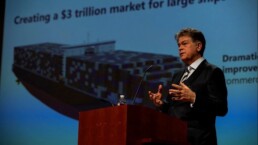
CORE POWER CEO Mikal Bøe laid out the company’s transformative vision in his keynote presentation at CORE POWER’s New Nuclear for Maritime summit in Houston, TX, which took place on 12th February. Over 230 delegates were in attendance to hear a wide variety of speakers explore the many possible uses of nuclear power in the maritime sector.
“The Liberty program will unlock a floating power market worth $2.6 tn, and shipyard construction of nuclear will deliver on time and on budget,” Bøe said. “Given that 65% of economic activity takes place on the coast, this will allow nuclear to reach new markets.”
The first part of the Liberty program will see the mass production of floating nuclear power plants (FNPPs). The expertise gained in rolling out FNPPs on a large scale will pave the way for the second part of the program, which involves developing nuclear propulsion for civil ships.
FNPPs will be produced in shipyards on a modular production line, making use of well-established shipbuilding processes and leveraging an already-skilled workforce. They will be manufactured as power barges that can be moored at ports and coastal locations, as well as larger-capacity generation units anchored further offshore.
A fleet of FNPPs can be mass produced and towed to customer locations without complex site preparations, while a central yard carries out commissioning, maintenance, refueling, and waste management.
This mass production is possible because the Liberty program will employ advanced nuclear technologies, such as molten salt reactors. Unlike conventional nuclear technologies, these next-generation reactors are inherently and passively safe and operate at near atmospheric pressures –negating the need for a large emergency exclusion zone and vastly improving the insurability of FNPPs and nuclear-powered commercial ships.
Advanced nuclear technologies are also vastly more efficient than conventional nuclear propulsion – enabling a ship to run on a single fuel load for its entire design life while simultaneously minimizing the amount of waste produced. Nuclear-propelled ships will therefore offer huge improvements in speed, efficiency and cargo-carrying capacity. COREPOWER is working in partnership with various developers of advanced nuclear technologies to develop the reactors and ensure they are optimized for maritime use.
The Liberty program envisions opening the orderbook for floating nuclear power plants (FNPPs) in 2028 and reaching full commercialisation by the middle of the next decade. In laying out the first phase of CORE POWER’s roadmap to 2030, Bøe said that in addition to design the company would focus on creating the necessary framework for licensing, insurance and export control.
The second phase will focus on developing the supply chain and workforce. The third phase will see the development of business operations models and creating the manufacturing base. At the same time, CORE POWER will aid the development of international safety and security standards by working together with the International Maritime Organization and International Atomic Energy Authority to create a civil liability convention for nuclear-powered ships.
The program will also encompass creating the robust regulatory framework necessary to operate FNPPs and (later) civil vessels with nuclear propulsion. It will also include the supply chains (such as fuel and highly trained personnel) that will enable advanced nuclear reactors to function.
The program takes its name and its inspiration from the Liberty ships of the Second World War, which were mass produced in the US quickly and at scale and enabled the Allies to win the Battle of the Atlantic. It also emphasises the US-anchored nature of the program, which will leverage the country’s globally respected nuclear regulatory frameworks to make worldwide operation of FNPPs and nuclear-powered ships a reality. Finally, it reflects the fact that COREPOWER will choose a location in the US to build the initial manufacturing yard for FNPPs.
“CORE POWER’s Liberty program will deliver resilient energy security for heavy industry and ocean transport,” Bøe said. “In doing so, it will revolutionise the maritime sector and transform global trade.”



Related News.

Navigating the Multi-Orbit Era: In Conversation with Intellian’s Jon Harrison at SMM 2026
At SMM 2026 in Hamburg, the rapid evolution of maritime satellite communications took centre stage. Across the exhibition halls, discussions among…

Cyprus ports need joint energy and investment strategy, shipping agents chief says
Cyprus needs a coordinated strategy for shipping, energy and environmental protection to support port investment and modernisation, Cyprus shipping…

MASO Public Affairs introduces MASO Regulatory Intelligence
A new subscription service helping businesses understand what is changing and what it means for them MASO Public Affairs introduces MASO Regulatory…

Anglo-Eastern helps turn CMBTECH’s ammonia ambition into an operational reality
From early feasibility study and risk-based design to newbuilding supervision, crew readiness and technical management, Anglo-Eastern drew on its…

Escalation of attacks threatens to derail recovery in Middle East oil exports
World oil demand is forecast to fall by 2.5 mb/d y-o-y in 4Q26 and 2.6 mb/d on average in 2026. As the Iran war manifests itself through restricted…

New study finds shipping pays twice its share to EU ETS earmarked revenues should triple to help build market for sustainable fuels and technologies
Shipping is responsible for around 10% of EU ETS emissions but pays almost 20% of the ETS bill. Unlike other sectors, it has never received free…

MSARC strengthens maritime mass rescue readiness through training and national live exercise off Dakar, Senegal
Joint MSARC–FHAS programme combines three days of SAR training with a national multi-agency live exercise The Maritime Search and Rescue Council ,…

Sogese report deliveries are still being delayed as container freight rates fluctuate
FOR IMPORTERS Spot rates into the Mediterranean are back at January levels, Far East to Europe reliability sits at pandemic lows, and nearly…

Glencore begins trading on Australian Securities Exchange
Glencore has begun trading on the Australian Securities Exchange under the ASX code GLC. Gary Nagle, Glencore’s CEO, said it was an exciting day for…

BIMCO Shipping Number of the Week
Suez Canal container ship transits exceed 50% of pre-disruption levels "During the first two weeks of October, weekly container ship capacity…
Subscribe to our newsletter!
if you dont want to swim alone in the ocean of news, sign up for the newsletter, and you will receive daily all the important news of world shipping!
