
Effective management strategies and insights for evolving fuel use.
Back in 2020, the IMO 2020 regulations, which reduced the global upper limit on the sulphur content of ships’ fuel oil from 3.5% to 0.50%, posed significant challenges for the marine industry.
Beyond compliance, ship operators faced difficulties stemming from very low sulphur fuel oil (VLSFO) blends. Key issues included poor cold-flow properties, short shelf life, sludge formation, stability concerns, and, most critically, liner scuffing in large two-stroke engines.
Liner scuffing, a significant contributor to main engine damage, was initially thought to be unrelated to fuel quality, engine maintenance, or fuel compatibility. However, further investigations identified interactions between VLSFO blends and cylinder oils as the root cause.
Cylinder oil plays a vital role in maintaining engine health through:
- Lubrication: creating an oil film to minimise friction and wear between cylinder liners and piston rings.
- Deposit removal: detergent properties clean combustion deposits from critical engine components.
- Acid neutralisation: additives in the cylinder oil neutralise acidic byproducts of fuel combustion.
With the introduction of VLSFO, oil majors and original equipment manufacturers (OEMs) recommended a shift from high Base Number (BN) cylinder oils (70/100 BN) to lower BN oils (40 BN). This change reduced calcium-based additives, which are crucial for neutralisation and detergency, leading to increased deposit formation and, in some cases, resulting in liner scuffing.
Addressing liner scuffing
By mid-2020, OEMs introduced Category II (CAT II) cylinder oils designed to enhance cleaning and deposit control. Alongside improved cylinder lubrication practices, close monitoring of liner wear helped mitigate scuffing issues. Some operators successfully adopted blend-on-board techniques, enabling customisation of cylinder oil properties such as neutralisation and detergency. This flexibility significantly reduced engine issues, demonstrating the importance of tailored cylinder lubrication strategies.
VLSFO also exhibited poor cold-flow properties, leading to wax precipitation and reduced stability in colder climates. These challenges emphasised the importance of proper fuel storage, handling, and management practices to maintain fuel integrity and engine reliability.
The evolving landscape of marine fuels, driven by regulatory and environmental pressures, demands better understanding and management of both traditional fossil fuels and emerging alternatives like biofuels. International standard ISO8217:2024 is seen as a major step forward in terms of setting specifications for marine fuel quality.
Biofuel alternatives
With the industry looking to decarbonise, and a view to introducing low- to zero-carbon fuels, biofuels such as methanol and various fatty acid methyl esters (FAME) blends currently account for approximately 1% of the fuel mix. The more traditional fossil fuels are continuing to satisfy the day-to-day demand in terms of fuels supplied to vessels at this time.
Among these, cashew nutshell liquid (CNSL) and FAME have been explored as drop-in fuel options alongside several other alternatives. CNSL is a renewable resource with potential as a ready drop-in fuel. Its key phenolic compounds include:
- Anacardic Acid (60–75%): a major contributor to CNSL’s high acidity. Thermal decarboxylation converts this to cardanol, reducing acidity and enhancing stability.
- Cardanol (5–15%): a stable phenolic compound derived from anacardic acid with improved combustion and lubricity properties.
- Cardol (15–20%): A dihydroxybenzene derivative with surfactant-like behaviour.
While CNSL improves lubricity and energy content, its limitations include high acidity, poor combustion properties, and corrosive tendencies.
In 2022, CNSL-blended fuels caused operational challenges, particularly in the Amsterdam-Rotterdam-Antwerp (ARA) region. Reported issues included:
- Accelerated wear of fuel pump components.
- Cracks and scratches in fuel systems.
- Poor engine performance and power loss.
These issues were primarily attributed to CNSL’s high acidity leading to corrosion of fuel systems and polymerisation tendencies, which in turn led to sludge formation. With regards to combustion characteristics, CNSL exhibited late ignition and extended period of combustion leading to after burning, high exhaust temperatures, carbon deposits in the exhaust system and less power developed. Even at low concentrations, CNSL requires careful management to avoid significant impacts on engine components.
Thermal decarboxylation – converting anacardic acid into cardanol, reducing acidity and increasing stability – and distillation – separating cardanol from other components to create a product better suited for fuel blending – can be applied to enhance CNSL characteristics.
While these treatments are known to improve CNSL’s usability, further research is necessary to fully understand its long-term effects on engine performance and reliability.
FAME is the most widely used biofuel in marine applications. Although relatively new to the shipping industry, its extensive use in road transportation provides valuable insights.
Meanwhile, between 2023 and 2024, the use of used cooking oil methyl ester (UCOME) increased significantly.
Many operators tested B100 blends to prepare for regulatory requirements, including the GHG Strategy [greenhouse gas], EEDI [Energy Efficiency Design Index], CII [Carbon Intensity Indicator], and EEXI [Energy Efficiency existing ship Index]. In 2024, at Veritas Petroleum Services we noticed an uptake of B30 blends, a rise considered consistent with MARPOL Annex VI, Regulation 18.3.2, which mandates verification of NOx impacts for blends exceeding 30%.
The impending implementation of FuelEU Maritime is expected to further boost the adoption of biofuel blends.
Operational considerations for FAME blends
There are some important operational considerations to consider for FAME blends. First, it has a tendency to absorb water, potentially leading to microbial growth. Proper storage and a first-in, first-out approach are critical to address this.
Second, at higher concentrations (B100, for example), there could be material compatibility issues. Third, FAME’s solvency can dissolve deposits in fuel systems, potentially clogging filters. Lastly, due to its limited stability, FAME should be consumed promptly.
However, despite these considerations, when managed correctly, FAME blends can be used effectively alongside conventional fuels without significant operational issues.
The evolution of marine fuels, from VLSFO to alternative options like CNSL and FAME, underscores the need for comprehensive fuel and lubrication management strategies.
Addressing challenges such as liner scuffing, cold-flow properties, and compatibility is critical to maintaining engine reliability and operational efficiency. With increasing regulatory demands, the marine industry must continue to innovate and adapt to ensure a sustainable and efficient future.
Source: Veritas Petroleum Services



Related News.
Intelligent Skies, Secure Seas: Navigating Connectivity, Cyber Resilience, and AI Liability at the 5th CSN Greece ICT Conference
The 5th CSN Greece ICT Conference, held on 19th November 2026 at the Ploes Floating Venue in Paleo Faliro, Athens, successfully convened maritime…

EU moves to ban tankers insured in Russia, repair services at Russian refineries
EU targets Russian-insured tankers, refineries Von der Leyen announces 22nd sanctions package All 27 member states must approve new…
IMO tackling fraudulent registries together
Strong national systems and international information sharing are crucial to tackling fraudulent registries and fraudulent ship registration…
Open letter on freedom of navigation and the protection of seafarers
Dear High Representative Kallas, Dear Foreign Affairs Ministers, European Shipowners | ECSA, BIMCO, the Cruise Lines International Association…

Davies Turner warns of Rising Asia-UK Container Disruption and European Port Congestion
Davies Turner, one of the UK’s largest independent freight forwarding and logistics companies, says that disruption to container shipments from Asia…
Disruptions still dominate tanker market outlook
"This year, tanker markets have been affected by disruption to transits through the Strait of Hormuz, the Houthi blockade of Saudi Arabian Red Sea…
Panama’s President called on to match COP31 Heroism with action at shipping climate talks
As a series of crucial meetings tasked with cutting greenhouse gas emissions from global shipping takes place this week and next, environmental NGOs…

Trafigura appoints Helio Cumbi as Executive Director, Mozambique
Trafigura has appointed Helio Cumbi as Executive Director, Mozambique, and Business Development Lead for East and Southern Africa Oil. Helio is a…

“K” LINE holds FY2026 Global Dry Bulk Meeting
Kawasaki Kisen Kaisha, announces that it held a global meeting for its dry bulk business at the company’s head office on November 9 and 10. The…
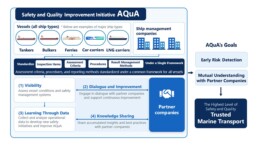
MOL launches ‘AQuA’ safety and quality improvement initiative
Standardizing Group-wide Safety and Quality Assessment Criteria to Enhance Vessel Safety and Quality Mitsui O.S.K. Lines, announced the launch of…
Subscribe to our newsletter!
if you dont want to swim alone in the ocean of news, sign up for the newsletter, and you will receive daily all the important news of world shipping!
