Soft skills training can lead to solid commercial benefits says The Nautical Institute

The maritime industry is experiencing a pivotal shift, with the rising recognition that soft skills are just as critical as technical expertise in ensuring the safety, effectiveness, and overall wellbeing of seafarers.
As awareness grows around crew mental health and the human element in maritime operations, industry leaders are acknowledging that soft skills, such as communication, leadership, and emotional intelligence, are essential in fostering a safer and more productive working environment.
There is no doubt that seafarers must have the technical skills needed to carry out their daily tasks, but today, the value of soft skills is increasingly appreciated for their role in enhancing operational safety and efficiency – both of which directly impact the bottom line.
By investing in soft skills training, the maritime sector can not only improve vessel operations but also address key challenges such as crew attraction and retention. According to a Gallup survey, soft skills training has been shown to boost productivity by 12% and improve workplace morale by 27%, and with safety and talent attraction among the industry’s top concerns, leveraging soft skills presents an opportunity that cannot be overlooked.
Steven Gosling MSc AFNI, Head of Information and Publications at The Nautical Institute, explains, “While The Nautical Institute offers a range of courses which have been developed to ensure seafarers are technically competent, we are of the opinion that soft skills have an equally vital role to play in the smooth running of vessels. Communication, leadership and emotional intelligence enhance teamwork and mutual support which can lead to fewer errors, greater safety and crew wellbeing.”

Carole Davis, Professor Emeritus at Warsash Maritime School, Solent University, firmly believes that soft skills take the human element to a new level and their adoption creates change for the better in workplaces where they are implemented. “Soft skills should be seen as the golden thread running through professional life. In complex systems, both operational and strategic, soft skills are essential since the key driver of human performance is social context. It is also about creating, or facilitating, teachable moments within a reflective environment.”

Having been tasked by the United Kingdom Maritime and Coastguard Agency to lead a review of human element leadership and management courses, Prof Davis realised there was a need for an ‘informative and encouraging handbook aimed at colleagues teaching soft skills’. Soft skills education might be widespread but it is still in its infancy and the challenge is in ensuring that teaching engages participants in such a way that it has a positive impact on working practices.
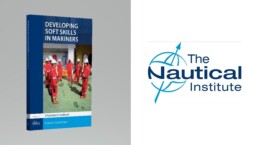
The Nautical Institute is therefore delighted to be publishing Professor Davis’ book, ‘Developing Soft Skills in Mariners’ aimed at, among others, course designers and facilitators as well as maritime organisations seeking tangible outcomes from investing in soft skills training, and includes:
- Soft skills definition and discussion
- Tips for creating effective learning environments
- Experiential learning and handling sensitive issues
- Facilitator assessment and evaluation methods
Steven Gosling continues, “This book gives practical advice that can be implemented in any workforce to enhance its cohesion and effectiveness and we are pleased that Prof Davis has entrusted it to us.”



Related News.

Greece has the most to lose from delays in shipping’s green transition, new analysis finds
UCL and WWF Greece report finds the IMO Net-Zero Framework offers Greek ship owners the clarity they need, and the best protection against a…

Snow Land joins Cool Carriers as the world’s first reefer with a gate rudder, a new chapter for sustainable and efficient reefer shipping
Cool Carriers, the world’s largest operator of specialised reefer vessels, took delivery of Snow Land from Kitanihon Shipbuilding in Japan on 12…

IBIA launches Marine Energy Outlook Survey as Annual Convention in New York
IBIA - The International Bunker Industry Association officially launched its Marine Energy Outlook Survey during the IBIA Annual Convention in New…

Why did ITF staff vote to strike again?
Staff at the International Transport Workers’ Federation (ITF) headquarters in London have voted to give their union a strike mandate. According to…

Nearly half of maritime crew tickets booked a week ahead are cancelled
Two new C Teleport reports show when maritime and aircrew teams book crew flights, how often they cancel, and what late booking costs, with a…

Kpler completes $1.5bn+ Sixth Street investment and continues accelerating growth
Investment backs Kpler's bold ambition to shape the future of global trade intelligence. Kpler, a leading provider of global physical trade…

How SAL and DNV are strengthening heavy-lift shipping
From classification and newbuilding support to operational tools and advisory expertise, SAL and DNV have been collaborating for decades. The…

PSA Singapore breaks ground on Tuas Port Phase Two to strengthen Global Trade Connectivity
PSA Singapore marked the groundbreaking of Tuas Port Phase Two, a significant step in the development of the world’s largest fully automated…

 …

BIFA welcomes UK–EU trade progress and calls for clarity on implementation
The British International Freight Association (BIFA) has welcomed progress made at today's UK–EU Summit in Brussels, highlighting the potential…
Subscribe to our newsletter!
if you dont want to swim alone in the ocean of news, sign up for the newsletter, and you will receive daily all the important news of world shipping!
